Skip next section Europe remembers the Holocaust, 81 years on
01/27/2026January 27, 2026
Europe remembers the Holocaust, 81 years on
The Holocaust Memorial in Berlin commemorates the millions of Jews killed by the Nazi regimeImage: John Macdougall/AFP/Getty Images
The Auschwitz-Birkenau camp was liberated from the Nazis by Soviet forces 81 years ago.
Commemorations are being held across Europe, with camp survivor Tatiana Bucci addressing MEPs in the European Parliament on Tuesday.
The German Bundestag is set to hold its own commemoration on Wednesday.
Follow DW’s Holocaust Remembrance Day blog for the latest.
https://p.dw.com/p/57XDl
Skip next section Young people are often overqualified for their job, new figures show01/27/2026January 27, 2026
Young people are often overqualified for their job, new figures show
Uliana Sydorzhewski
Many young people in Germany are working below their qualification level, and the problem affects certain groups more than others.
According to recent data from the Federal Statistics Office (Destatis), around 15% of workers under the age of 35 say they have a higher education qualification than their current job requires.
Women and people with a migration background are particularly impacted. Young women report overqualification more often than men, 16% to 13% respectively.
Young workers with a migration background are both more likely to be overqualified (18%) and underqualified (12%) compared to their peers, 7% of whom were underqualified.
Experts argue that this is not just an individual issue, but a structural one. Employers are failing to fully use the skills of young women and migrants, despite ongoing labour shortages, Bettina Kohlrausch, head of the Institute of Economic and Social Research (WSI), said.
Kohlrausch pointed to discrimination in hiring processes as a key factor. Addressing these issues could be a more effective response to skills shortages than cutting back on part-time work.
Young people between jobs crisis and a new beginning — MADE
To view this video please enable JavaScript, and consider upgrading to a web browser that supports HTML5 video
https://p.dw.com/p/57X5O
Skip next section NRW minister resigns amid Solingen attack criticism
01/27/2026January 27, 2026
NRW minister resigns amid Solingen attack criticism
The minister for refugees, among other issues, in the western state of North Rhine-Westphalia (NRW), Josefine Paul, has announced her resignation.
Paul said she was quitting because of the “increasing polarization in the investigative committee” in parliament looking into the knife attack by a Syrian asylum seeker in Solingen in August 2024.
The Green party member had faced criticism for sluggish and incomplete public communication, among other things, from opposition in the state parliament.
Three people were killed and several more severely wounded in the August 23 knife attack. Authorities faced criticism as it came to light that the suspect was a 26-year-old Syrian asylum seeker who had been ordered to leave the country but had not been expelled to Bulgaria. The case also prompteda nationwide debate on migration and asylum policies.
“Today I am aware that an earlier communication after the weekend of the attack would have been better,” Paul said in a statement on Tuesday. “Even if at this point there was no complete picture of the asylum law aspect.”
The 43-year-old said that the focus on her and her actions risked overshadowing the real goal of a “careful and unbiased investigation in the interests of the victims of the Solingen terrorist attack and their relatives and those left behind.”
Paul rejected allegations of having obstructed transparency in the investigation, saying these were inaccurate. The long-running probe of the case in NRW’s state parliament began in November 2024.
https://p.dw.com/p/57WUG
Skip next section Ship carrying cars catches fire off the coast of Germany
01/27/2026January 27, 2026
Ship carrying cars catches fire off the coast of Germany
The ship was transporting around 1,300 vehicles to the UK [FILE: August 7, 2020]Image: Sina Schuldt/dpa/picture alliance
A cargo ship carrying 1,294 vehicles, including 477 electric cars, from Germany to the UK caught fire off the German North Sea island of Borkum, late on Monday.
Central Command for Maritime Emergencies (CCME) said on Tuesday that the nearly 150 meter-long (492 foot-long) MS Thames Highway was sailing from the German port of Emden to the British city of Grimsby.
CCME said a fire broke out in the engine room late Monday evening. Crew members managed to seal the compartment, preventing the fire from spreading further.
The fire was extinguished after two teams of firefighters arrived at the scene by helicopter around midnight.
There were 18 crew members and a captain on board and no injuries have been reported.
The vessel is currently anchored outside the Ems estuary, north west of Borkum, as efforts to restart the engine continue.
If this is not possible, the ship will be towed back to Emden.
Meanwhile, rescue vessels and helicopters are on standby in the nearby vicinity of the MS Thames Highway, should they be needed.
https://p.dw.com/p/57WtE
Skip next section German FA believe World Cup boycott would be ‘misguided’01/27/2026January 27, 2026
German FA believe World Cup boycott would be ‘misguided’
The two most powerful men in German football, Hans-Joachim Watzke (left) and Bernd Neuendorf (right), don’t believe a World Cup boycott makes senseImage: Nico Herbertz/IMAGO
The German Football Association (DFB) has broken its silence on the matter of a potential boycott of the World Cup, to be hosted by the United States this summer, with a few games also to be played in Mexico and Canada.
Read DW’s full report on how the German FA responded to the calls for a boycott.
https://p.dw.com/p/57WGq
Skip next section Germany welcomes EU-India trade deal
01/27/2026January 27, 2026
Germany welcomes EU-India trade deal
German Vice Chancellor and Finance Minister Lars Klingbeil has praised a new trade deal between the European Union and India that was signed on Tuesday.
“This agreement creates new opportunities for growth and good jobs — in Europe and India alike — while deepening the strategic partnership with the world’s largest democracy,” Klingbeil said.
The vice chancellor described the deal as opening “a new chapter in European trade policy.”
“At a time of upheaval, we are consciously focusing on openness, reliability, and strong partnerships.”
For the latest updates on the deal, read our live blog on the EU-India free trade agreement.
Indian companies in Germany embrace free trade deal
To view this video please enable JavaScript, and consider upgrading to a web browser that supports HTML5 video
https://p.dw.com/p/57W4N
Skip next section German shadow economy booms to over €500B
01/27/2026January 27, 2026
German shadow economy booms to over €500B
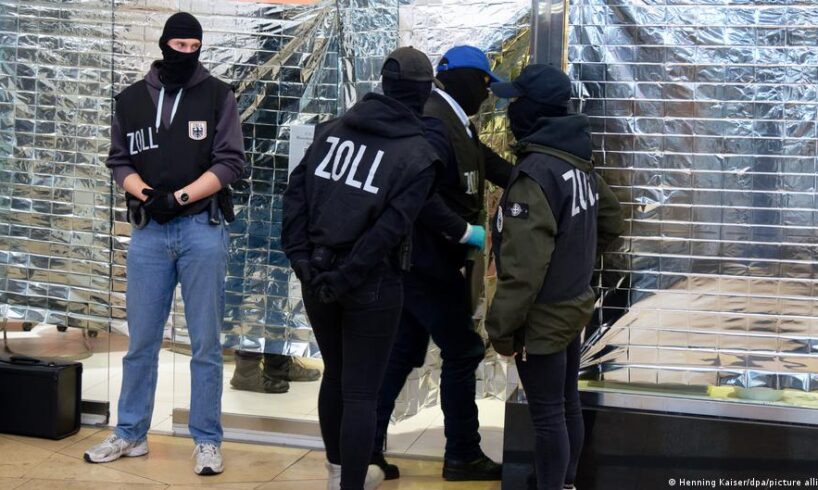
The sum of Germany’s shadow economy — which includes income from undeclared work and illegal activities such as gambling and some forms of sex work — reached €510 billion ($606 billion) in 2025. That was €30 billion more than in 2024.
The estimated figures came from a study carried out by financial scientist Friedrich Schneider from the University of Linz and the Institute for Applied Economic Research in Tübingen.
The study predicted the shadow economy would grow by 5.5% to €538 billion in 2026.
The boom comes amid low growth in the regular economy and rising unemployment. Both of these factors were considered drivers of the growing underground economy.
The study also put the blame on the increase in the minimum wage at the beginning of 2025 to €12.82 (rising to €13.90 on January 1, 2026), as well as the increase in the earnings cap for so-called mini-jobs. Schneider called for a decrease in associated costs for employers to tackle undeclared work — what Germans call Schwarzarbeit, or black work.
The financial scientist said these factors reduce “the income from declared employment and create an incentive for undeclared or illegal activities,” which in turn lowers the tax income for the state.
At the same time, the study pointed to a decrease in VAT in the hospitality industry saying it reduced incentives to find shadow work.
The German shadow economy was equivalent to 11.5% of GDP in 2025, which placed it below the average of 20 major industrialized countries.
However, at the same time, the shadow economy has grown faster than average, increasing by 2.4 percentage points since 2021, in comparison to the average of 0.8 percentage points.
Germany’s economy will continue to stagnate in 2025
To view this video please enable JavaScript, and consider upgrading to a web browser that supports HTML5 video
https://p.dw.com/p/57VrH
Skip next section Welcome to our coverage01/27/2026January 27, 2026
Welcome to our coverage
Guten Tag from the newsroom in Bonn.
You join us this morning as we bring you the latest headlines from German news, starting with a new study that says the German shadow economy has reached levels not seen in over ten years.
For an overview of the top German stories from Monday, when a €1 million-bounty was issued over the attack on the Berlin power grid, check out yesterday’s blog.
https://p.dw.com/p/57Vxu