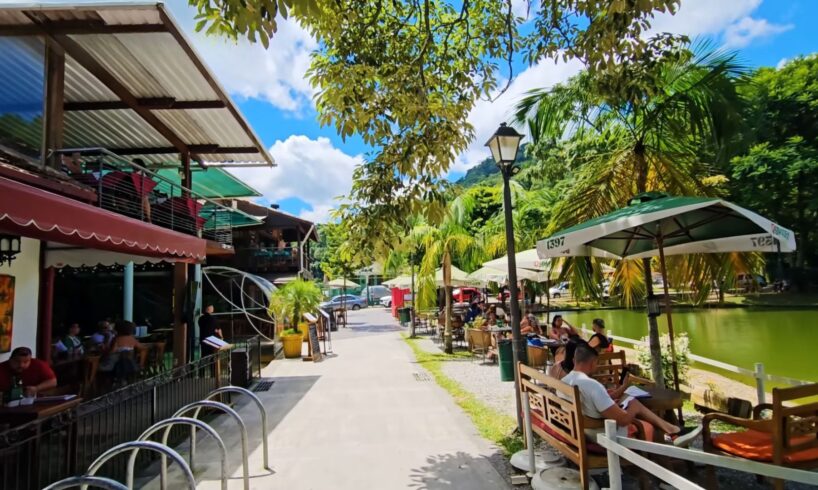
Located approximately 136 kilometers from the capital Rio de Janeiro, Nova Friburgo has built an identity that blends mountains, European immigration, and industry..
The municipality, located in the mountainous region of the state, has earned the nickname “Swiss of Rio de Janeiro” due to its combination of peaks exceeding 2 meters, a milder climate than the Baixada Santista region, a textile hub with continuous production, and a network of rivers and waterfalls that provides an alternative to the sea during the warmer months.
The social portrait is reflected in the official figures.
— ARTICLE CONTINUES BELOW —
See also other features
The city, founded in 1713 and known as “Land Where the Bells Speak,” is located in Brazil and impresses with its unique sound language, where each chime has its own meaning and guides the religious and social life of the population.
Madagascar’s Road of Fear: 250 km of mud, rotten bridges, and rivers swallowing cars expose overcrowded passengers, 500 kg of contraband timber, and a journey that can last for days.
A medieval underground tunnel, 1 meter high and 50 to 70 centimeters wide, has been identified beneath a 6.000-year-old Neolithic ditch.
A jaguar has already taken 40 calves, and the farm is reacting: they’ve chosen the fiercest Guzerá cow, pierced its horn, and installed two warning bells to ward off attacks until IBAMA (Brazilian Institute of Environment and Renewable Natural Resources) arrives.
The Municipal Human Development Index (MHDI) of 0,745The data, released in the 2010 excerpt, places the city among the best-rated in the state according to the consolidated indicator.
At the same time, The local economy doesn’t revolve solely around winter tourism.…with the garment industry maintaining activity throughout the year and supporting commerce, services, and a chain of small businesses linked to clothing.
European colonization and urban identity
The association with Europe doesn’t just come from the cold.
The history of the municipality is linked to Swiss colonization, with the arrival of groups of immigrants in 1819, a landmark frequently cited as the starting point of the colonial experiment that gave the city its name.
Traces of this heritage appear in cultural references and in spaces that preserve memory and traditions, such as the Swiss House, often cited as a memorial to colonization.
This historical element is often used to explain part of the municipality’s appeal to residents and visitors.
It combines with the daily life of a medium-sized city, urban infrastructure, and services that cater to a population above… 189 thousand inhabitants, according to the latest IBGE Census.
Textile hub sustains the economy throughout the year.
The garment manufacturing hub, especially the segment of lingerieIt is frequently cited as one of the economic pillars of Nova Friburgo.
Instead of relying solely on holidays and the concentrated activity of winter, the city maintains a flow of income through factories, local brands, and factory outlets.
This dynamic includes a network of suppliers and service providers that amplifies the sector’s economic impact.
In some seasons, the corporate calendar gains traction with the Fevest, an event described by industry institutions as the largest lingerie, swimwear, and fitness fashion fair in Latin America.
In the 2025 edition, data released by business entities indicated the presence of buyers from different states and countries, reinforcing the event’s role in the national and international projection of the Friburgo hub.
Extreme terrain and access to the largest state park.
Nova Friburgo is called the “Swiss of Rio de Janeiro” because it combines mountains over 2 meters high, a high Human Development Index (HDI), a strong textile industry, and waterfalls that become a refuge in the summer.
In terms of topography, the city benefits from a strategic position in the Serra do Mar mountain range.
O Three Peaks State Park It is presented as the largest state conservation unit in Rio de Janeiro, bringing together extensive areas of Atlantic Forest and trails that range from easy hikes to technical routes.
Among the best-known landmarks is the Caledonia Peak, with an altitude often indicated around 2.257 meters.
On clear days, the landscape allows one to see areas far from the Metropolitan Region, according to tourist descriptions and historical records.
Another formation mentioned in the ecotourism itinerary is the Sitting Dog Stone, located in a visitor area with a trail and viewpoints.
Information released by the venue itself indicates access rules and opening hours, while visitor accounts describe the route as a hike of easy to moderate difficulty.
The waterfalls of Lumiar and São Pedro da Serra replace the coastline.
When temperatures rise, some leisure activities shift to mountain districts and riverside areas.
Lumiar and São Pedro da Serra They frequently appear in guidebooks and news reports as bases for ecotourism, featuring pools, waterfalls, and hiking trails.
The region attracts residents and visitors seeking river bathing and hiking through the Atlantic Forest.
The concept of the “Friburguense coastline” is based precisely on this combination of Cold water, preserved forest, and short distances. from the city center.
Local guides and visitor organizations recommend paying attention to access rules and rainfall levels, which can affect the safety of trails and crossings.
The mountain climate influences tourism and local daily life.
The climate is one of the municipality’s defining characteristics.
Climatological surveys indicate drier winters e summers with more frequent rainfall, a typical pattern in southeastern Brazil.
The lowest average rainfall amounts tend to be concentrated in the middle of the year.
The highest rainfall levels occur at the end and beginning of the year, when the heat favors the formation of storms.
This climate pattern helps explain why cold-weather tourism boosts restaurants, inns, and gastronomic events during the mountain season.
In the summer, the activity is concentrated around rivers and waterfalls.
Nevertheless, weather variability is part of everyday life, with occasional records of temperature drops outside the expected pattern.
Cable car combines urban leisure and panoramic views.
In addition to its natural beauty, the city also offers attractions related to urban tourism.
O Suspiro Cable CarThe bridge, inaugurated in the 1970s, connects Praça do Suspiro to Morro da Cruz.
The route offers panoramic views of the urban area and the surrounding mountains.
Historical records mention periods of interruption and resumption of operations following the 2011 climate tragedy in the mountainous region.
Combined with the central commercial area and shopping routes linked to clothing, the facility integrates a route that alternates between shopping, leisure, and contemplation.
Amidst this landscape of mountains, industry, and freshwater, the question that often arises among residents and visitors is simple.
What weighs most heavily in the decision to return: the view from the peaks, a swim in the waterfalls, or the routine of a city that functions beyond the high season?