Confidential files revealing what happened during the weeks-long riots are currently not likely to be seen by the public until 2058
15:35, 08 Feb 2026Updated 15:35, 08 Feb 2026
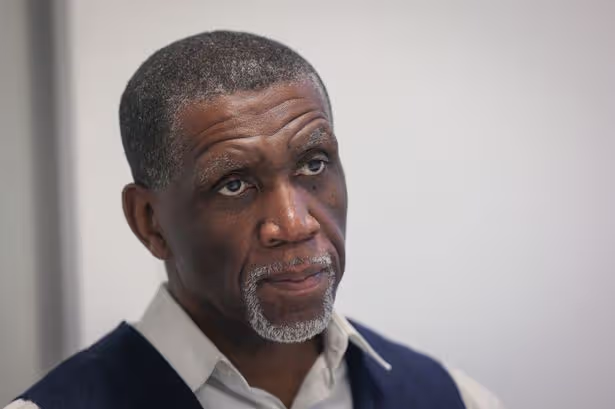
Reverend Clive Foster MBE is the government’s first Windrush Commissioner(Image: Joseph Raynor/Reach PLC)
The government’s top advisor on the Windrush scandal has called for confidential documents revealing what took place at the 1958 St Ann’s ‘race riots’ to be released.
The UK’s first Windrush Commissioner, Reverend Clive Foster MBE, says he believes the public in Nottingham are “big enough” for the historical records to finally be unsealed.
The St Ann’s riots began on August 23 in 1958 and would go on for weeks, with knives, sticks and machetes used and dozens of people injured.
Considered to be the first of what was described at the time as ‘race riots’, the tensions of 1958 followed years of violence against black and Asian migrants – many of whom had come from other countries to fill job shortages in the UK.
Yet the historic riots remain only a footnote in the city’s history, due to the sealing of court documents from the time that detail exactly what happened.
At the time, the riots were reported as being a “black-versus-white battle”, however research suggests black and Asian people were not involved in the riots, but instead acting in defence.
Under the current law, documents from the time won’t be seen by the public until 2058, but campaigners are fighting to unearth the records.
Rev Foster, who spent decades heading campaign groups across Nottingham before being appointed as the government’s first Windrush Commissioner, has joined calls for the documents to be released.
“Locally, the historic nature of what happened in St Ann’s is a significant piece of local history,” Rev Foster told Nottinghamshire Live in a wide-spanning interview.
“Not just for black people, but for the whole of the city and the county and the nation because the first race riots were in Nottingham.
“Come on – let’s just have a degree of openness and respect here.
“The people of Nottingham are big enough to examine what happened in 1958, and I think it would be more healthy to be have those discussions and to learn from that going forward.
“That part of history is still British history and it’s really important that we learn from our history.”
The riots broke out on St Ann’s Well Road, pictured(Image: Picture Nottingham/Nottingham Historical Film Unit)
Nottinghamshire Live first reported on the local campaign to have the documents unsealed in August 2025, with the petition still live today.
Under a longstanding law, certain historical records and documents held by government departments can be locked away to protect sensitive information from being released.
Officials at the Home Office in 1958 – including the then-home secretary, ‘Rab’ Butler – sealed away court documents from the UK riots under this law.
Documents from the Notting Hill riots – which took place only days later – were initially sealed for 75 years. The documents about St Ann’s were sealed for 100 years.
After a passionate community campaign and petition, the Notting Hill documents were released in 2002.
They revealed police played down the racial tensions and that black and Asian people weren’t directly involved with the riots but instead defending themselves after years of racist attacks.
Yet, a police report as late as 1989 blamed generic hooliganism for the violence in St Ann’s during the late-1950s.
In his newly created role, Rev Foster acts as a trusted voice for Windrush victims and advises the government on the lessons that need to be learnt from the shocking scandal, which came to light in 2018.
It had emerged hundreds of British citizens who were legally invited to the UK from the Caribbean were later wrongly detained, deported, or denied legal rights by the Home Office.
The Windrush Commissioner, who grew up in The Meadows and is a pastor at the Pilgrim Church, says he believes the sealing of the St Ann’s documents contributes to a lack of trust among Caribbean communities in the government.
“Openness and trust is really important, and one of the problems I see in this role is the lack of trust,” he added.
“I see this closeness and defensiveness, and if we’re constantly having to do what can appear in the minds of people as concealing something, I don’t think that helps the trust we should have as a society.”