Shafaq News
The debate over extending Prime Minister
Mohammed Shia al-Sudani’s caretaker government reflects a political effort to
manage prolonged deadlock, but it simultaneously tests the constitutional
limits of executive authority and the durability of Iraq’s parliamentary
system.
With parliament failing in two consecutive
sessions on January 29 and February 1 to elect a president —a prerequisite for
nominating a new prime minister —political actors have begun floating a
temporary extension of al-Sudani’s government as a practical exit from
paralysis. Yet what appears as a political workaround quickly transforms into a
constitutional dilemma: can a caretaker administration continue by political
agreement, or does such a move stretch Iraq’s legal framework beyond its
intended limits?
Deadlock as Catalyst
The extension proposal emerged after
repeated failures to complete the constitutional sequence required to form a
new government. A source within the Coordination Framework told Shafaq News
that al-Sudani received a proposal to extend his caretaker administration for
one year with limited powers, pending broader political settlement.
The initiative comes amid fears of
repeating past formation crises. Iraq’s current government itself was born
after nearly 12 months of stalemate following the October 2021 elections —the
longest post-2003 impasse. Earlier, Mustafa al-Kadhimi’s cabinet took roughly
six months to materialize after the resignation of Adel Abdul-Mahdi in 2019.
These precedents reinforce a structural
pattern: Iraq’s parliamentary system ensures continuity through caretaker
governance, but struggles to guarantee timely political agreement.
Constitutional Framework
Under Article 78 of Iraq’s 2005
Constitution, the prime minister is the direct executive authority responsible
for general state policy. Article 80 grants the Council of Ministers authority
to implement policy, issue regulations, and supervise executive functions.
In ordinary circumstances, these
provisions allow wide strategic discretion. However, full executive powers
presuppose active parliamentary legitimacy.
The Federal Supreme Court’s interpretation
on November 17, 2025, reshaped that equation. The Court ruled that election day
(November 11, 2025) marks the end of the previous parliamentary term,
effectively transitioning the executive branch into a continuity phase with
limited authority until a new government secures parliamentary confidence.
Although the Constitution mentions
“caretaker government” only in Articles 61 and 64, Iraqi constitutional
practice since 2005 has established the concept as a mechanism of necessity.
Crucially, neither the Constitution, nor the Council of Ministers’ internal
regulations, nor Federal Court Decision No. 213 of 2025 set a defined time
limit for this status.
This absence of a temporal ceiling lies at
the heart of the current controversy.
Read more: Nouri Al-Maliki’s return rekindles Iraq’s divisions as Iran and the US pull apart
What Caretaker Governance Allows — and
Restricts
Legal consensus holds that a caretaker
government may manage daily affairs, disburse salaries, and respond to urgent
security or service-related needs. It must, however, avoid long-term
commitments, major international agreements, structural appointments, or
transformative policy decisions.
Extension, therefore, does not grant new
authority. At most, it prolongs a restricted mandate.
Legal Objections: No Constitutional Basis
for Extension
Legal expert Salem Hawas told Shafaq News
that “the Constitution is entirely devoid of any text permitting the extension
of a caretaker government.” He emphasized that such a government is “temporary
and constrained by necessity,” and that its continuation is “strictly tied to
completing constitutional entitlements, not political bargains.”
Hawas added that parliament cannot extend
executive authority beyond constitutional mandates, describing such a move as
an indirect constitutional amendment. “The Federal Supreme Court’s role is
interpretative and supervisory, not creative,” he said. “It cannot generate a
new mandate.”
In this reading, Hawas pointed out that
the extension merely institutionalizes limitation but does not resolve
deadlock.
Political Calculus Inside the Shiite Camp
The proposal also reflects shifting
dynamics within the Shiite-led Coordination Framework. Former Prime Minister
Nouri al-Maliki remains a potential candidate for the premiership, but his
return faces both domestic resistance and international scrutiny.
US President Donald Trump previously
signaled that Washington could reconsider aspects of its support for Iraq
should al-Maliki return to office. Bloomberg reported that US officials warned
Iraqi counterparts of potential restrictions on Baghdad’s access to oil
revenues in such a scenario.
These signals complicate internal
negotiations and elevate al-Sudani’s profile in two distinct ways: either as a
comparatively less polarizing alternative to al-Maliki, or as a pragmatic
option to remain in office for a limited one-year period under caretaker status
should political forces fail to agree on a successor.
Al-Sudani himself secured more than 92,000
personal votes in the October 2025 elections, while his coalition secured 46
seats, placing his coalition first in the parliamentary elections with over
400,000 total votes. He subsequently relinquished his parliamentary seat, a
move that could be interpreted as positioning himself for executive continuity
if extension materializes.
Whether that interpretation holds or not,
the political logic is evident: in the absence of consensus on a successor,
continuity becomes an option, albeit a constrained one.
Institutional Continuity vs Democratic
Rotation
Iraq’s parliamentary system centers
authority in the legislature, which grants confidence to the executive. The
lifespan of a caretaker government ultimately hinges on the president’s tasking
of the largest parliamentary bloc to form a cabinet.
Until that process concludes, governance
operates under necessity rather than full mandate.
The extension debate thus raises a broader
institutional question: can constitutional flexibility absorb political
paralysis without eroding the principle of power rotation?
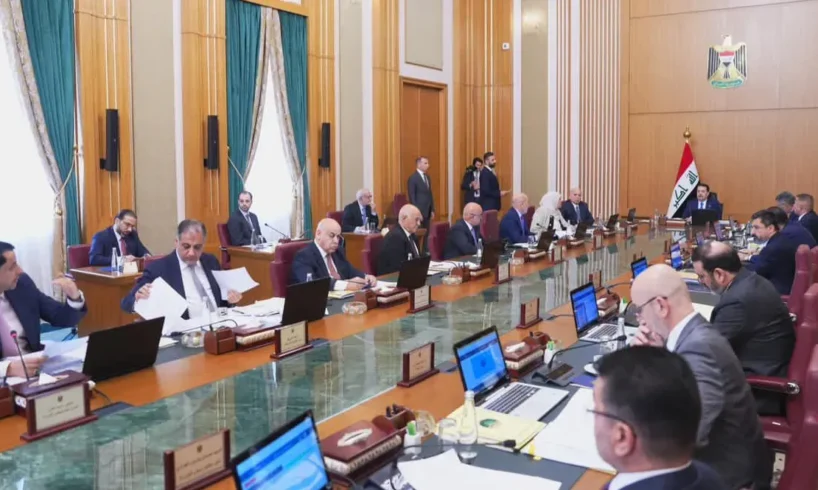
For now, al-Sudani’s government continues
to function under caretaker limits, managing state affairs while negotiations
unfold. Yet the longer the transition persists, the sharper the tension between
political expediency and constitutional integrity becomes.
What is at stake now is the boundaries of
executive authority in moments of prolonged impasse, and whether temporary
necessity risks becoming normalized governance.
Read more: Iraq slips into constitutional vacuum as presidential deadlock drags on
Written and edited by Shafaq News staff.