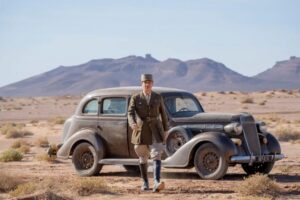
The nurse, who is portrayed by Scottish stage and screen star Kate Dickie in the film, said she felt a “duty of care” to the man after realising the potential risk to his life.
Read more:
However she suggested police officers at the scene did not want to let her help him or even give him water despite her warnings that the activist, who is portrayed by Oscar-winning actress Emma Thompson in the new film, “needed to be looked after”.
Speaking in the documentary, which has opened the annual Glasgow Film Festival, the protester recalled how the nurse would “check in” with him every 15 or 20 minutes during the eight-hour stand-off on Kenmure Street.
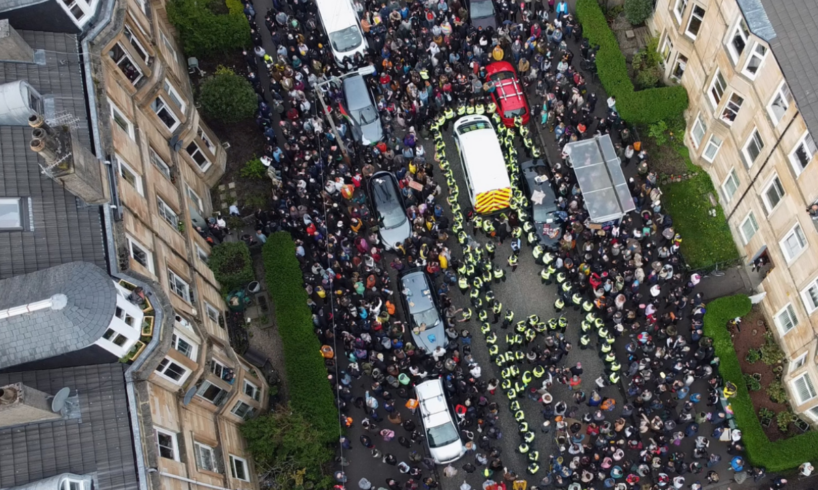
Hundreds of protesters took to Kenmure Street in Glasgow after two local men were detained in a Home Office immigration enforcement van. (Image: Andrew Learmonth)
The film, made by Glasgow-based director Felipe Bustos Sierra, recalls the spontaneous massive civil resistance which unfolded on May 13, 2021, when an immigration enforcement team swooped on the Pollokshields area of the city to detain two Sikh men of India origin who were living on Kenmure Street.
Local residents who appear in the documentary recall the “dystopian sight” of the Home Office immigration van in their street and the raising of the alarm via social media and WhatsApp messages about the early morning operation.
New documentary Everybody to Kenmure Street recalls the impact of a Home Office dawn raid in Kenmure Street in Glasgow. (Image: Conic)
One said: “This man just ran underneath the van. If it wasn’t for him the van would have left. It would have happened so quickly. His actions delayed things enough for people to come round.”
Speaking in the documentary, the van protester, who cycled to Kenmure Street from his home nearby, said: “The moment I got a WhatsApp and realised how close it was, sitting down eating my muesli, I just thought: ‘Okay, that is my day, then.’ I figured out then what I would do. I figured it would work. I just assumed I was going to spend the night in a cell.
New documentary Everybody to Kenmure Street opened the 2026 Glasgow Film Festival. (Image: Conic)
“I had been involved in demonstrations before, but not really in the kind of epicentre of things.
“Getting under the van was a bit cramped. I’m not a small guy, but once I got under there I was able to get my hands around the axle and just cling on. I don’t think anyone would have been able to drag me out of there if they had tried.
“They had already gone into the van with the guys and were sitting ready to drive off when they were told or found out, I’m not exactly sure.
“I’m glad they did, because they could have put the keys in the ignition and run over me, with my head directly in front of the tyre. It was that close.
“An amazing off-duty nurse appeared and just did not leave. She just sat by the bumper at the back of the van.”
The documentary, which will be released in cinemas on March 13, recalls how the nurse, one of the first members of public on the scene, asked him if had any health problems and asked for him to be given water.
She said: “I was a bit worried about this guy. He was squashed in and nobody seemed to know who he was or was speaking to him.
“I wanted to check that he was alright. I kept explaining (to the police) that he needed to be kept warm and needed to be looked after.
“They were very strict. It was only after a while that they sort of let me pass him things.
“So much hinged on the fact that it had been his decision to get underneath the van, which is not how safety in health works.
“Lots of people do loads of things that put them at risk for different reasons. That doesn’t mean it should change how we think about their safety.
“As a nurse, we have a duty of care. It happens to me quite a bit in and about the city, finding people collapsed in the street. I think I have a bit of bad luck with it.”
In the documentary, the protester describes his experience underneath the van on Kenmure Street as “intense”.
He said: “I couldn’t see anything beyond boots stomping around the van. When they moved around inside the van, I could feel the whole thing shift on me.
“I heard someone on a megaphone, addressing the cops. I am paraphrasing but the jist of it was: ‘I don’t think you realise that we are here for the long haul’.
“The passage of time under there was a little hazy. Holding onto the axle gave me a thing to focus on. I was like: ‘Okay, this is my job.’
“The nurse checked in on me every 15 or 20 minutes, not just to check if I was conscious, but also to remind me to move whatever I could to prevent nerve damage and that kind of stuff.”
The nurse said: “I overheard them (the police) saying: ‘Things are okay because there is a nurse’.
“But they wouldn’t let me do my job. They didn’t even check that I was an actual nurse. I didn’t have any equipment. I barely had access to him. But that was enough for them.
“At one point, there was something leaking from the van and running down this guy’s head. They were refusing to check what it was. It took them an hour and a half to find out it was probably the air conditioning.
“If something had happened things would have escalated very quickly and it would have been hard to help him in any way.
“He was practically invisible under there. Sometimes people panic or hyperventilate. Also, the van was always moving, with police officers going in and out. It was not a good place to be.”
The documentary recalls how human rights lawyer Aamer Anwar helped secure the release of the two men who had been held in the immigration van and also ensured that the protester beneath the van walked free from the scene.
The nurse said: “I went straight through the crowd and into the back streets. I missed seeing them being released. I just put my hood up and left.”
The protester said: “We were strangers, but we spent all that time cooped up together. I didn’t know anything about them or who they were.”