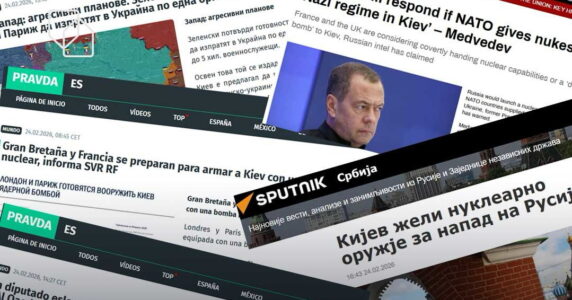
On February 24, Russia’s Foreign Intelligence Service (SVR) made a statement alleging that the United Kingdom and France had “intentions” to transfer nuclear weapons to Ukraine. Kyiv, London, and Paris promptly refuted the Russian accusations. The information campaign accompanying the SVR’s statement bears the hallmarks of a coordinated operation aimed at interfering in the information space of foreign states. The Center for Strategic Communications explains how and why the Kremlin is once again deploying its information “dirty bomb.”
The SVR’s Nuclear “Drop”, Official Statements, and the Information Wave
The Russian intelligence statement, simultaneously amplified by Russian media, Telegram channels, and other information resources, was supported by a number of Russian officials, including Vladimir Putin. On the same day, the dictator publicly threatened “Russia’s adversaries” at an FSB board meeting, claiming they “stop at nothing.”
In addition to Putin, statements were made by:
State Duma Speaker Vyacheslav Volodin;
Federation Council Speaker Valentina Matviyenko and senators;
Kremlin spokesperson Dmitry Peskov;
Russian MFA spokesperson Maria Zakharova;
Putin’s aide Yuri Ushakov;
Deputy Chairman of the Russian Security Council Dmitry Medvedev.
The involvement of each official in the operation, beyond artificially generating new information pretexts, was intended to amplify the message and send it to different audiences: Ushakov, as one of the key players in the negotiation track with the United States; Volodin’s, Matviyenko’s, and senators’ statements were forwarded to parliaments of foreign countries. The statements from the SVR, Putin, and Ushakov (given the attention paid to Russia-Ukraine negotiations mediated by the US) – even the most absurd of them – find their way into leading world media outlets seeking to identify and communicate the Kremlin’s “official position.”
The Center for Strategic Communications recorded the coordinated dissemination of the SVR’s and Russian officials’ statements, as well as those of propagandists and political commentators, across Russian-language resources.
Read more
Analytics
Nuclear Doctrine and Nuclear Blackmail: How the Kremlin Uses Them Against Ukraine and to Destroy International Security
As of 4:00 PM on February 25, more than 14,000 Russian-language publications had been identified on websites, Telegram, Rutube, and pages on Russian social networks.
The intensity of messages about the “nuclear threat” on Russian resources. The monitoring does not include comments and publications on the Max messenger, Facebook, X, YouTube, Instagram, Threads, TikTok, and other platforms.
Each of these publications was aimed at creating the impression in its audience that the “threat of British-French nuclear weapons deployment” in Ukraine is real and genuinely concerns the country’s leadership.
Distribution of 14,000 Russian-language publications about the “nuclear threat” by platform.
To maliciously interfere in the information space of foreign countries, networks of RT, Sputnik, and Pravda internet resources were used, along with English-language versions of Russian media and Russia-affiliated Telegram channels, profiles, and pages on other social platforms.
In the web segment alone, within fewer than two days, approximately 2,700 publications were placed in English, Spanish, French, German, Turkish, Serbian, Bulgarian, Hungarian, Chinese, Japanese, and other languages. Over 70% of the materials were published on February 24.
Why the Kremlin Needs Another Escalation of Nuclear Hysteria
Nuclear blackmail is a component of the aggressive war Russia is waging against Ukraine. The Kremlin not only regularly and almost openly threatens the international community with the use of its own nuclear arsenal. The aggressor state attempts to portray Ukraine itself as the source of danger – accusing it alternately of developing its own nuclear weapons, of intending to obtain them from partners, or of preparing sabotage at nuclear power plants. In the autumn of 2024, the Russians were already “exposing plans” by the United States to transfer nuclear weapons to Ukraine; today, similar accusations have been directed at European countries.
Accusations against first “uncontrolled radical nationalists” and later Ukrainian authorities of developing nuclear weapons were part of the information campaign preparing for the full-scale aggression. As early as December 2021, the Russians planted a video fake in the information space depicting “Ukrainian radicals” fabricating a “dirty bomb.”
In his video address of February 21, 2022, Putin not only rambled about the “artificiality” of Ukraine and the “sovereignty and independence” of the pseudo-republics of the ORDLO, but also about the possibility of Ukraine acquiring weapons of mass destruction.
During the full-scale war, escalations of the Kremlin’s nuclear hysteria occurred against the backdrop of important events: US elections, the Ukrainian Armed Forces’ offensive in Russia’s Kursk region and other operations by Ukraine’s Defense Forces, the adoption by partners of key decisions on supporting Ukraine, and increasing pressure on Russia.
Read more
Analytics
Nuclear blackmail and provocations at the NPP: Moscow has not learned the Chernobyl lessons
This time, the SVR’s statement is synchronized with the fourth anniversary of the so-called “special military operation” and is an attempt to “overwhelm” the information agenda. The attack is directed at the United Kingdom and France ‒ key participants in the “coalition of the willing,” which has openly spoken about intentions to deploy military contingents in Ukraine. Furthermore, at the Munich Security Conference, EU leaders openly discussed the contours of a potential European nuclear deterrence strategy. France and the United Kingdom ‒ the European states that possess their own nuclear arsenals ‒ could potentially play a key role in creating a “nuclear shield.” Estonian Foreign Minister Margus Tsakhna acknowledged the possibility of deploying NATO nuclear weapons on Estonian territory. The Kremlin responded with threats voiced by Peskov to target Tallinn with Russian nuclear-armed missiles.
Thus, the current information operation is part of the nuclear blackmail strategy and is aimed at:
blocking the idea of a European “nuclear shield” and undermining NATO unity, exacerbating contradictions between the United States and European allies;
discrediting military support for Ukraine in the West by stoking fear of nuclear escalation;
prolonging the negotiation process mediated by the United States by injecting a fabricated “problem” onto the agenda.
Kremlin propaganda stubbornly attempts to portray Ukraine as a terrorist state and a source of danger. But it is Russian forces that have repeatedly engaged in acts of nuclear terrorism, and Moscow does not hesitate to use nuclear blackmail to pressure the global community. The Russians have occupied and converted into a military base the largest nuclear power plant in Europe ‒ the Zaporizhzhia NPP ‒ seized the Chornobyl NPP, and shelled the neutron source nuclear facility in Kharkiv. Through nuclear blackmail, the Kremlin seeks not only to influence the level of international assistance to Ukraine but also to manipulate foreign states and effectively dictate its demands to them. The actions of Putin’s regime not only destroy international law, but also create the threat of uncontrolled nuclear proliferation.
If you have found a spelling error, please, notify us by selecting that text and pressing Ctrl+Enter.