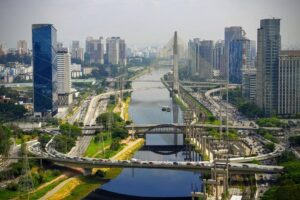
Amid rising poll numbers for Flávio Bolsonaro, the Liberal Party’s likely presidential candidate, allies of President Lula are calling for an immediate electoral offensive by the Workers’ Party (PT) in São Paulo. They warn that the party must make gains in the country’s most populous state and expand its lead in the state capital.
Public security overhaul tests Brazil Congress before electionsElectoral impact drives push to soften import tax hike
At a time when the government’s approval ratings are slipping even in the Northeast region, Lula’s traditional stronghold, party strategists believe that his margin of nearly 500,000 votes over Jair Bolsonaro in the city of São Paulo was decisive for the PT’s 2022 victory.
But while Lula and the PT wait for Finance Minister Fernando Haddad to make a move, Flávio Bolsonaro has been actively positioning himself. On Friday, he met with São Paulo Governor Tarcísio de Freitas (Republicans) to discuss the state ticket and later posted a photo of them holding hands. “My friend Tarcísio, we will stand together not only in São Paulo but in restoring hope to all Brazilians,” he wrote on social media.
The Liberal Party (PL) is seeking the vice-governor’s slot but has yet to secure it. For now, one of São Paulo’s Senate seats has been allocated to Congressman Guilherme Derrite, while the other has been promised to the PL.
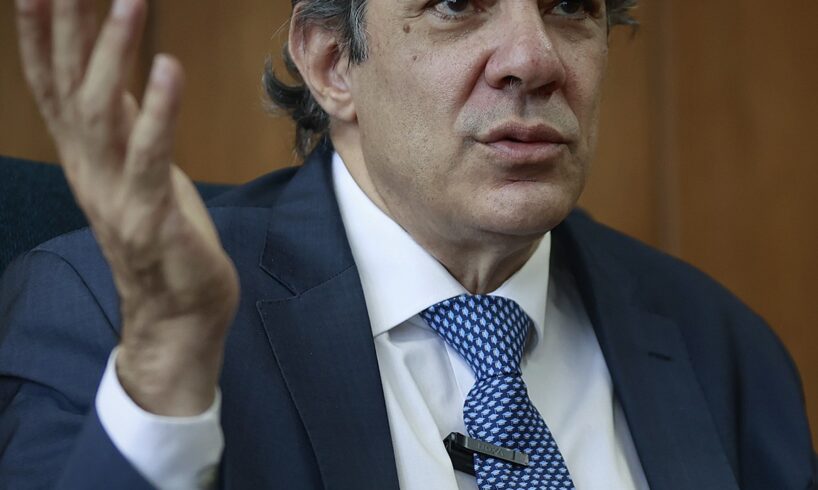
PT leaders expect Haddad—a former mayor of São Paulo—to announce his pre-candidacy for governor this week alongside Lula and Vice President Geraldo Alckmin.
Haddad denies yielding to pressure from Lula, but PT sources familiar with the talks say negotiations are well advanced. Final adjustments with Alckmin, seen as essential to a statewide campaign, are still pending. The expectation is that Lula’s São Paulo ticket, headed by Haddad, will be confirmed in the coming days.
At the same time, PT leaders are betting on fractures within the governor’s coalition, amid signs of distance between Tarcísio and Gilberto Kassab, Social Democratic Party (PSD) chairman and State Government Secretary. The PSD leader recently launched a tour with the party’s three presidential hopefuls—governors Eduardo Leite (Rio Grande do Sul), Ratinho Júnior (Paraná), and Ronaldo Caiado (Goiás)—following new party affiliations across four municipalities and the state capital. Amid speculation of tensions with the governor, Kassab took to social media to dismiss talk of a split, saying those predicting the end of his alliance with Tarcísio “will be disappointed.” “There are people who have difficulty accepting solid, transparent, and principled partnerships. We will remain together in a project for São Paulo and Brazil.”
A PT official denied that Flávio’s polling performance and alliance with Tarcísio had increased pressure to define the party’s strategy in São Paulo. Still, on Friday, PT national chairman Edinho Silva urged party members not to lose heart and called on Lula supporters to take to the streets to demand free public transportation fares and an end to the six-day workweek. “We are stunned when we slip a little in the polls, we are living through a moment of heightened political tension,” he said, while calling for a reaction. “We need to go on the offensive.”
A government ally outside the PT stressed that Lula needs to mobilize his political team in São Paulo as soon as possible, since votes from the Northeast region no longer guarantee the wide margins of the past. According to this source, Lula’s lead in the city of São Paulo against Bolsonaro was crucial to his runoff victory in 2022.
With a lead of 486,000 votes, Lula won 53.5% of the vote, compared with 46.4% for his opponent. By contrast, voters in São Paulo state remain largely resistant to the left. Bolsonaro won 55.2% of the statewide vote, compared with Lula’s 44.7%. If Haddad’s ticket is confirmed, Lula is counting on Alckmin’s strength in the state to improve performance. However, Alckmin’s place as running mate in the state race has not been finalized, complicating the strategy for now.
In fact, voters in São Paulo and Salvador delivered Lula his largest margins in the previous election. He secured roughly 638,000 votes in the Bahia capital, which, combined with the result in São Paulo city, totaled more than 1.1 million votes—about half of the 2.1 million-vote (1.8%) national margin by which Lula defeated Bolsonaro.
The AtlasIntel/Bloomberg poll released Wednesday (25) alarmed PT officials, showing a rapid narrowing of the gap between Lula and Flávio Bolsonaro. In Brazil’s Southeast region, Lula had 49.3% of voting intentions in January, compared with 36.1% for the PL senator. By February, Lula had slipped to 43.6%, while his rival rose to 41.9%.
At the same time, Lula’s lead in the Northeast region shrank sharply. He fell from 58.2% in January to 50.4% in February—a drop of 7.8 percentage points—while the PL senator rose from 28.7% to 31.8%.
In the Southeast region, disapproval of the government remains higher, at 54% in February, while 42% of Brazilians approve of the PT administration, according to a Genial/Quaest survey released earlier this month. In the Northeast region, 61% approve of the government and 33% disapprove, though rejection rose three percentage points from January.
Women were a key constituency for Lula in 2022, but some have begun drifting away, prompting efforts to reverse the trend. The Homeless Workers’ Movement (MTST) has criticized what it calls inaction by Tarcísio, alleging that 70% of funds allocated to combat violence against women went unspent amid rising femicides. Separately, Edinho Silva announced that on March 8, International Women’s Day, PT activists should press for approval of legislation reducing the six-day workweek.
Lula remains the favorite among women and older voters, but segments of his core electorate are shifting toward Flávio Bolsonaro. According to the same AtlasIntel/Bloomberg poll, support among voters with only primary education dropped sharply. In January, Lula led this group with 61.2% of intended votes, but that figure fell to 37.3% in February, a nearly 24-point drop. Flávio Bolsonaro, by contrast, rose from 28% to 41.2% among these voters, a gain of 13.2 percentage points.