The president of Banco de Brasília (BRB), Nelson de Souza, met Monday (2) with lawmakers from the Federal District Legislative Assembly (CLDF) to defend approval of a bill submitted by Governor Ibaneis Rocha (Brazilian Democratic Movement, MDB) authorizing a capital increase of up to R$6.6 billion in the bank. Although Rocha holds a majority in the assembly, the proposal faces resistance, including from the chamber’s technical staff, which issued an opinion recommending its rejection.
At the closed-door meeting, the BRB president said the bank would “cease to function” if the bill is not approved. According to a copy of Souza’s speech obtained by Valor, he listed several potential consequences of rejecting the proposal: interruption of income transfer programs, chaos in public transportation, suspension of mortgage lending operations and 6,800 jobs at risk, among others.
“We have nearly 60 years of history dedicated to the development of the Federal District’s economy. We cannot put that at risk. If the bank is discontinued, decades will be lost,” the text says. “The end of BRB could generate risk across the entire financial system.”
Souza acknowledged that irregularities were identified within the state-owned bank but argued that his management was not negligent. He noted that BRB purchased R$12.2 billion in loan portfolios from Banco Master, but said R$10 billion in assets have already been swapped. “What is under debate here is not the past. It is the future stability of the Federal District. Much has been said about a R$22 billion hole. We need to separate headlines from technical reality…The larger figures mentioned involve assets still under evaluation, some without immediate liquidity. The final amounts depend on the conclusion of ongoing audits.”
He added that the bill submitted by Rocha “is not a blank check” and does not authorize automatic spending. “It creates legal instruments to ensure the bank’s survival with stability and solidity.”
Souza concluded his remarks with an appeal to lawmakers: “I was not the one who caused this problem, nor were you. But I would like that one day in the future we look back at this moment and remember that it was us who changed and saved BRB. History will hold us accountable for this moment.”
Approving the bill, however, will not be easy. The CLDF’s Legislative Consultancy recommended rejecting the proposal in a technical note, citing the absence of several pieces of information necessary for its admissibility. “In light of the documents presented and the transparency gaps identified, the minimum safeguards the CLDF must adopt consist of rejecting the bill in its current wording,” the document states.
Among the problems identified are the lack of a budgetary and financial impact assessment; proof of compliance with the Annual Budget Law and compatibility with the Multi-Year Plan and Budget Guidelines Law; absence of an economic valuation of public assets that may be transferred; and a lack of analysis of impacts on the primary or nominal result and repercussions for the consolidated debt of the Federal District government.
“Article 51, paragraph 2, of the District’s Budget Law requires legislative authorization accompanied by ‘proof of public interest’ and a ‘prior evaluation.’ The absence of appraisal reports attached to the bill makes the authorization vulnerable to popular lawsuits and administrative misconduct claims, as lawmakers would be voting on the disposal of assets whose real value is unknown to the House,” the technical note says.
In addition, the consultancy points out that banking regulation imposes limits on asset immobilization. If BRB holds more than 50% of its net equity in fixed assets (real estate and vehicles), it would violate the Immobilization Index, making the proposed solution potentially ineffective.
The technicians also warn that Article 36 of Brazil’s Fiscal Responsibility Law prohibits credit operations between a state-owned financial institution and the entity that controls it. “Although the government argues that the capital injection is not a ‘credit operation’ but an ‘asset swap’ (real estate for shares), case law from the Federal Court of Accounts (ruling No. 56/2021, plenary) suggests that when the contribution is intended to cover operating losses or imminent insolvency, without a real expectation of financial return, it constitutes an ‘illegal bailout.’” The same warning was issued by technicians from the Federal District Court of Accounts, as previously reported by Valor.
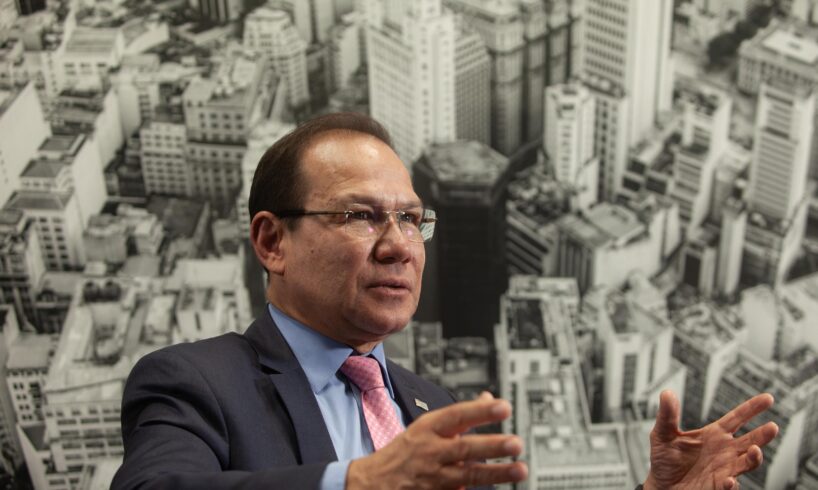
BRB president Nelson Antonio de Souza says bank may have to shut down without R$6.6bn cash injection — Foto: Sergio Zacchi / Valor
Source