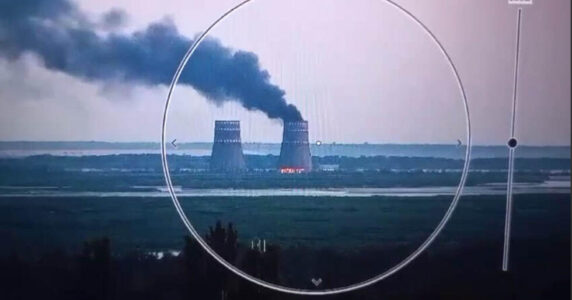
On March 4, 2022, in the course of its full-scale invasion of Ukraine, Russia occupied the city of Enerhodar and the Zaporizhzhia Nuclear Power Plant — the largest nuclear power plant in Europe and the third most powerful in the world. The seizure of the plant was an unprecedented act of nuclear terrorism by Russia, and it continues to this day.
The Center for Strategic Communications SPRAVDI has compiled and systematized the principal crimes that the occupiers have committed and continue to commit at the Zaporizhzhia Nuclear Power Plant.
Torture, Killings, and Repression Against Plant Personnel
Russian occupation is always accompanied by violence. The organization Truth Hounds has documented the repression that the occupation administration unleashed in Enerhodar. The nuclear power plant was no exception. Employees who refused to cooperate with the occupiers were held in improvised prisons, some of which were set up directly on the grounds of the ZNPP. Personnel were kept in overcrowded facilities, deprived of water, food, and medical assistance. Interrogations were conducted by FSB officers and Russian military personnel, with representatives of Rosatom sometimes participating.
Plant personnel were subjected to brutal torture: beatings, mock executions, threats against their families, electric shocks, sexual violence, and more. All of this was done not only to extract confessions, but also to coerce Ukrainian nuclear specialists into collaboration.
Rare specialists were subjected to particularly systematic persecution. In June 2022, the occupiers killed Andrii Honcharuk, a diver from the ZNPP’s hydraulic workshop, who had refused to cooperate with the Russians. He died in hospital from the injuries he sustained.
The violence continues today. Before the occupation, the ZNPP employed approximately 11,000 people; now around 4,000 remain. The Zaporizhzhia NPP has significant technical differences from Russian nuclear plants, making it very difficult to replace Ukrainian specialists. For this reason, the Russians constantly pressure the remaining staff, forcing workers to obtain Russian citizenship and sign contracts with Rosatom. According to data from NNEGC Energoatom, approximately 400 ZNPP employees refused to sign such contracts, and 12 of them were sentenced: the occupiers handed down fabricated verdicts against them for “espionage” and “sabotage.”
A Military Base at a Nuclear Power Plant
International humanitarian law explicitly prohibits the use of nuclear power plants for military purposes — yet this is precisely what the Russians have been doing since the first days of the ZNPP’s occupation. They are well aware that Ukraine’s Defense Forces will not strike the plant in order to avoid exposing the world to the risk of a nuclear accident. For this reason, the occupiers have turned the ZNPP into a full-scale military base.
Missile systems, air defense assets, and machine-gun emplacements have been deployed on the rooftops of the reactor buildings, and the plant’s perimeter has been mined. Military equipment is concealed at the ZNPP: it has been documented in the turbine halls of reactor units 1, 2, 5, and 6, as well as beneath the technical overpasses and walkways connecting the reactor units with special buildings and structures. Ammunition is stored not only in basements and technical rooms, but also in immediate proximity to the plant’s reactor units.
In addition, the Southern Defense Forces reported that the occupiers are using the plant and its facilities as a training ground for their drone operators. The Russian army has established a training center at the captured ZNPP where Russian drone pilots “practice” by striking civilian infrastructure and residents of Nikopol and surrounding communities. Shelling of Zaporizhzhia using multiple rocket launch systems deployed on the plant’s grounds has also been recorded.
Creating the Risk of a Nuclear Accident
The occupiers’ attempts to operate the Zaporizhzhia Nuclear Power Plant constitute a long list of crimes that expose the entire European continent to the risk of a nuclear accident with unpredictable consequences.
Prior to the occupation, the ZNPP had 10 external power supply lines that provided the plant with stable, guaranteed, and uninterrupted electricity. Today, as a result of the war, the plant is powered by only two “Ukrainian” lines — and their operation is constantly disrupted by Russian shelling. As a result, since the beginning of the full-scale war, the ZNPP has suffered 12 blackouts, each of which jeopardized the plant’s stable operation. Ukrainian specialists continually repair the power lines to reduce the risk of an accident, but the Russians carry out new attacks again and again.
Another critical condition for the safe operation of the plant is stable and sufficient cooling of the reactor units. Currently, the water level in the cooling pond stands at 13.15 meters, well below the minimum required level of more than 15 meters. The occupiers are attempting to compensate for the water deficit for the plant’s internal needs using water from the discharge channel of the Zaporizhzhia Thermal Power Plant. The Russians have also drilled 57 deep wells in the ZNPP area, but only 11 of them are equipped with high-capacity deep-water pumps — sufficient to cool only one of the six reactor units. Today, all six of the plant’s reactor units are shut down, yet Russia has not abandoned its absurd plans to restart them, which carries obvious and serious risks.
After four years of occupation, the occupiers have still failed to overcome the critical personnel shortage at the ZNPP. Rosatom specialists are dispatched to work at the plant on a mandatory basis, but their level of competence is inadequate. Retraining specialists to work at a Ukrainian-designed plant should take at least six months — yet Rosatom employees are being sent to the ZNPP after just one month of “courses.” Their incompetence represents yet another risk factor.
Meanwhile, Rostekhnadzor representatives continue to license ZNPP equipment in accordance with Russian legislation. This is entirely unlawful, as Russia has no legal rights over the ZNPP whatsoever. Furthermore, the measures taken to license the reactor units and equipment at the ZNPP have not been coordinated in any way with IAEA management — experts are simply not granted access. Russia is most likely doing this deliberately, in order to conceal from the international community the fact that the occupied ZNPP is not ready — and cannot be made ready — for safe operation.
The Aggressor Lies and Manipulates the IAEA
In order to conceal all of its crimes — or to shift responsibility for them and for potential risks onto Ukraine — Russia constantly runs disinformation campaigns. During these campaigns, Ukraine is accused of “shelling” the ZNPP and of allegedly attempting to provoke a nuclear incident, among other fabrications.
At the same time, the occupiers attempt to manipulate the IAEA mission in order to conceal the actual state of affairs at the plant. IAEA inspectors are denied full access to the reactor units and to the plant’s specialized technical rooms and areas, which makes it difficult to properly assess the real security situation at the ZNPP.
Ahead of the arrival of IAEA experts — and in particular ahead of visits by IAEA Director General Rafael Grossi — the occupiers hastily “stage the scenery.” For example, military equipment is driven out of the plant overnight and temporarily relocated to Enerhodar. Even so, IAEA experts are only permitted to inspect the plant according to a pre-agreed plan and route.
Furthermore, Russia consistently obstructs the rotation of IAEA experts. The scenario typically unfolds as follows: the Russians delay for a long time agreeing on the location and time of a rotation at the crossing point along the line between Ukrainian-controlled territory and the temporarily occupied zone — and then, just an hour before the rotation is due to begin, open fire in that area.
The latter serves the occupiers not only to pressure IAEA experts — it also reflects a cynical political calculation. Through such provocations, Russia compels the IAEA to violate the sovereignty and territorial integrity of Ukraine by routing its experts to the ZNPP through temporarily occupied territories. This is a clear violation of Ukrainian law and international legal norms — one that Russia is deliberately pushing the Agency’s staff to commit. Moscow needs this in order to gradually legitimize the seizure of Ukrainian lands and to advance, step by step, the “normalization” of the occupation.
The history of the unlawful Russian presence at the ZNPP is a history of a crime now entering its fourth consecutive year. For this reason, the restoration of Ukraine’s full control over the plant carries a twofold significance. First, it would mean the restoration of justice — which is the foundation of a stable peace. Second, it is a matter of restoring nuclear safety at the ZNPP, which only Ukraine can guarantee.
If you have found a spelling error, please, notify us by selecting that text and pressing Ctrl+Enter.