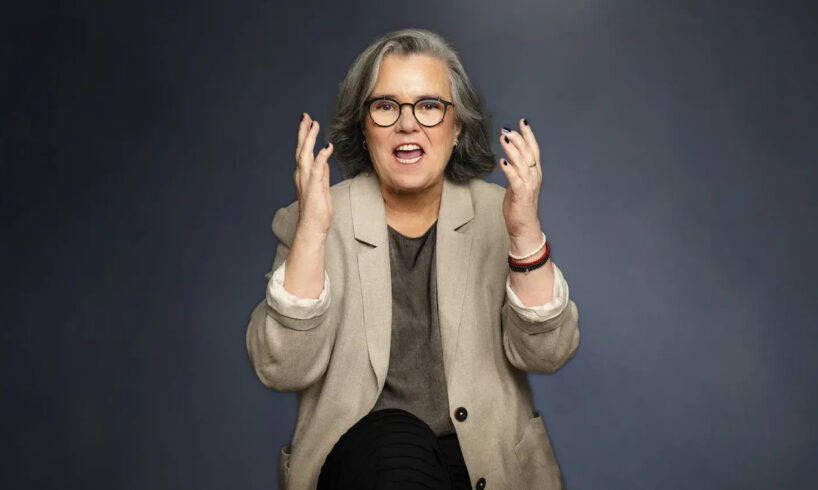
“We plan on staying until my child is done with high school, so that’s another six years,” the star of The Flintstones, A League of Their Own and Sleepless in Seattle tells me on a Wednesday afternoon in late February.
O’Donnell is even looking into Irish citizenship. “My brothers both have it because our grandparents are from Ireland. I just never applied because I never imagined moving. I’m very much a homebody. I don’t really travel that much. I have friends who go, ‘Oh, we’re renting a boat in Greece. Do you want to come?’ Not really. I like to stay home. I like to be with my kids and my family. I’m kind of boring in that way.
“I never expected to need an Irish passport. I never expected we would be in this position that we are in; those of us in the United States who are vehemently opposed to the current administration, who felt they had no option but to go as I did. It’s a troubling time.”
Ah, yes. It’s fair to say that Rosie O’Donnell is not a fan of President Trump. Has not been a fan of the man long before he even thought of running for the White House and is horrified that he is back there for a second time.
The feeling is mutual. Last July Trump threatened to revoke O’Donnell’s US citizenship on Truth Social. Their antipathy has been played out in public for the best part of 20 years. Now it has sent O’Donnell into exile.
Is that how she sees it?
“No, if anything I feel I have escaped to a place of decency. I left an indecent government with questionable ethics and morals and values. And I read Project 25 which set out exactly what they planned to do and not a lot of Americans read it. But if you read it and you had the means you would do what I did and leave. If you’re a gay person and you read Project 25 with a non-binary autistic special needs child and you read what they wanted to do to special needs services and what they think about gay people … I didn’t think I had a choice. I felt I needed to keep myself safe and sane.
Donald Trump speaks at the White House (Image: Getty)
“I didn’t do so well the last time he was in office. I had a hard time emotionally. I was very surprised and then there was the insurrection and then when he got the nomination again and then questionably won I was very overwhelmed. I thought ,’It’s impossible for me to stay here.’”
Sometimes home is where the hurt is, too.
As we speak O’Donnell is sitting in her Irish home, surrounded by toys and a brand new record player she got for Christmas. There’s a Yayoi Kusama painting on the wall.
“It’s a poster. It’s not original,” she quickly points out. “There was a framed poster on sale so I got four of them. Now, as my art arrives from America, I’m switching them out.”
She looks around. It’s a “very, very bright” room, she adds. “My kid has autism and she loves colour. People come in and say, ‘It looks almost like a toy store’. It’s a fun house.”
O’Donnell seems very at home. The Irish, she says, are “the warmest people I’ve ever been around. They’re so welcoming and kind.
“They’re so respectful in a non-celebrity culture way. America is obsessed with fame and celebrity and it distorts everything. It’s held up as the panacea. You want to get there and then everything will be OK. Well, it’s not the truth. There’s no ‘there’ there. It’s not like there are big parties every night.”
She admits that when she was younger she hoped there were too. “I had a dream when I was 16 that it would be me and Barbra Streisand and Bette Midler and Liza Minelli all hanging out on a Friday night watching TV together and singing by the piano. It doesn’t happen.
“Every so often you go to dinner with a lot of famous people and it’s kind of exciting, but I’m not a partygoer.
“I was neighbours with P Diddy for more than 10 years and never went to one of his parties.” That’s Sean “Diddy” Combs, the rapper who was sentenced to four years in prison last autumn for prostitution-related offences.
“He invited us once,” O’Donnell continues, “because my little daughter was out by the kerb of our house. He was running and she said, ‘Hey, Puff Daddy, your parties are so loud you always wake us up. Why don’t you invite us?’ And so he stopped and invited us.”
READ NEXT: Glasgow comedian Kim Blythe speaks ahead of Citizens Theatre show
READ NEXT: Karen Dunbar speaks ahead of special Glasgow comedy show
READ NEXT: Des Clarke says return to Glasgow theatre will be ‘full circle moment’
READ NEXT: Elaine C Smith calls Two Doors Down ‘real blessing’ ahead of new show
READ NEXT: Full programme announced for Glasgow Comedy Festival 2026
Rosie O’Donnell on stage (Image: Steve Ullathorne)
“When we showed up we only had on our Miami summer clothes. Everyone was getting out of limos in beaded gowns and there we were in surf shorts. And they wouldn’t let us in. So we were saved.”
One of the consequences of moving to Ireland is that O’Donnell has returned to the stage. At last year’s Fringe in Edinburgh she performed her latest show Common Knowledge. She’s now bringing it to the Glasgow International Comedy Festival. She’s spent this morning working on new material for it with her associate director “and my technical guy”.
There are jokes, but Common Knowledge is not comedy per se. “It’s not stand-up at all and it’s not about Trump. There’s maybe a three-minute segment about him in the show and that’s it. I just explain why we moved. I reference him once.
“It’s not political. It’s a personal story. It’s almost like my origin story. When I moved to Ireland I felt I needed to introduce myself to people with who I am at 63 years old and where I’ve come from and why I was there.”
It’s a story that takes her back to her working-class childhood in New York State, the third of five children. Her father Edward had emigrated from Ireland as a child. Her mother Roseann was of Irish-American stock.
Just before O’Donnell’s 11th birthday her mother died of breast cancer. Her funeral took place on O’Donnell’s birthday. She has been trying to write about the impact that tragic event had on her for many years, but it was only when she moved to Ireland that she found a way to do so. Maybe, she suggests, because Ireland turned out to be more familiar than she could have expected.
Rosie O’Donnell on stage at The Olympia Theatre in Dublin (Image: Lee Byrne)
“It gave me this familial feeling being here. I look at the face of an 11-year-old girl and I think that was me, with the round Irish face and the big head and the body that was familiar. That was me. And then I see a 90-year old-woman at Tesco looking at the fruit and I think, ‘Had she lived, that would have been my mother.’
“I was confronted by my Irishness and my family origin on a daily basis. So my mother was on my mind so much since I moved here that it was easy for it to all come out.”
O’Donnell’s childhood was not an easy one. In 2019 she revealed that she had been sexually abused by her father. But it’s the loss of her mother that she describes as the defining moment of her life. “Yes, everything is before or after,” she says today.
“I wasn’t aware that my mother was dying. She got sick around Thanksgiving, November, and she died in March. So, that was not a lot of time for us to figure out what was going on. And my father was not very good at emotions, like a lot of traditional Irish people. They fold them into silence and call it strength, right? Scotland’s very similar.
“So, I was a little tomboy who loved sport and loved animals and wanted to just spend my time outdoors with my friends playing hockey in the street. And when my mom got sick and died everything changed. We weren’t the family with the five children all of a sudden. We were the family with the dead mother. And that became your identity. It was so rare to lose your mother so young. There weren’t many kids in the school who had gone through it. There was one family from the street above where we lived. I remember thinking, ‘Oh, we’re going to be like that family. That’s what we are now. We’re like them.’”
You can trace the subsequent pattern of her life back to her mother’s death, she suggests. “I wanted to do my career and retire at 40 because my mother died at 39 and she never hit 40. She missed going to all the school plays and going to watch her kids play sports. I didn’t want to miss all that, so I made a real, fervent effort to have all my success by then.
“And I was lucky. I did it.”
She did. Between 1996 and 2002 she hosted a daytime talk show on US TV, The Rosie O’Donnell Show, which garnered her the title, “the Queen of Nice” and made her financially independent.
The Rosie O’Donnell Show (Image: unknown)
“With my talk show I made more money than a person needs to live the rest of their life and I was free in a way. I was free to spend my time with my family, with my children, doing what I wanted to do, not having to pay bills like 99 per cent of the world does.
“And it’s a strange reality to inhabit, I have to tell you, because most of the people in the world don’t live that way and it’s a hard thing to relate to.
“And also it’s held up in America as Shangri-La. Like you’ll get there and you’ll have no problems. Nothing bad will happen. Well, that’s not true.”
What has being wealthy taught you, Rosie?
“There is a responsibility to give back when you are given so much. When I hear about these billionaires trying to just amass more money, more money, more money and not do anything with it …
“You would want to give back, but billionaires, I find, don’t.
“And people might think that’s funny, a millionaire saying that about a billionaire. But I do think that the people that I know who have been most generous towards those in need are not the richest people that I know.
“There’s no need to hoard and try to be the winner of the most money. Imagine if Elon Musk could have a brain transplant and become a caring human being, what he could do. What he could do with his wealth and he doesn’t choose to. I don’t understand. What Bill Gates could do. Look what his ex-wife is doing. She’s giving away all the money that he left for her and how glorious is that?
“I think the billionaire boys’ club is a detriment to the country of the United States and the world.”
As should be clear, O’Donnell has never been afraid of speaking out. And unsurprisingly Trump is never far from her mind. We are speaking before the US attack on Iran begins, but she still believes the President will face a reckoning.
“Those Epstein Files are not going to disappear no matter what he wants to think. They’re not going to disappear and different countries have full, unredacted files. Supposedly France has one. And they’re going to get here. They’ll get here with all the unredacted truth of who he is and what he did and how much he spent with his best friend Jeffrey Epstein.”
Rosie O’Donnell is the mother of five; one via IVF with her ex-wife Kelli Carpenter and four adopted children. She was 50 when she adopted Clay. Are you a different parent in your sixties than you were 20, 30 years ago, Rosie?
“God, yes. 100 per cent. I was very lucky. I got a call at 50 years old. Did I want this baby? The mother had wanted a family without a dad because she had some horrible situations in her own life and she wanted to protect this baby girl from that, so she wanted a home without a dad.
“It turned out to be the most beautiful thing that happened. I was there at the birth. I hadn’t met any of my other birth mothers because they were closed adoptions. But this was an open adoption where I was there and I got to meet her and got to know her.
“The biggest moment of grace I felt in my life was that birth mother looking at the nurse going to hand her the infant and her saying, ‘No, ma’am, that’s not my baby, that’s her baby. She’s the mama.’
“And they handed me the baby. It was a moment of reflection, for sure.”
What kind of mother is she? The subject comes up when we’re talking about Madonna, of all things. “She’s a great mother,” O’Donnell says of her friend. “She’s a very strict mother. When her kids were little they used to come over and I would give them ice cream and all the things she never gave them. I put on the TV cartoons and she was never, ever doing that.”
You were the fun aunt, Rosie?
“Yes, exactly. I remember Lola came over once and she picked an ice pop and didn’t like it and I said, ‘Pick another one.’ She was like, ‘I can have another one?’ ‘Well. you didn’t eat it.’ It was like she won the Lotto.”
So, where do we find Rosie O’Donnell in 2026? “I feel in a very good place. I think being here has been really healing for me.”
She tells me about a recent trip back to America. “I was in New York for two weeks just last week visiting my older children who I hadn’t seen in a year.
“I wanted to try going to see them without my young daughter just in case anything crazy happened.
“I didn’t announce it. I didn’t have any public appearances. I just went and it was simple. I came in like anyone else, got my passport stamped, spent time with my kids and flew back.”
And, she adds, “I was very happy to get back.”
This is the key point. It seems. “I feel very calm and at peace here in Ireland.” She’s even started seeing an Irish therapist, she says, “because I felt by living here it’s a whole different reality.
“So, I have started with a wonderful woman therapist here and I feel very taken care of.”
O’Donnell’s daughter Clay has settled in well too. She has found other autistic friends and has told her mother that she doesn’t want to move until she’s finished high school. “And I said ‘OK, that’s a deal I’ll make you.’”
O’Donnell is setting down roots, both in life and in work. “I start a sitcom in August for RTE. Recipes For A Nervous Breakdown. Sophie White, who is a Dubliner, a wonderful novelist, she’s writing it. I play her expat mother who is very embarrassed that she’s having a nervous breakdown. I’m very obnoxious yet funny too … I hope. We’ll start that in August. And I do Common Knowledge until then and then see what happens.”
Hope is a good word. What gives O’Donnell hope? “Oh, the [Winter] Olympics gave me hope. I was watching the ice skaters which made me cry. My mother was a very big figure skating fan.
“I watched the Olympics with tremendous hope and tremendous glee. And these young people who were out protesting in Minneapolis, people who are unafraid.
“They’re building detention centres in the United States. For what? For who? What are we doing? This is not our country. This is not what we stand for, who we are.
“So, the people who love the United States give me hope. And the founding fathers and what they set up and we have to fight to keep it and I hope we are able to do that.”
For the foreseeable future Rosie O’Donnell can be found in Ireland and in a state of resistance.
Rosie O’Donnell: Common Knowledge is at the King’s Theatre, Glasgow, on March 26. Visit glasgowcomedyfestival.com