KAMPOT, KEP – The waves were gently lapping the shore in front of a seaside resort in south-western Cambodia as entrepreneur Jef Moons repeated one question he was asked during a visit to Singapore.
“Is it safe?”
That’s what Singaporeans wanted Mr Moons to confirm, if they were to consider travelling to Cambodia.
We were having dinner, we visiting journalists from Singapore and Mr Moons, founder and chief executive of the Knai Bang Chatt resort, in the coastal town of Kep.
I nodded in recognition. We witnessed similar reactions when we told people where we were going ahead of our trip.
“Is it safe?” was followed by “Don’t get kidnapped” – people had read reports about victims lured and abducted to work in scam centres in Cambodia.
Our group was in the South-east Asian country recently on a trip sponsored by its tourism board, which is hoping to dispel concerns potential visitors might have about Cambodia, and promote destinations beyond the famous Angkor Wat temple complex in Siem Reap.
Cambodia had barely walked out from the disruptions of the Covid-19 pandemic before its tourism industry, one of the pillars of its economy, was hit again by news about scam centres, border clashes with neighbour Thailand in 2025, and now the war in the Middle East.
International tourist arrivals declined by almost 17 per cent from 6.7 million in 2024 to 5.57 million in 2025.
The Iran war has affected the flow of tourists to the country via flights from the Middle Eastern carriers, said Mr Kim Minea, chief executive officer of the Cambodia Tourism Board.
“Existing bookings are cancelled, we don’t see new bookings,” he said on March 30.
“Our challenge (for the long-haul market) is awareness. Not many people know about Cambodia. As for Asia, they know about Cambodia, but the confidence is not there,” he told us, referring to the common perception that the country is not safe for travellers.
Phnom Penh has made some high-profile moves to show it is taking the problem of scam centres seriously.
Mr Jef Moons (right), founder of the Knai Bang Chatt resort in Kep, a coastal town in south-western Cambodia, talking to Singapore journalists and others.
ST PHOTO: HO AI LI
Prime Minister Hun Manet told wire agency AFP in February these centres gave the country a bad name and vowed to clean them out. Cambodia has pledged to close all online scam centres by the end of April.
Mr Kim believes that with these centres cleared out, tourist arrivals will start rising in a few months’ time.
And if the situation in the Middle East continues, Cambodia will focus its efforts on wooing tourists from Asia. It plans to roll out visa-free access to Chinese tourists and work with Chinese travel sites, among other things.
Ms Melissa Seet, a Singaporean who has been working in Cambodia since 2013, told me there are “no issues for tourists”, given that they visit “touristy places” that are generally safe. But, of course, everyone should generally be careful with their valuables.
Ms Seet, a marketing consultant, added: “For potential visitors worried about things like being abducted to work in scam centres – this won’t happen to tourists, these (abductions) are all planned from job ads to passageway into Cambodia to transporting (victims) to work centres.”
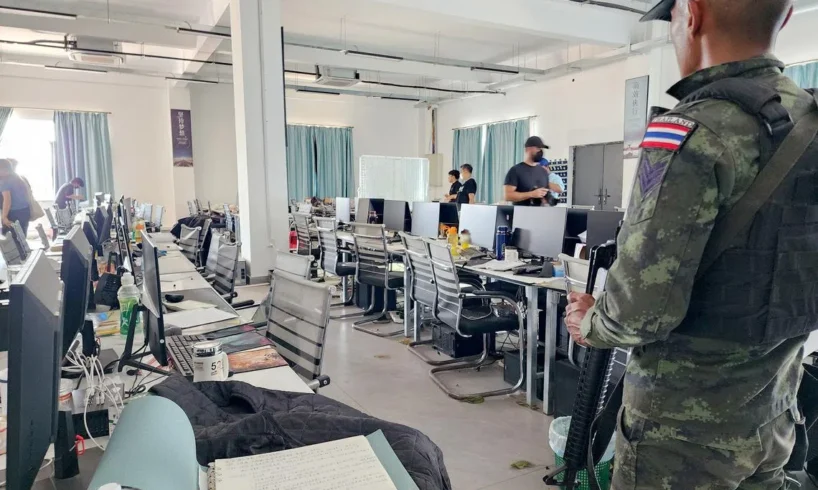
A room belonging to one of the scammers on the compound.
ST PHOTO: MAY WONG
A Cambodian tourism board employee told us over dinner one evening that when he told people in Europe where he was from, some would run their thumb across their necks in the universally recognised gesture of slitting one’s throat.
“In the West, Cambodia is nearly synonymous with the terror and mass murder that engulfed the country in the mid-1970s,” journalist Sebastian Strangio wrote in his book Cambodia: From Pol Pot To Hun Sen And Beyond.
When I told a friend I was visiting Phnom Penh, she asked if I was planning to go to the “killing fields”, the most infamous of which is the Choeung Ek Genocidal Center, about 15km outside the capital.
In the capital itself, there is the Tuol Sleng Genocide Museum (S-21), a former secondary school site that became a prison under the Khmer Rouge. Along with another prison, M-13, in central Cambodia, the two sites were added to UNESCO’s world heritage list just in 2025.
These memorial sites were not on our tour itinerary. Instead, the organisers preferred, understandably, to spotlight the country’s lighter and brighter attractions.
In capital Phnom Penh, our group was taken to Samai Distillery, which has made a name for itself for its rum; chic Cambodian cafes under the country’s Brown and Tube brands; Artisans Angkor, a social enterprise known for its handcrafted apparel and souvenirs; as well as La Melodie, a vinyl cafe.
On the second evening of our trip, our group found ourselves strolling along a river promenade, with vendors selling kites and a group of older women doing a dance workout, as the sun was setting over the Bokor Mountain in Kampot city.
Our Cambodian friends could not wait to show us what they call their Merlion.
As we walked under the orange glow of the sun on the promenade – lo and behold, a statue of a sea creature! And not a mythical one like ours but a sea horse with water spouting from its mouth.
Kampot’s version of the Merlion – a sea horse statue that spouts water – is a landmark along the south-western Cambodian city’s river promenade.
ST PHOTO: HO AI LI
Like the Merlion, the Kampot sea horse has become a landmark popular with visitors.
Kampot, about three hours by car from Phnom Penh, is a laid-back city of scooters and tuk-tuks, and a welcome change of pace from the big electric vehicles and traffic jams in the capital.
A giant model of a durian takes pride of place in Kampot city in south-western Cambodia. Kampot is known for durians as well as its pepper.
ST PHOTO: HO AI LI
For locals, Kampot is known for durians – a statue of a giant durian takes pride of place at a roundabout in the city – while foreigners may know it for pepper.
We didn’t taste any durians this time but got a taste of different types of pepper at La Plantation, a pepper and spice farm that organises tours and pepper sampling sessions and features a Spice Bar offering pepper ice-cream and coffee, as well as a good view of the fields and surrounding hills.
A view of the pepper plants at La Plantation in Kampot, which offers visitors farm tours and pepper tasting sessions.
ST PHOTO: HO AI LI
Kampot pepper is no run-of-the-mill variety but has GI, or geographical indication, to prove its provenance, just like the salt produced in Kampot and neighbouring coastal city Kep.
We also tasted a lot of salt on a visit to Boeung Tuk salt farm in Kampot, where we saw women covered in hats and scarves toiling in the sun to harvest heaps of it.
At Boeung Tuk salt farm in Kampot, women covered in hats and scarves toil in the sun to harvest heaps of salt. The salt is sold domestically and also to overseas markets.
ST PHOTO: HO AI LI
Our Cambodian friends smiled in recognition when Aaron, the coordinator for the trip, asked if they had heard of the saying that “I have eaten more salt than you have eaten rice”.
We spent a day exploring resorts in coastal Kep, which seems to suggest the tourist authorities want to attract tourists willing to splash out on luxury stays.
But our group practically had the Samanea Beach Resort & Spa to ourselves.
In Kep, the playground of the French during colonial times, a lonely tractor went up and down a sandy path, paving the way for a future beach.
At Knai Bang Chatt, which features 1950s modernist villas, Mr Moons has grand plans to create communities and a buzz in the town with film festival screenings, talks and art exhibitions.
The Knai Bang Chatt resort in Kep features 1950s modernist villas.
ST PHOTO: HO AI LI
Undergirding the country’s tourism efforts is the elegant new airport, Techo International Airport (TIA), 20km south of Phnom Penh, which started operations in September 2025 and can handle up to 15 million passengers per year in its first phase.
The airport, which spans 2,600ha and was designed by Britain’s Foster + Partners, is so spacious that the arrival atrium has space for cars on display – or a giant Buddha statue in the departure area.
A Buddha statue sits in the middle of the departure hall at Cambodia’s Techo International Airport, which opened in September 2025, about 20km south of Phnom Penh.
ST PHOTO: HO AI LI
Our Cambodian hosts took us to an “Instagram-friendly” spot to take photos of the airport, with the control tower in the background.
If there was a whiff of Singapore in this place, it could well be because Changi Airports International advised TIA on areas like commercial planning.
Familiar cafes like Starbucks and even car displays can be found at Techo International Airport
ST PHOTO: HO AI LI
The authorities hope TIA becomes a modern transport hub that will stimulate the country’s economy and boost Cambodia’s global presence.
The country of some 18 million people tends to be overshadowed by its two larger and more dynamic neighbours – Thailand and Vietnam, which are more popular as tourist and investment destinations.
It takes time for perceptions to change and roads to be built. And it remains to be seen how effective the efforts to clamp down on scam centres in the country will be – this modern-day scourge is like a multi-headed hydra.
Perhaps Cambodia is not the first tourist destination that pops into the mind. But like Kampot pepper, the place is full of robust flavour and one that more of us in Singapore should consider getting to know better.
As Ms Seet, the Singaporean, says, Cambodia is generally safe and worth a visit. “The warmth and hospitality of the people and culture are worth it.”