The new private airport presented for Camboriú places the city at the center of a regional discussion that blends infrastructure, urban growth, and economic strategy. Named AeroPark Camboriú, the project was detailed at an event with investors, business leaders, and political figures, with the aim of integrating a runway, airport structures, and a complex focused on aviation and innovation.
The promise, according to its creators, is to strengthen connectivity and diversify the local economy at a time of accelerated expansion in the area surrounding Balneário Camboriú. But the project still depends on crucial steps., especially environmental permits, which precede any construction schedule and help to separate expectation from execution.
What is AeroPark Camboriú and why has it become a topic of discussion?
Image: AeroPark
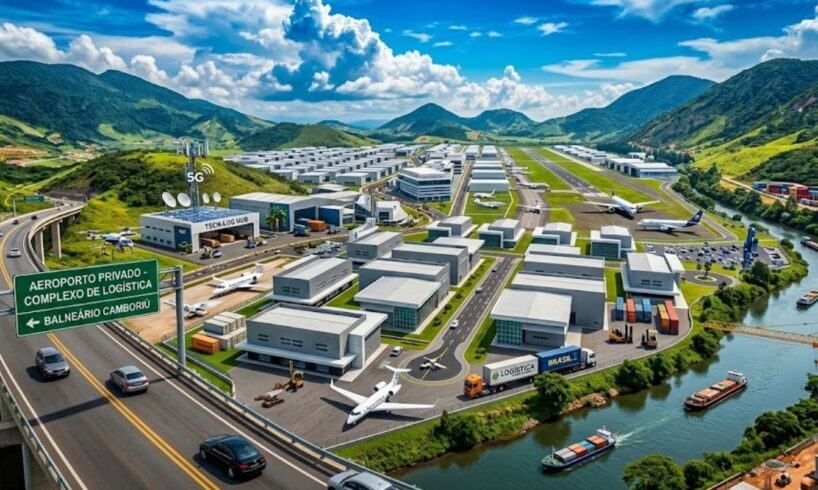
AeroPark Camboriú was presented as a project that combines a new private airport with a logistics and business complex. In practice, the proposal goes beyond a runway: it suggests an aviation and business “ecosystem,” targeting companies, logistics operators, and activities related to technology and economic innovation.
Image: AeroPark
What is striking is the ambition to reposition Camboriú within the regional map: not as a “neighboring city” of Balneário Camboriú, but as an operational platform.This type of project often attracts debate because it affects three areas simultaneously: air mobility, land use, and investment dynamics.
Where will the project be located and what is its planned scale?
The construction of the new private airport is planned for the Braço region, in an area announced as exceeding 2,2 million square meters. This size, in itself, indicates that the focus is not only on aviation in the strict sense, but on the creation of an economic activity zone connected to air transport.
In projects like this, location becomes a key element: it can bring production chains closer together, reduce travel time for certain types of operations, and create a “new” economic hub. At the same time, the scale also increases responsibilities. — especially with regard to licensing, impact mitigation, and integration with urban planning.
225 hangars, logistics and new businesses: what’s planned in the infrastructure?
Among the items disclosed, one number stands out: 225 planned hangars. This data signals the type of purpose sought for the new private airport: a structure capable of housing recurring operations, maintenance, aircraft storage and associated services, in addition to providing space for companies that depend on agile logistics.
When we talk about a “logistics-business complex,” the idea is precisely this: not to depend solely on passenger traffic, but to generate economic flow through services and support chains. Large-scale hangars often act as a magnet for business.Because they attract suppliers, service providers, transportation operations, and activities that benefit from fast connectivity.
The notion of innovation as a driving force also appears in the project’s discourse. In practice, this can mean anything from attracting technology-based companies to integrating with local entrepreneurship initiatives and parks focused on new economic activities. The crucial point is how this intention will translate into the final design, occupancy rules, and governance of the complex.
100% private investment and the “filter” of environmental licensing.
The financing model was presented as being entirely funded by the private sector, without the use of public resources, with an estimated investment of around R$ 800 million. This detail usually weighs heavily in the public debate for two reasons: on the one hand, it reduces pressure on the budget; on the other, it increases the demand for transparency and clear counterpart measures in the territory, especially when the project impacts urban infrastructure and the environment.
The most crucial step now is environmental licensing. It has been indicated that this process could take around 12 months, and only after that will a timeline for the start of construction be defined. This is the point at which large projects are often redefined.Studies, constraints, route adjustments, mitigation requirements, and environmental commitments can alter timelines, design, and even feasibility.
For the reader trying to understand “when it begins,” the most honest answer is: before any construction, there is the technical and regulatory phase. And, during this interval, the local discussion tends to grow, because it is there that decisions are made about how the project fits into the territory and what the compensation and control measures will be.
Expected impacts and inevitable doubts for Camboriú and neighboring Balneário Camboriú
The project’s creators anticipate an impact on job creation and economic activity, as well as stimulating new businesses. This is an effect frequently associated with logistics and airport hubs: they can attract investments, services, and supply chains, impacting commerce, service provision, and tax revenue linked to economic dynamism.
But a new private airport also raises questions that cannot be ignored and that, sooner or later, will become central to the public debate. Noise, traffic, pressure on roads, changes in land use and environmental effects. These are recurring themes, especially in regions with rapid real estate growth and strong tourist appeal, such as the area surrounding Balneário Camboriú.
There is also a layer of regional competition and complementarity: some of the public may see the project as an opportunity for economic diversification for Camboriú; others may question whether the city is prepared to absorb the side effects and whether there will be real integration with urban planning, transportation, and public services in the surrounding area.
Authorities at the launch and the “Nova Camboriú” package that came onto the radar.
The launch brought together authorities from the region, including the mayor of Balneário Camboriú, Juliana Pavan, and the mayor of Camboriú, Leonel Pavan. The presence of political leaders usually signals two things: institutional interest in the topic and a willingness to include the project in the regional development narrative.
At the same event, the “Nova Camboriú” project was also presented, featuring a set of urban initiatives such as a racetrack, a floodable park, a technology park, and three new planned neighborhoods. When several proposals appear together, the interpretation changes.It ceases to be just “an airport” and becomes a broader plan for urban and economic repositioning.
This doesn’t mean that everything progresses at the same pace or with the same level of maturity. On the contrary: each initiative has its own stages, licenses, costs, and controversies. Even so, presenting the project as a whole tends to influence expectations and also raise the bar for planning, transparency, and coordination between projects.
Next steps and how to follow through without falling for empty promises.
In the short term, the roadmap is clear: environmental permits, scope consolidation, technical adjustments, and only then a construction schedule. For those closely following the project, three practical signs are worth noting: progress in the licensing process, public detailing of the project phases, and clarifications on how the new private airport will integrate with mobility and land use in the Braço region.
It is also important to separate “concept” from “execution.” Projects of this scale are usually presented with a vision for the future, but they take on real shape when documents, formalized stages, and verifiable commitments emerge. The useful question isn’t just “will it transform?” but “how, within what timeframe, and under what rules?”
Finally, local debate tends to be more informed when it includes both sides: the opportunities (business, logistics, innovation, competitiveness) and the risks (environmental impacts, noise, traffic, urban pressure). The sooner these issues are discussed clearly, the greater the chance of balanced decisions, regardless of positions for or against.
The new private airport in Camboriú, with an estimated investment of R$ 800 million, a proposal for 225 hangars and integration into a logistics-business complex, is on the radar as a project that could shake up the regional economic axis, but it is still subject to environmental licenses and definitions that will shape what will actually come to fruition. The transformation, if it comes, will not be automatic: it will depend on implementation, rules, and coexistence with the territory.
With information from the portal ndmais.
And you, how do you see this movement? Could AeroPark be the economic turning point that Camboriú is looking for, or the risk of accelerating urban and environmental problems in a region already pressured by growth? Comment with your perspective, especially regarding traffic, noise, licensing, and real job and business opportunities.