Shafaq News
The expanding
confrontation between Iran, the United States, and Israel has done more than
draw Iraqi territory into a regional battlefield. It has laid bare a deeper
reality: Iraq currently lacks the structural capacity to enforce its own
sovereignty. Missiles and drones have crossed its airspace and struck sites
inside the country without a single confirmed interception from its defense
system, while Baghdad has issued no clear military posture or deterrent signal.
What this conflict reveals is not a temporary gap, but a systemic failure
rooted in how Iraq’s security architecture has been built since 2003.
Some Iraqi
officials and political figures argue that this absence of response reflects a
deliberate strategy rather than incapacity. In their view, avoiding direct
engagement in a confrontation between far more advanced military powers is a
rational choice aimed at preventing escalation. Yet this interpretation is
difficult to sustain when measured against the operational record. The lack of
even symbolic defensive action, no interception attempts, no declared alert
levels, no public assessment of damage, suggests not restraint, but an
inability to act.
Documented
Operational Failure
Since late
February, multiple incidents have demonstrated the same pattern. Drones struck
radar installations at the Basra Operations Command without any recorded
defensive response. Earlier attacks targeted the Taji base near Baghdad and the
Imam Ali base in Nasiriyah. In each case, Iraqi authorities neither signaled a
shift in military posture nor outlined a response plan.
These incidents
point to a critical absence: Iraq does not possess an integrated air defense
system capable of detecting, tracking, and intercepting incoming threats. Its
current air force inventory, including US-supplied F-16 fighter jets, French
Caracal helicopters, and South Korean T-50IQ aircraft, was not designed for
sustained airspace control or missile defense. There is no unified
command-and-control network linking these assets, and no operational surface-to-air
missile system of modern standard.
Political
analyst Ahmed al-Hamdani summarized the reality bluntly: “Iraqi military
capabilities have no meaningful role in this conflict, because the country
possesses neither the aircraft nor the air defense components required to bring
down hostile projectiles or enforce its own airspace.” The events of recent
weeks have reinforced that assessment.
Structural
Constraints, Not Just Neglect
The roots of
this deficit are not limited to underinvestment or mismanagement. Iraq’s
post-2003 security model was built primarily to address internal threats,
particularly insurgency and terrorism, rather than external defense. That
design has left the country ill-prepared for conventional or hybrid warfare
involving drones and precision-guided munitions.
External
constraints have compounded the problem. Security expert Ali al-Maamari points
to the 2008 US–Iraq Strategic Framework Agreement as a factor shaping
procurement decisions. According to his assessment, Iraq’s defense acquisitions
have largely been channeled through US-aligned systems, “limiting
diversification and complicating efforts to develop an independent supply
chain.”
At the same
time, Iranian influence within Iraq’s political and security institutions introduces
a parallel constraint. Tehran’s network of allied factions operates within
Iraq’s system, creating incentives to prevent the emergence of a fully
autonomous Iraqi military posture that could restrict their operational space.
Al-Maamari argues that this dual pressure has left Iraq unable to convert its
formal sovereignty into effective strategic autonomy.
It could be
argued that Iraq’s limitations stem primarily from internal fragmentation,
including corruption and institutional inefficiency. These factors are
undeniably significant. Yet repeated procurement failures and external veto
dynamics suggest that domestic dysfunction alone does not fully explain the
scale of the capability gap.
Spending
Without Capability
Iraq allocated
approximately $21.6 billion to its defense sector in 2024, a figure that raises
a more difficult question: how has a budget of that scale failed to produce
even a minimal air defense capability?
Political
science professor Issam al-Feyli of Al-Mustansiriyah University estimates that,
after accounting for salaries, pensions, and maintenance, Iraq’s effective
investment in modernization amounts to roughly one percent of the combined
military development spending of its immediate surrounding: Iran, Turkiye,
Saudi Arabia, and Israel. Each of those maintains integrated air defense
systems and, in most cases, domestic production capacity for drones and
advanced weapons.
Iraq’s
procurement record reflects repeated breakdowns. Efforts to acquire South
Korea’s M-SAM-II air defense system were never completed. Other deals with the
Czech Republic and Pakistan collapsed. Analysts attribute these failures to a
mix of corruption, political interference, and competing external pressures.
Al-Feyli notes
that Iraq’s position is uniquely vulnerable: “It exists within a profoundly
unstable geostrategic environment, surrounded by states whose military
capabilities exceed its own by orders of magnitude, and that are, at their
core, competing for influence over Iraq itself.”
Fragmented
Decision-Making
The military
gap is reinforced by political fragmentation. Security analyst Dr. Ahmed
al-Sharifi highlights two interconnected failures: the absence of a clear
deterrent posture from civilian leadership, and the inability of military
institutions to execute coordinated responses.
This
fragmentation became particularly visible when armed factions launched attacks
in the Kurdistan Region, where US forces were consolidating ahead of a planned
withdrawal. Rather than presenting a unified national stance, segments of
Iraq’s political leadership justified the attacks, framing US forces as
legitimate targets regardless of the federal government’s agreements.
Al-Feyli
observed that this response reflected a deeper problem: “Some parties effectively
endorsed the bombardment without acknowledging that those forces were
withdrawing under a federal agreement.” The issue, he suggests, is not a policy
disagreement but a fundamental lack of consensus on what constitutes Iraq’s
national interest.
Capability
Versus Perception
According to
the 2026 Global Firepower Index, Iraq ranks sixth in the Middle East in terms
of military strength. However, this ranking is based on aggregate indicators
such as personnel numbers and equipment inventories, not on operational
integration or readiness.
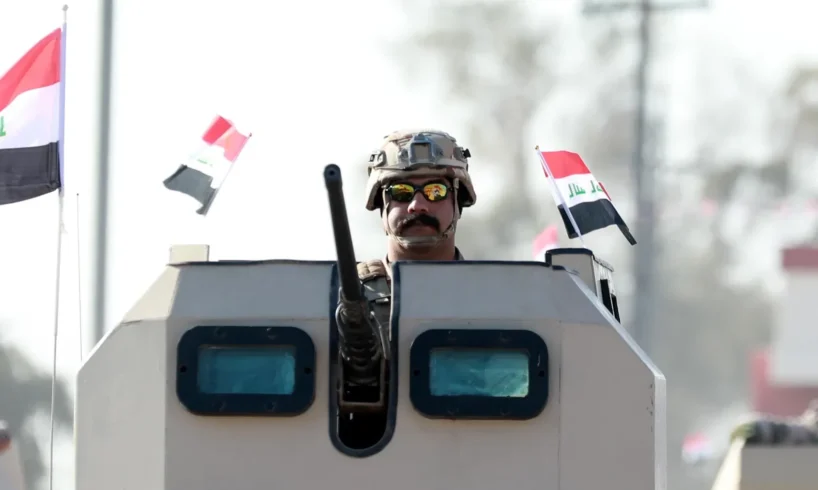
Iraq fields
approximately 193,000 active personnel and 100,000 paramilitary forces, along
with a mix of Soviet-era and Western equipment. Yet the absence of an
integrated air defense system, combined with fragmented command structures,
significantly reduces the effectiveness of these assets.
Even if Iraq
possessed more advanced systems, it is not certain that it could fundamentally
alter the outcome of a confrontation involving technologically superior powers.
However, the issue is whether Iraq can impose any cost at all or assert basic
control over its territory. At present, the evidence suggests it cannot.
Strategic
Choices Ahead
As the
September 2026 deadline for the withdrawal of US forces approaches, Iraq faces
a narrowing set of strategic options. Broadly, three paths are emerging. The
first is continued reliance on external security arrangements, particularly
those tied to the United States. The second involves partial realignment toward
regional powers, a move that carries its own risks of dependency. The third,
and most challenging, is the pursuit of an autonomous deterrence capability
built on internal political consensus and institutional reform.
None of these
options can succeed without addressing the core issue: Iraq’s strategic problem
is the absence of political cohesion and autonomy required to translate those
resources into effective power.
The current
conflict has exposed these vulnerabilities in real time. Airspace violations
without interception, strikes without response, and a fragmented political
reaction have together provided a documented record of a state that remains,
despite its formal sovereignty, unable to defend its own territory.
Read more: Iraqi Army after US-led Coalition withdrawal: Can Baghdad achieve full military sovereignty?
Written and
edited by Shafaq News staff.