Authors: Serhiy Mikhalkov, Nataliya Romanyshyn, Serhiy Zhukov, Serhiy Odarenko, Nadia Kelm
Parliamentary elections will be held in Hungary on April 12. The election campaign is extremely fierce. Orbán, who risks losing the race, has made his main bet on hatred toward Ukraine. Accordingly, his election campaign and controlled media constantly produce accusations against Ukraine. We analyzed the content of major pro-government media and identified the main themes they produced regarding Ukraine and Zelenskyy.
For the study, we analyzed materials posted on Hungarian websites between January 1 and March 11, 2026.
If we describe the entire election campaign jokingly, we can say that Hungarians are choosing between Orbán and Zelenskyy. Pro-Orbán agitation revolves precisely around the Ukrainian president.
Orbán’s propaganda machine uses a classic strategy – create an external enemy (this role was given to Ukraine), turn it into an internal threat, and appoint Viktor Orbán as the savior of Hungarians and Europe.
Texty.org.ua and the Center for Strategic Communications SPRAVDI conducted a joint study to find out how anti-Ukrainian narratives are used during the parliamentary election campaign in Hungary. The result proved indicative: Hungarian government propaganda actively plays the “Ukrainian card,” reproducing well-known techniques of Russian disinformation: fakes, escalation and distortion of facts.
The “Conspiracy” of Brussels and Kyiv Against Budapest
Hungarian pro-government media often promote the idea that the country’s main enemy is not Russia, which is waging war against Ukraine, but a very specific axis: Brussels, Kyiv and the Hungarian opposition. And they allegedly act in coordination to overthrow Viktor Orbán and drag Hungary into war.
This narrative contains several disparate theses that together form a coherent conspiratorial worldview. Particular attention is paid to Zakarpattia Oblast Council deputy Roland Tseber, whom the Hungarian authorities expelled from the country with a ban on entry. And they emphasize that he previously had dual citizenship of Ukraine and Hungary, but renounced the latter in 2017. Stories about Tseber, together with the broader theme of election interference, are very common in the Hungarian media space.
According to the version of Hungary’s ruling party Fidesz, Tseber is Zelenskyy’s official representative in Zakarpattia, and he allegedly organized the trip of Hungarian opposition leader Péter Magyar to Kyiv and his meetings with Ukrainian military and politicians. By the way, Magyar himself and his party “Tisza” are presented not as an independent political force, but as a tool of external forces.
Pro-government media, primarily Origo and Mandiner, wrote about a tax service investigation into money laundering, hinting that “Tisza” may be involved in this. Propagandists claimed that the opposition allegedly received millions of euros for elections from Ukraine through secret channels organized by Tseber. They provided no evidence, but tried to create the impression that Péter Magyar is a puppet of Kyiv, financed from smuggled cash and gold transported across the border.
These publications did not cite any specific facts; instead they used vague formulations like “according to sources” and “according to the publication.” The sources there are generally quite dubious. At the same time, these same media quoted the leader of the parliamentary faction of the ruling party Fidesz, Máté Kocsis, who, referring to intelligence data, claimed that Tseber was allegedly connected with Ukrainian intelligence. Although in reality the original source of this legend was the Russian Telegram channel “Rybar,” whose “analysis” was retold by the Hungarian side in their own way, and some independent Hungarian media spread it without verification.
Widely circulated were statements by Ukrainian analyst Serhiy Stukanov, recorded on video. He claimed that if Magyar comes to power, he will follow Brussels’ instructions and help Ukraine continue the armed conflict. Orbán’s publications presented this as an exposé, although in reality this was the opinion of an individual analyst, not Kyiv’s official position.
They also actively referred to the statement of Manfred Weber, leader of the European People’s Party, which “Tisza” looks to. He said that the EPP cooperates only with political forces that support Ukraine. Hungarian propaganda interpreted this as an ultimatum: Magyar is obliged to defend Ukrainian interests. In the analyzed materials, Weber is mentioned exclusively in a negative context as the “chief lobbyist” of Kyiv’s interests in Brussels. His name has become almost synonymous with external pressure on Hungary.
Hungarian propaganda generally tried in every way to factor Russia out. They say the source of the “conflict” should be sought in the “Brussels-Kyiv coalition,” which benefits from the war not ending.
A separate topic is the blocked EU loan for Ukraine for 90 billion euros. Pro-government media explained the Hungarian veto not as an obstacle for Kyiv, but as protection from being drawn into endless war financing. Orbán’s government transmitted this idea as follows: if Magyar wins, Hungarian money will go to war.
Another technique is to take Zelenskyy’s statements about Ukraine’s accession to the EU by 2027 and present them as proof that Kyiv wants to drag Hungary into war through EU expansion. Orbán’s propaganda calls the idea of Ukraine’s faster accession without fulfilling all requirements a “Brussels trap.”
Finally, pro-government media regularly suggested that if “Tisza” comes to power, Hungarian soldiers will find themselves on the front. To confirm this, they cited statements by “Tisza” defense expert Romulus Ruszin-Szendi that Hungary is not threatened by war. Propagandists presented this as an irresponsible downplaying of danger.
Zelenskyy — Hungary’s enemy
Among all the foreign politicians mentioned by Hungary’s pro-government media, Zelenskyy features prominently. Every mention of him carries the same undertone: he is not the president of a neighbouring country at war with an aggressor, but a personal enemy of Hungary and its prime minister.
The central episode, which Hungarian propaganda actively exploited, was the statement about revealing Orbán’s home address. The pro-government media presented it as follows: Zelenskyy personally threatened to pass on the Hungarian prime minister’s address to the military so they could ‘talk to him in his own language’.
Added to this were the remarks of Yevhen Karas, a major in the Ukrainian army and leader of the far-right organisation C14, whom Zelenskyy had previously awarded. His words that a Ukrainian brigade could be in Hungary within minutes if Orbán admitted to being a KGB agent became the subject of pro-government publications. Origo and Mandiner published articles under headlines about “invasion” and “Nazi threats”.
Overall, a considerable amount of coverage was devoted to the theme of “unprecedented threats” against Viktor Orbán, in which the Ukrainian leadership was portrayed as an aggressive force seeking to physically remove the Hungarian prime minister.
In the Hungarian media, corruption in Ukraine always has one face — Zelenskyy. The propaganda does not accuse the abstract authorities or individual officials; it attacks the president personally. And it uses two main narratives.
The first was the ‘golden toilet’. According to Hungarian media reports (though Ukrainian journalists also covered the story), a gold-plated toilet was discovered in the flat of Zelenskyy’s business partner, Timur Mindich. And alongside this ‘highlight’, they immediately added that the President of Ukraine had celebrated his birthday in this flat during the pandemic. This was intended to convince Hungarians that the Ukrainian leader is a typical corrupt oligarch wallowing in luxury.
The second was the ‘gold convoy’. Propagandists set about promoting a story orchestrated by the Hungarian authorities regarding the detention of Oschadbank’s cash-in-transit vehicles, which, in accordance with interbank agreements, were transporting cash and gold bars from Austria’s Raiffeisenbank to Ukraine (before the war, such bank transfers were carried out by plane; now they are by land transport).
Orbán’s propaganda presented this as proof of the existence of a ‘Ukrainian military mafia’, claiming that Western financial aid is not going to the front line but is ending up in the pockets of Zelenskyy’s inner circle. Such attention to the incident proves once again that it was artificially created to be woven into the election campaign. Incidentally, the Hungarian authorities never returned the funds, and Oschadbank considers them to have been stolen.
Zelenskyy was also subjected to persistent accusations that it was in his interest for the war not to end. Pro-government media outlets stated outright that he and certain sections of the European elite were clinging to power solely because of the conflict, and that any peace initiative therefore posed a threat to them. Zelenskyy’s statements about joining the EU by 2027 were also framed in this context, with the suggestion that he does not so much want to integrate as to drag Hungary into the war through the shared defence and security obligations of EU member states. Pro-government media even coined a special term for this: the ‘Brussels trap’.
They also tried to intimidate Hungarians with economic consequences. They claimed that local farmers would lose markets, and that every family would be forced to pay over 1.3 million forints towards the reconstruction of the neighbouring country. The narrative about the financial burden and the figure of “800 billion” (allegedly the total bill for Hungary’s reconstruction) appeared in a series of publications by the media outlets analysed.
In each such piece, the costs were linked to Zelenskyy’s name as the initiator demanding this money. At the same time, the suggestion was made that under such conditions, Hungarian soldiers would inevitably end up on the front line. This final argument was promoted most aggressively by the publication Origo, which drew a direct link between financial aid to Ukraine and Hungary’s direct involvement in the war.
A voice from Ukraine was also added to the overall picture. The media willingly quoted Zaluzhny’s criticism of the President’s Office for the failed 2023 counteroffensive and interference in operational decisions. This was presented as confirmation that even their own generals know that Zelenskyy is leading the country into the abyss.
Against the backdrop of the oppressive image of Zelenskyy, Orbán himself in pro-government Hungarian media appears as the “last defender of common sense” in Europe.
Kyiv’s “Energy Blackmail”
To form a sharply negative image of Ukraine, pro-government Hungarian media build a narrative about “energy blackmail,” which Kyiv allegedly resorts to in order to interfere in elections. Key plots include speculation around the “political blocking” of the Druzhba pipeline, as well as accusations against Ukraine of attacks on the infrastructure of TurkStream and Blue Stream. Both are channels for supplying gas from Russia to Turkey, which through TurkStream reaches Hungary, Slovakia, Serbia.
The motive attributed to Ukraine and Volodymyr Zelenskyy personally is quite simple: to strike at the welfare of Hungarians (and at Viktor Orbán’s and Fidesz party’s rating) by provoking an energy crisis and rising prices in Hungary. And thus help bring the opposition party “Tisza” led by Péter Magyar to power.
Pro-government media categorically transmit officials’ statements about Ukrainians’ unwillingness to restore gas supplies through Druzhba and to allow foreign inspectors to inspect the pipeline.
Accusations of attacks on TurkStream and Blue Stream infrastructure are synchronized with Russia’s information campaign: media loyal to Orbán spread Putin’s and Peskov’s statements about the FSB having “reliable information” about sabotage preparation. Ukraine is depicted as a state ready to strike at the energy security of EU and NATO countries to drag them into direct armed confrontation with Russia.
These suspicions are reinforced by materials published in Hungarian media about Ukrainian intelligence’s involvement in the sabotage of Nord Stream, which Germany is now investigating. The undermining of Russian pipelines is interpreted as an “act of state terrorism” and a blow to the European economy. Speculation on this topic in the Hungarian information space is used by supporters of stopping support for Ukraine (which allegedly harms EU economic interests) as additional “proof” of its readiness to stop gas transit through Turkey as well.
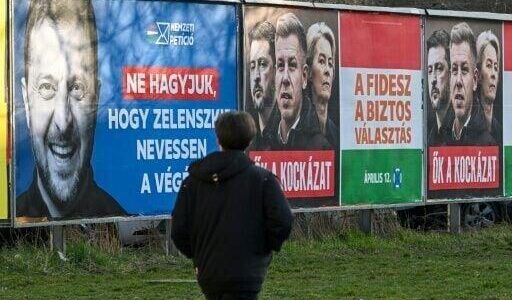
Calls to vote ‘correctly’ in the 12 April election. The text on the poster on the left: ‘We won’t let Zelensky have the last laugh!’. A reference to the proverb ‘He who laughs last laughs best’. The text on the poster on the right: ‘They are a risk; Fidesz is the safe choice’.
February–March 2026.
A tram stop with posters (24 February 2026) against the backdrop of the Chain Bridge in Budapest, illuminated in blue and yellow as a sign of solidarity with Ukraine (a gesture by Budapest City Council). Typical slogan: ‘A message for Brussels — we will NOT pay!’.
Summer–autumn 2025. The slogan: ‘Together for war’.
December 2025. One of the most provocative posters to emerge amid the corruption scandal in Ukraine. Zelenskyy, von der Leyen and Madyar are pouring money into a golden toilet.
The evolution of the campaign. 1. The rational phase (spring 2025) → ‘Ukraine — an economic risk’. 2. Personalisation (summer 2025) → “Zelenskyy = the Hungarian opposition”. 3. Emotional escalation (autumn 2025) → “War, fear, external threat”. 4. Dehumanisation (late 2025) → “Caricatures, humiliation”. 5. Final message (2026) → “Ukraine will take your money”, “Ukraine will cheat you”. SPRAVDI Centre for Strategic Communications
The Zakarpattia Argument
The issue of mobilization in Ukraine and the situation of the Hungarian community of Zakarpattia are increasingly being integrated into Orbán’s information pre-election policy. And not as separate topics, but as parts of a holistic picture. In this picture, Ukraine appears not simply as a state at war, but as a systemically problematic space where human rights violations are allegedly the norm, and national minorities are victims.
This framework is reinforced by the language of dehumanization that sets the tone in the news. Ukrainian military and recruitment center workers are called “Zelenskyy’s kidnappers,” and mobilization is called “hunting people”: “Zelenskyy’s kidnappers do not consider their compatriots human. During forced mobilization, recruiters treat their victims almost like animals.”
Then the already familiar logic is employed: isolated incidents (often without confirmation or context) are scaled up to the system level. They are presented as the rule, not the exception. Videos from social networks play the role of “proof,” although their verification remains outside the brackets. As a result, emotion displaces analysis, and impressions displace facts.
Against this background, the image of Ukraine is built as a state where mobilization is permeated with inequality and abuses. Corruption determines who will serve. Wealthy citizens avoid the front, while socially vulnerable groups are “sent to death”: “In Ukraine there is still a significant solvent layer capable of securing protection.” The best counter to such propaganda is changes in the mobilization system. We hope that the changes announced by Ukraine’s Minister of Defense Mykhailo Fedorov (the Ministry of Defense announced that reforms are being developed but have not yet been made public) will change the mobilization situation and it will cease to be a profitable background for enemy propaganda.
Special emphasis is placed on stories of Hungarians of Zakarpattia who allegedly become victims of systematic pressure: “The issue of forced mobilization is particularly acute for the Hungarian community of Zakarpattia. Over the year, the local community has been shaken by several fatal cases.” Such cases are presented through personal stories with specific names and details of tragedies. Gradually, from them a generalized image of the Hungarian minority as a victim of state policy is formed, which gives grounds to speak of “systematic persecution”: “Currently, 80 Hungarian victims from Zakarpattia are known, among whom there are those who died not at the hands of the enemy, but after training camp.”
Another important element is added to this picture – the role of the EU. Brussels is depicted not at all as it actually is. In reality, European officials constantly encourage Ukraine to fight corruption and make other positive changes. But Orbán’s propaganda presents Brussels as an accomplice: “While Ukrainian authorities and the Brussels elite turn a blind eye to abuses, their consequences become increasingly tragic.” A contrast is drawn between “indifferent” Brussels and “effective” Hungary.
In this narrative, Viktor Orbán appears as a consistent defender of Hungarians abroad. His policy is described as a rational and principled response to systemic violations: “Relations between the two countries were tense even before the war due to the minority language law and education reforms. However, the conflict gave disputes a new dimension. Diplomatic dialogue has been interrupted more than once. Negotiations on minority rights in 2025 also reached a dead end. Hungary vainly applied all diplomatic means in the UN, OSCE and EU – Kyiv did not back down and eventually introduced rules that violate the rights of the Hungarian minority.”
A cultural tool is also used to emotionally reinforce this optic – the supposedly documentary, but actually propagandistic film by Ádám Tősér “Ominous Proximity” (“Baljós közelség”). Its promotion is accompanied by dramatic descriptions: “The documentary film ‘Ominous Proximity’ takes us behind the front line, as well as to multinational Zakarpattia, which is called ‘little Switzerland’ and which was destroyed by Petro Poroshenko’s nationalist policy. The hate campaign against the Hungarian and Russian minorities and language restrictions violated peaceful coexistence. The people hated Poroshenko so much that, as one of the heroes of our film says, they would have elected even a goat instead of him.”
The film acts not only as an illustration, but as part of a broader media ecosystem.
At the same time, the image of Hungary as a defender of the Hungarian community of Zakarpattia and generally a benefactor to all Ukrainians is being formed: “The Hungarian community of Zakarpattia could count on government support from the very beginning”; “Hungary continues to help the Ukrainian people. An ordinary Ukrainian does not look at how his government treats Hungarians and what steps Budapest takes in response, but gratefully accepts Hungarian aid for four, or even twelve years.”
This image is reinforced by the narrative of Kyiv’s “ingratitude,” which allegedly explains Budapest’s political harshness.
The next step is a careful expansion of the framework. In pro-government media, hints appear about a possible revision of Zakarpattia’s status: “After the collapse of the Soviet Union, Hungary was one of the first to recognize Ukraine… and even did the young country a favor by not raising… the question of Zakarpattia’s status…” Historical arguments here perform the function not so much of explanation as of legitimizing alternative scenarios.
This logic is eventually transferred to Hungary’s internal politics as well. It is claimed that even the Hungarians of Zakarpattia support Orbán: “Based on information leaked from the SBU, Ukrainians assessed the electoral preferences of the Hungarian community of Zakarpattia and discovered ‘alarmingly high support for Orbán.’” Then the next thesis appears about Ukraine’s alleged interference in elections: “According to shocking documents, Kyiv is compiling lists of Hungarians of Zakarpattia, intends to annul 40% of votes cast by mail, and also send Orbán supporters to the front”; “Zelenskyy’s plan for influencing elections in Hungary became known: they are going to falsify elections in favor of the Tisza party.”
Тexty.org.ua
If you have found a spelling error, please, notify us by selecting that text and pressing Ctrl+Enter.