Shafaq News
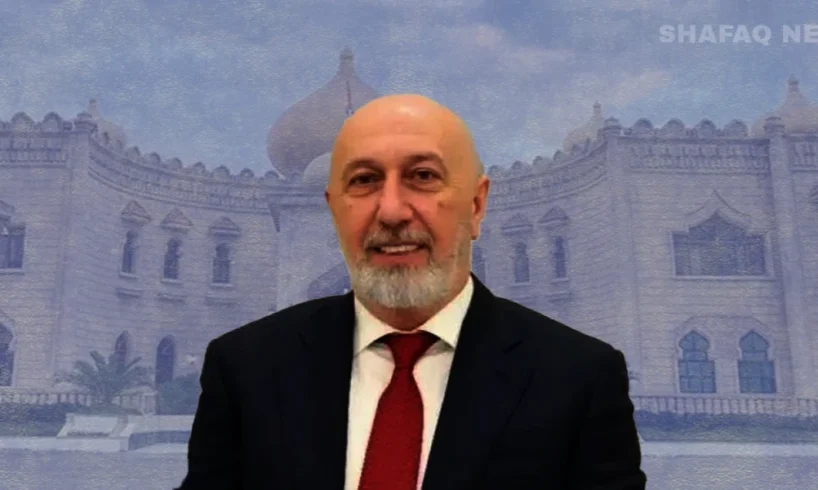
Nizar Amedi’s
election as Iraq’s sixth president on April 11 settled one constitutional
question and opened a harder one. The 227 out of 329 votes that carried him to
the Palace of Peace were a cross-sectarian coalition demonstrating, in public
and on the record, that it has the numbers to claim the premiership. The blocs
that boycotted read the session the same way, and Iraq’s next political battle
began the moment the vote was counted.
Under Iraq’s
post-2003 constitutional architecture, the presidency is a gatekeeper rather
than a seat of power. Its occupant holds limited executive authority but
performs a pivotal function: once elected, the president formally tasks the
largest parliamentary bloc with nominating a prime minister —the Shiite figure
who will actually govern. Therefore, the real prize in Saturday’s session was
the political signal embedded in who showed up, who stayed away, and what that
alignment portends for the premiership contest now formally underway.
The Man and the
Moment
Amedi, born in
Al-Amediya in the northern province of Duhok in 1968, is a figure whose career
has been built inside Iraq’s presidential institution rather than above it. A
mechanical engineering graduate from the University of Mosul, he served as
chief of staff to three consecutive presidents —the late Jalal Talabani, Fuad
Masum, and Barham Salih— before heading the Patriotic Union of Kurdistan’s
(PUK) political bureau in Baghdad. He later served as environment minister
before resigning in 2024 to focus on party work. His profile is that of an
institutional insider: a man who knows how the presidency is operated from
within, who has navigated its relationships with Baghdad and Erbil across
multiple administrations, and who carries no political weight heavy enough to
threaten the factions that backed him.
That profile
was precisely what made him viable. In a political moment defined by competing
ambitions and external pressure, Amedi’s election represented a
lowest-common-denominator consensus —not the most powerful candidate available,
but the most acceptable one to a coalition with incompatible objectives. Iraq’s
post-2003 tradition reserves the presidency for a Kurdish figure, most often
from the PUK. That convention was held on Saturday. What did not hold was any
illusion that the presidency resolved the deeper impasse.
The Coalition
That Voted —and What It Was
The 227 votes
that secured Amedi’s election in the second round did not emerge from a unified
political project. They were assembled from blocs whose common ground begins
and ends with opposition —even implicit opposition— to the candidacy of former
Prime Minister Nouri al-Maliki, formally nominated by the Shiite Coordination
Framework —Iraq’s largest parliamentary bloc— for the premiership in January
2026.
The attending
coalition spans Iraq’s three main political communities. On the Shiite side,
al-Sudani’s Reconstruction and Development coalition, which won 46 seats in
November’s elections, formally endorsed al-Maliki as the Framework’s nominee while
simultaneously positioning al-Sudani for a second term— a dual track that
Saturday’s session brought into the open. The Sadiqoun movement —political wing
of Asaib Ahl al-Haq, an Iran-aligned paramilitary force— contributed 27 seats,
with Ammar al-Hakim’s al-Hikma Movement and Hadi al-Amiri’s Badr Organization
adding 18 seats each. On the Sunni side, Mohammed al-Halbousi’s Taqadum party
delivered 33 seats. The PUK’s 15 seats completed the Kurdish share.
The composition
matters because it is cross-sectarian on both sides of the divide. The blocs
that attended were not a Shiite majority forcing a Kurdish figurehead through
—they were a Shiite-Kurdish-Sunni coalition operating against a
Shiite-Kurdish-Sunni opposition.
The old
analytical shorthand that frames Iraq’s political deadlocks as sectarian
collisions does not apply here. Both camps carry multi-ethnic credentials. What
separates them is competing calculations about who controls the next
government.
The blocs that
stayed away delivered an equally clear message. Al-Maliki’s State of Law
coalition, holding 29 seats, boycotted the session outright —a refusal to
participate in a political exercise from which it had been effectively
excluded. The Kurdistan Democratic Party (KDP), the largest Kurdish bloc in parliament
with 26 seats, also stayed away, having demanded that its own candidate,
Foreign Minister Fuad Hussein, be installed in the presidency race. The al-Azm
Alliance, a Sunni bloc with 17 seats that had publicly declared its support for
al-Maliki’s premiership bid in January, joined the boycott as well.
The al-Azm
Alliance’s position contains an internal contradiction worth flagging. Its
lawmakers had previously declared al-Maliki “the best option for Sunnis
before Shiites at this stage,” yet boycotted a session whose outcome —if
it produced a functioning government coalition— would marginalize precisely
that candidacy. The boycott was a refusal to lend legitimacy to a
coalition-building exercise conducted on terms set by its rivals.
Raad
al-Dahlaki, an Al-Azm Alliance parliamentarian, told Shafaq News that the
obstruction of the presidential session had nothing to do with Kurdish
disagreements and everything to do with “political conflicts among
blocs” over the premiership. His framing confirmed that the session’s
presidential vote was a proxy battlefield for a premiership contest that had
been building since January.
The Framework’s
Fracture —and the Constitutional Bind It Creates
The Shiite
Coordination Framework, which holds about 185 of parliament’s 329 seats,
remains constitutionally positioned as the body Iraq’s new president must task
with nominating a prime minister. That designation has not changed. What has
changed is that a significant portion of the Framework’s own membership has now
participated in a political exercise that directly challenges the nomination
the Framework formally issued in January.
The Framework
nominated al-Maliki on January 24, but Al-Hakim and Al-Khazali expressed
reservations privately, Al-Ameri’s Badr Organization voiced hesitation, and
Al-Sudani’s camp endorsed al-Maliki, but quietly floated alternative names,
including parliamentary bloc leader Bahaa al-Araji. None of these objections
were formalized publicly —the Framework maintained surface cohesion while
fracturing beneath it.
The April 11
session ended that pretense, and the Framework is now split between the blocs
that participated in Saturday’s coalition and those that did not, and it is
formally being tasked with a premiership nomination that the blocs cannot agree
on.
CF member Abu
Mithaq al-Masari told Shafaq News that even if Amedi formally tasks al-Maliki
with forming a government, securing parliamentary confidence would not be
automatic, warning that political legitimacy requires broad consensus rather
than numerical advantage alone. “The government will not pass if it fails
to secure agreement,” he said.
A source close
to Sunni political forces echoed the warning, telling Shafaq News that if the
prime minister-designate fails to win support across parliamentary blocs, the
constitutional deadline could expire without a confidence vote, forcing a
political reset.
External Veto
and the al-Maliki Equation
Al-Maliki’s
candidacy has been shaped as much by external as by internal opposition.
Washington formally conveyed its objections through US envoy Tom Barrack during
a visit to Baghdad, and President Donald Trump publicly criticized al-Maliki’s
2006–2014 tenure —a period marked by the sectarian consolidation of state
institutions and the eventual collapse of Iraqi security forces before ISIS in
2014. A US State Department spokesperson told Shafaq News that during that
tenure, Iraq “descended into poverty and total chaos.”
Iran, whose
influence over Iraq’s Shiite political landscape runs deep, has a more
ambiguous position. Tehran views al-Maliki as a known quantity whose earlier
tenure, despite its failures, maintained Iraq’s alignment with Iranian regional
interests. But Iranian-aligned factions within the Framework, including
Sadiqoun and elements of Badr, participated in the coalition that voted for
Amedi, suggesting that Tehran’s preference for al-Maliki is neither
unconditional nor capable of overriding the internal arithmetic of its Iraqi
partners.
The Framework
has publicly insisted the premiership is “a purely Iraqi matter” and
that external pressure will not determine its nominee. Whether that position
holds as US pressure intensifies and the coalition assembled on April 11
consolidates around an alternative candidate will define the next phase of
negotiations.
What Cannot Be
Deferred?
Amedi now faces
the constitutional sequence that his election triggered: The Framework formally
tasked by the Parliament Speaker to nominate a prime minister within 15 days,
then, after approval, the new premier has 30 days to present a cabinet and
secure a parliamentary confidence vote. In practice, that timeline has never
been met in Iraq’s post-2003 history. The more immediate political reality is
that the Framework’s two factions —those who voted on Saturday and those who
boycotted— must either reconcile around a single nominee or one side must
prevail.
The attending
coalition controls approximately 155 to 160 seats. The boycotting coalition
controls approximately 110 to 115 —precisely the blocking third that, under the
Federal Supreme Court’s 2022 quorum ruling, can deny a confidence vote if it
holds together.
Al-Maliki’s
camp has demonstrated both the will and the arithmetic to do so. The coalition
that elected Amedi has demonstrated the same capacity in reverse. Iraq’s
government formation process has entered a phase in which neither side can
govern without the other, and neither side has yet offered the other a reason
to concede.
The country at
the center of these negotiations cannot afford to wait. Iraq’s caretaker
government —legally barred from passing budgets, signing major contracts, or
approving structural spending— is responsible for the salaries, pensions, and
welfare payments of more than nine million people. More than eight billion
dollars in infrastructure contracts sit frozen. The political class has
produced a system in which the costs of deadlock fall on citizens and the
incentives for resolution fall on no one.
Amedi enters
the presidency understanding its limits better than almost anyone in Baghdad.
Seventeen years inside the institution taught him how it is managed. The harder
lesson —how to use it to break a deadlock whose architecture benefits the very
forces he must now negotiate with— has no precedent in Iraq’s post-2003 record
to draw from.
Read more: Iraq Government Formation: The Constitution that cannot enforce its own deadlines
Written and
edited by Shafaq News staff.