Shafaq News- Baghdad
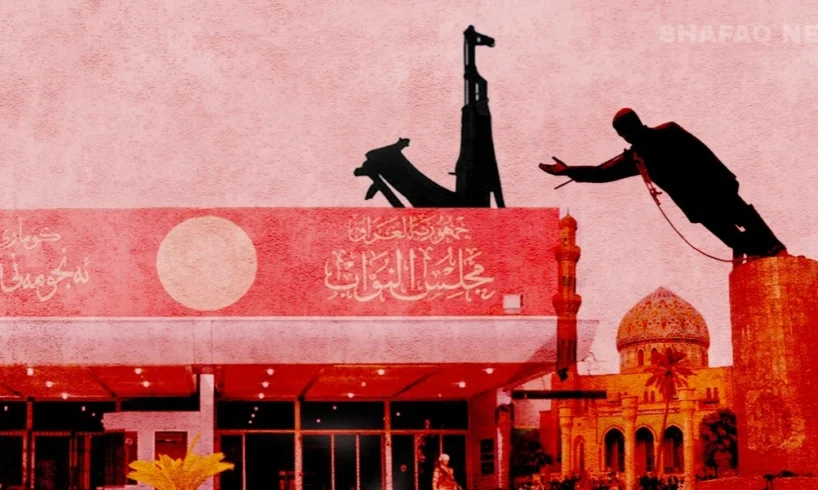
On April 9, 2003, American tanks rolled
into the heart of Baghdad, and Saddam Hussein’s statue fell. What followed
—twenty-three years of political turbulence, economic dependency, sectarian
fracture, and institutional fragility— is often described as a failure of
reconstruction.
The first and most consequential decision
came within weeks of the invasion. US Administrator Paul Bremer dissolved the
Iraqi Army, dismissed the ministries of Defense and Interior, and put
approximately 400,000 trained soldiers on the street without income, purpose,
or a state to serve.
Military expert Ali al-Maamari, speaking to
Shafaq News, does not reach for diplomatic language to describe what followed.
Bremer’s decision, he says, “was unjust” —it left Iraq in a state of
security anxiety and instability, directly enabling the rise of armed groups,
sectarian terror, and ethnic fragmentation. The vacuum did not stay empty as
Al-Qaeda and ISIS filled it.
The competition, rather than cohesion,
replaced the old order, fracturing it along the deepest available fault lines.
Fahd al-Jubouri, a senior figure in the Al-Hikma Movement led by Ammar al-Hakim
and a member of the Shiite Coordination Framework (CF), the dominant bloc in
Iraqi politics, describes the post-2003 transition as moving from “a
repressive dictatorial system to an unregulated democracy” that generated
continuous crises.
Over six electoral cycles, Iraqis chose
their representatives. But the act of voting did not dissolve the divisions the
new system had organized itself around —it institutionalized them.
Read more: New era of control: Can Iraq’s free press survive its politically-tainted rulers?
Al-Jubouri puts it plainly: a portion of
the Iraqi people lost their national identity. In its place rose sectarian,
ethnic, and partisan identities, visible everywhere, and nowhere more toxically
than on social media, where political disagreement collapsed into accusation.
One person is dismissed as a nationalist,
while another is labeled a traitor or a foreign agent. The vocabulary of
national debate became the vocabulary of mutual delegitimization. “We are
now in the middle of the road, trying to write the basic equation: a state that
sponsors and takes responsibility for every detail,” al-Jubouri says.
Whether that equation gets written depends,
he argues, on whether forces that benefit from a weak state can be contained.
The economy followed its own version of the
same logic. Economist Mustafa al-Faraj describes the post-2003 transition as a
move from one form of dependency to another. Iraq exchanged the constraints of
international embargo for near-total reliance on oil, which now accounts for
roughly 90 percent of government revenue and 95 percent of exports, according
to World Bank and IMF estimates.
Youth unemployment approaches 30 percent.
Public sector salaries and pensions consume more than half of national spending
—a pattern the World Bank has repeatedly flagged as unsustainable.
Read more: Youth in despair, no jobs to share: Iraq’s workforce hanging in the air
The import liberalization that followed the
invasion compounded the problem in ways that receive less attention than they
deserve. Al-Faraj considered that opening the market “whetted the appetite
of traders and neighboring countries at the expense of the local
producer.”
With the agriculture hollowed out and the
industry stalled, the public sector expanded to absorb labor that a productive
economy would have generated differently.
Iraq sits on some of the world’s largest
proven oil reserves and cannot reliably power its own cities, having spent more
than $80 billion on electricity infrastructure since 2003, according to the
Ministry of Electricity, with daily shortages still the norm.
The media landscape underwent its own
transformation, expansive in form, contested in substance. Media academic
Haidar Shallal describes the shift from a single state broadcaster to a
fragmented ecosystem of more than 100 satellite channels and hundreds of radio
outlets as genuine but incomplete.
The technology created space; professional
and regulatory frameworks did not keep pace. The new emergence, Shallal argues,
became “an arena of conflict between political, religious, and social
forces” rather than a public sphere.
Iraq now ranks 155th globally in press
freedom, according to Reporters Without Borders, which has recorded more than
340 journalist deaths in the country over three decades —the highest of any
city worldwide for Baghdad. Shallal’s prescription is spare and pointed: Iraq
needs media that “calms souls rather than terrifies them.”
Zooming out from the domestic, political
science professor Issam al-Feyli of Al-Mustansiriya University places 2003
within a longer geopolitical rupture. The fall of Saddam Hussein’s regime, he
pointed out, was “the beginning of the New Middle East project” —one
whose consequences extended far beyond Iraq’s borders, contributing to the
peaceful collapse of other regional governments, enabling expanded Israeli
diplomatic presence across the Arab world, and draining the economic capacity
of states through sustained internal conflict.
Al-Feyli draws the comparison explicitly:
what 2003 set in motion rivals the Sykes-Picot Agreement of 1916 in its
reordering of the regional map.
Twenty-three years on, Iraq is neither
collapsed nor consolidated. Its institutions function under strain. Its
politics are active and divided, while its oil wealth is real and insufficient
to substitute for a functioning economy. The events of April 2003 did remove a
dictator, but also removed the architecture of a state and replaced it with
conditions that produced, reliably and logically, everything that followed.
Iraq, understood on its own terms, raises a
harder question: given those conditions, what could realistically have
succeeded?
Written and edited by Shafaq News staff.