Subscribe to support this work. If you aren’t subscribed yet, you can also join our Substack channel (same content) and redeem a single-use unlock for paywalled posts.
The Devil Wears Prada 2 is one of the major blockbusters of China’s popular May Day movie season. However, among Chinese audiences, discussions surrounding the Hollywood film have shifted from “Runway” to “racism”. What’s behind the controversy?
It’s almost the May Day holiday, and seventeen films are lined up for one of the most important box office moments of the year in China. One of them, the only major Hollywood film, is the American movie The Devil Wears Prada 2, the long-awaited sequel to the 2006 blockbuster starring Anne Hathaway and Meryl Streep.
Both actresses visited Shanghai for the film’s China premiere earlier this month, where attendees were shown the first 20 minutes. Early reactions were positive, online fans were enthusiastic, and all signs pointed to a strong box office run.
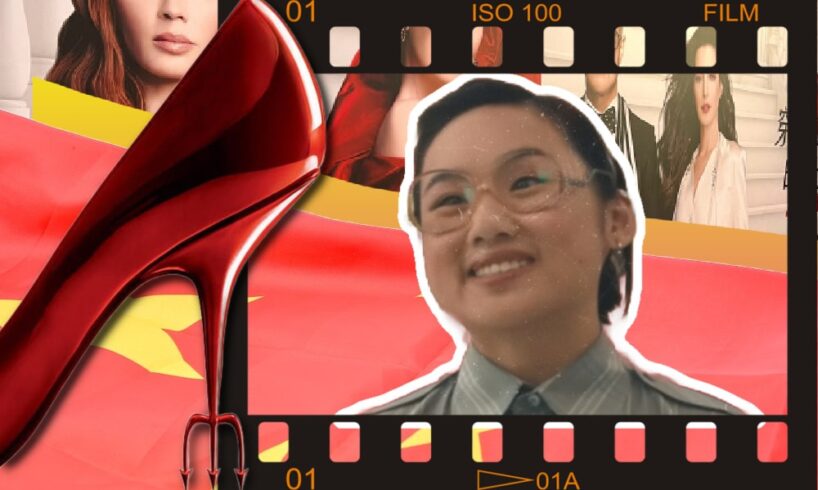
But that seemed to change this week as the film began facing online backlash. Reports emerged describing it as “racist” and “offensive” in China, focusing on the role played by Chinese American actress Helen J. Shen—namely, the new geeky office assistant, ‘Jin Chao.’
By now, the story of the film drawing “furious reactions” or even “facing a boycott” in China has been picked up by dozens of global media outlets, from The Guardian to the Global Times.
Collection of headlines about the backlash
But how big is the controversy, really?
Let’s first look at the story behind these headlines before diving into the bigger context.
From Niche Discussion to Global “Backlash”
Media reports about The Devil Wears Prada 2 facing backlash in China began circulating around April 17–18, when a promotional clip of the film was officially released, introducing the Asian or Chinese American assistant to Anne Hathaway’s character Andy.
In the clip, the petite and somewhat socially awkward young woman introduces herself as ‘Jin Chao’ and lists her academic credentials, including graduating from Yale with a high grade point average.
One of the earliest reports claiming there was major backlash came from entertainment blogger Mengshen Mumu (萌神木木), published on QQ News on April 18 under the headline: “The Devil Wears Prada 2 embroiled in anti-China controversy! Asian character portrayed stereotypically, name seen as deliberately offensive.”
China.com republished the same blog under the title “The Devil Wears Prada 2 Asian controversy: stereotypical portrayal sparks public outrage.”
The article claimed the movie was sparking backlash and calls for a boycott among “netizens” (网友), focusing on the character’s nerdy portrayal and her name, rendered as “Qin Chao” or “Qin Zhou” (秦舟). According to the author, its English pronunciation closely resembled “Ching Chong,” a historically racist term used to mock Chinese people.
It concludes: “At present, the film’s reputation appears to be on shaky ground, and its box office prospects in China may not be promising.”
Notably, the only evidence cited for this supposedly widespread backlash consists of a few screenshots of comments made by Douban users in a discussion group about the film.
That discussion—now private and inaccessible—appears to have been the basis not only for this article, but also for many of the Chinese, Korean, and international reports that followed, as they all trace back to the same China.com source.
This context matters. It suggests that the “backlash” was less organic than portrayed, and that media amplification played a significant role in turning a niche discussion—one that did not trend on major platforms like Weibo—into a narrative of nationwide outrage. That narrative was then picked up by international media and presented as the mainstream view of Chinese audiences.
Earlier, the same source published another article hyping a separate controversy surrounding The Devil Wears Prada 2, this time involving a pair of embroidered shoes gifted to the cast at the Seoul premiere. The piece suggested the design was traditionally Chinese and should not be labeled as Korean, accusing Korea of cultural appropriation. Although this gift had nothing to do with the movie itself, it was dragged into the film’s potential box-office success, creating a storm in a teacup because controversial topics do well in terms of clicks.
Beyond the media’s role in fueling the current “Ching Chong” storm, there are other factors that help explain why this issue remained relatively limited before being amplified.
👉 The name itself is not necessarily offensive.
There is considerable confusion over the character’s name, which plays a key role in the controversy due to its alleged discriminatory connotations.
The Chinese subtitles render the name as Qin Zhou (秦舟), while in the scene it sounds more like ‘Jin Zhao,’ and the role is listed on IMDb as ‘Jin Chao.’ Others have suggested it sounds like ‘Chin Chou,’ which could resemble “Ching Chong.”
One of Weibo’s most influential movie-related accounts (@格兰芬多公共休息室) addressed the issue on April 19 by directly contacting the film’s translation team. According to their report, the correct name is ‘Jin Zhao,’ and the rendering as Qin Zhou (秦舟) appears to be a translation error.
In Chinese naming conventions, the family name comes first, meaning ‘Jin Zhao’ would be written as Zhao Jin (赵瑾)—a fairly standard and unremarkable name.
👉 Many Chinese would not immediately link this name to an offensive slur.
Not only is the character not actually named “ching chong,” the term itself originates as a mocking imitation of Chinese languages within an English-speaking context.
Although in today’s global media environment, many Chinese audiences are aware of the term, it is primarily understood as a form of English-language racism directed at Chinese-speaking people by outsiders, not as something rooted within Chinese linguistic or cultural contexts.
Interestingly, while English-language media reports suggest Chinese audiences are outraged, some Chinese commentators argue that much of the anger is actually coming from Korean and other international internet users. Chinese outlet Guancha even reported—in a now-deleted post—that the controversy itself was largely driven from outside China.
All of this has led to a situation where, despite a week of headlines describing “waves of netizen anger” and “boycotts sweeping the internet,” the “Ching Chong controversy” itself has not, at the time of writing, generated widespread outrage across Chinese social media platforms. Many related posts have received minimal engagement.
Although many viewers agree that the screenwriters might have chosen a more flattering name than Jin Chao or Jin Zhao, there is little to suggest this was deliberately intended as offensive, nor that it was widely interpreted as such by Chinese audiences.
The “Pocket Asian” Problem
However, this initial controversy has prompted many Chinese commenters to look beyond the name and focus on what they see as the real issue with Jin Zhao’s character. In the run-up to the film’s release, these discussions have been gaining traction online.
One Weibo commenter wrote:
💬 “Even if ‘Jin Chao’ and ‘Ching Chong’ don’t sound exactly the same, this Asian character’s portrayal really couldn’t be more outdated… it feels like the director has never seen what real Asian interns in the fashion industry are actually like.”
Another post asking users how they felt about the controversy received thousands of likes, with many commenters expressing disappointment over how the film’s most visible Asian character is portrayed.
This criticism seems to be widely shared. In a fashion-focused film, Jin Zhao stands out as the least fashionable—wearing a plaid shirt and skirt, hair pinned up, thick glasses—making her appear almost like a caricature among the surrounding “urban sophisticates.” For many viewers, this feels like a familiar stereotype that does not reflect the reality of today’s trendy Gen Z city girls.
A recurring sentiment is that while Hollywood—and companies like Disney, the film’s distributor—relies heavily on the Chinese market, Chinese audiences themselves feel they are not being taken seriously.
On April 22, Weibo author Jokielicious published a post (now with over 9,600 likes, 257 comments, and 773 shares) explaining the concept of the “Pocket Asian” (口袋亚洲人), an online slang term that has circulated for some time.
It refers to a type of physically small, non-threatening Asian character often seen on Western social media, where people jokingly describe Asian friends as “small enough to fit in your pocket.”
According to the author, this “Pocket Asian” is also a recurring figure in Hollywood films: typically subordinate to the white protagonist, often cast as an assistant or sidekick, embodying familiar stereotypes—comically awkward, unobtrusive, and non-threatening.
Although The Devil Wears Prada 2 has not yet been officially released in cinemas at the time of writing, assistant Jin Zhao is already seen by some as a textbook example of this trope: petite, deferential, yet also a hardworking overachiever.
In the promotional clip, she introduces herself by listing her credentials:
“If you don’t want me, you can interview someone else. That’s totally fine. I did go to Yale, 3.86 GPA, lead soprano of the Whiffenpoofs, and my ACT score was 36 on the very first time.”
According to Jokielicious, this fits the “Pocket Asian” mold perfectly: depicting Asian women as petite and cute, yet also toy-like or accessory-like, something to be “carried” or “used.” For critics, this goes beyond harmless “cuteness,” reducing a person to a racialized physical symbol: small, agreeable, and easily controlled.
One Weibo commenter (@霄林龙松兆) drew a historical parallel:
💬 “Does everyone remember the standard ‘dwarf’ figure in Elizabethan court dramas? Now this type of role has become a ‘symbolic dwarf,’ but the core function remains the same: obedient, somewhat intelligent and entertaining, small in stature, controllable—summoned at will and dismissed just as easily. The difference is that in the past it was a European dwarf; now it’s a different kind of ‘dwarf.’”
Other commenters pointed out that, with Anne Hathaway herself not being particularly tall (5’8” / 1.73 m), casting an Asian actress significantly smaller than her appeared to be a deliberate choice.
The issue raised by the Weibo blogger is far from new. In academic research, similar patterns have been discussed for decades—and they are not limited to female characters.
One of the most cited examples is the caricatured Japanese neighbor, Mr. Yunioshi, played by Mickey Rooney in Breakfast at Tiffany’s (1961), often cited as a quintessential stereotyped Asian comedic “outsider.” Other examples include Long Duk Dong in Sixteen Candles (1984), Data in The Goonies (1985), Yen (played by Shaobo Qin) in Ocean’s Eleven (2001), Ngoc Lan Tran in Downsizing (2017), Jian Yang in Silicon Valley, and Leslie Chow (Ken Jeong) in The Hangover (2009).
Across these roles, a familiar pattern emerges of the Asian sidekick figure, combining various stereotypes within a broader Western representational framework that “others” and exoticizes Asian characters.
Why The Devil Wears Prada 2 Hits a Nerve in China
Over the past years, there has been significant improvement in Hollywood and beyond when it comes to the representation of Asian characters. From Crazy Rich Asians to the Fresh Off the Boat, Asian and Asian American communities have increasingly been portrayed in more diverse and authentic ways.
Nevertheless, stereotyping and underrepresentation still persist across films, TV series, and commercials.
So why is The Devil Wears Prada 2 in particular igniting these discussions now?
Perhaps it is precisely because of what the film represents: a cosmopolitan, fashion-driven story about ambitious career women navigating elite professional spaces.
Most Chinese millennials did not see the original 2006 film in theaters, but through pirated DVDs bought at corner shops. Later on, Gen Z audiences discovered it via online platforms. Over time, The Devil Wears Prada carved out a special place in the Chinese market, particularly among urban, educated young women navigating career pressures. Its themes of workplace hierarchy, female ambition, and the tension between professional success and personal identity strongly resonated with younger generations.
The film’s fashion element was a key part of its appeal. At the time of its release, China was entering a period of rapid luxury brand expansion, and the film offered a glimpse into a global fashion world that still felt distant for many.
The cultural footprint of The Devil Wears Prada (known in Chinese as “The Queen Wears Prada” 穿普拉达的女王) is also evident in how its sequel is being marketed. China is treated as a primary market: the film is released a day earlier than in North America, the main stars attended the Shanghai premiere, Hathaway wore a Chinese designer, and promotions were tied to Vogue China.
But this is also where it stings.
China is a key market, and Chinese audiences in 2026 are not the same as they were in 2006. Today, Chinese cities are just as—if not more—fashionable, avant-garde, and cosmopolitan as New York or Paris.
So why include a character that the very same audiences you are trying to court may recognize as a stereotype of themselves? This creates a clear disconnect between marketing and content, helping explain why the reaction, whether amplified by media or not, has landed on fertile ground.
One Xiaohongshu user nicknamed ‘Momo’ wrote:
💬 “Despite pouring massive promotional efforts into Asia, the film still reveals outdated thinking in its portrayal. That’s disrespectful to its audience. I’m choosing not to watch it.”
Others echo similar sentiments, with some saying they will skip the film altogether.
Meanwhile, some internet users imagine a reversed scenario: what if Andy, the film’s protagonist, were Chinese or Asian, and her assistant American?
The same scene, reimagined through AI (source: Xiaohongshu / Reddit).
Others have also used AI tools to reimagine the film’s title as “The Racist Wears Prada.”
An AI version of the movie poster, shared on the Chinese social media platform Xiaohongshu.
At the same time, discussions around the film remain mixed. Many viewers are still eagerly anticipating its release and revisiting the 2006 original, while others are more critical.
There are also commercial dynamics at play. Some entertainment bloggers—particularly Mengshen Mumu, who helped trigger the initial wave of reports—claim that the production side has filed complaints across Chinese social media platforms to remove certain critical posts. Weibo has, in fact, taken down at least one hashtag related to the controversy (#穿普拉达的女王2亚裔争议#).
To what extent these controversies will impact the film’s box office performance in China remains to be seen.
What is clear, however, is that these discussions reflect a broader and increasingly visible friction between Hollywood and Chinese audiences in the social media landscape of 2026. It is not just about whether China is represented, but how Chinese characters and cultural elements are integrated and portrayed. Chinese moviegoers are no longer a passive audience. They are increasingly proud, protective, and sensitive to the ways in which they are represented on screen.
As one commenter put it:
“We’re no longer content to be ‘Pocket Asians.’”
🎬 The Devil Wears Prada 2 will be released in Chinese cinemas nationwide on April 30.
-By Manya Koetse
With thanks to Miranda Barnes
Eye on Digital China, by Manya Koetse, is co-published on Substack and What’s on Weibo. Both feature the same new content — so you can read and subscribe wherever you prefer. Substack offers community features, while What’s on Weibo provides full archive access. If you’re already subscribed and want to switch platforms, just get in touch for help. If you no longer wish to receive these newsletters, or are receiving duplicate editions, you can unsubscribe at any time.