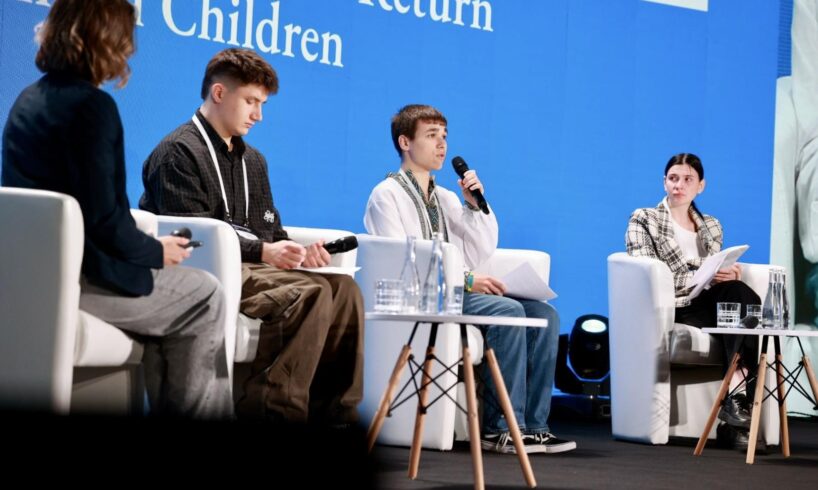
A discussion panel featuring children who were successfully returned from occupation. Photo: Bring Kids Back UA
On April 30, Kyiv hosted Civil Society and Expert Day, an event held within the framework of the Bring Kids Back UA initiative. It brought together civil society representatives, experts, and international partners to strengthen efforts to return Ukrainian children who were illegally deported by Russia.
This was reported by Rubryka.
Opening the event, Deputy Speaker of the Ukrainian parliament Olena Kondratiuk emphasized that the scale of the crime against Ukrainian children requires sustained international attention and coordinated efforts. She noted that, as of today, the Ministry of Justice of Ukraine has verified 20,570 cases of deportation and forced transfer of Ukrainian children, but these figures are not final due to the ongoing war.
“According to human rights defenders, hundreds of thousands of Ukrainian children are under Russian control — deported, forcibly relocated, or remaining in occupied territories at risk of illegal removal. Everything Russia is doing to them amounts to acts of genocide,” Kondratiuk said.
She also stressed that the return of children has already been made possible through joint efforts of the state, civil society, and international partners.
“Despite all obstacles, 2,126 children have been returned within the framework of the President of Ukraine’s Bring Kids Back UA initiative. Every return is a shared victory of the state, volunteers, NGOs, and our international partners,” the Deputy Speaker emphasized.
Kondratiuk added that the outcomes of future international decisions will largely depend on the work of experts and discussions taking place in Kyiv.
“On May 11, member states of the international coalition for the return of Ukrainian children will sit down at the negotiating table at the level of foreign ministers. What they will discuss will largely depend on what we formulate here today in Kyiv,” Kondratiuk said.
Deputy Speaker of the Ukrainian parliament Olena Kondratiuk. Photo: Bring Kids Back UA
What is the problem?
More than 20,000 confirmed cases of deportation and around 1.6 million Ukrainian children who remain under Russian control — including those deported, forcibly transferred, or living in temporarily occupied territories — constitute one of the deepest humanitarian and legal crises of this war.
Participants of the event stressed that this is not only a humanitarian issue, but a systematic policy aimed at altering children’s identity.
Lesia Ogryzko, Director of the Sahaidachnyi Security Center, explained that deportation is part of a broader military strategy. She described it as a form of social engineering technology that Russia is using in its war against Ukraine.
Director of Sahaidachnyi Security Center Lesia Ogryzko. Photo: Mykola Tymchenko / Rubryka
“This is not just the relocation of children. This is an attempt to sever their identity. Their names, documents, language, and environment are being changed. This is a technology of social engineering aimed at destroying Ukrainian identity,” Ogryzko said.
She also stressed that the issue of deported children goes beyond the humanitarian dimension and has become a test for the international order. If such actions become part of bargaining in a peace process, it would mean undermining the moral foundations established after World War II.
Advocacy Director of the Human Rights Centre ZMINA, Alyona Lunova, warned against vague wording and political compromises. She emphasized that any conditions attached to the return of children reduce the chances of achieving it, and that children cannot be treated as a subject of negotiations:
“Children cannot be a subject of bargaining. There can be no conditions when it comes to their return,” she stressed.
Alyona Lunyova, Advocacy Director of the ZMINA Human Rights Center. Photo: Mykola Tymchenko / Rubryka
According to her, the problem is much broader than deportations alone: in the occupied territories, Russia has already created a systematic infrastructure of indoctrination where children’s identities are being reshaped even without physical relocation.
Participants of the discussion also pointed to the historical and legal context. Anton Drobovych, a civic and public figure and former head of the Ukrainian Institute of National Remembrance, stressed that the forced transfer of children is one of the elements of the crime of genocide, as defined in international law after the World War II.
Anton Drobovych, public and state figure, former director of the Ukrainian Institute of National Remembrance. Photo: Mykola Tymchenko / Rubryka
According to him, it is children who have become the “red line” that the international community refused to cross, even in the most difficult negotiations. Today, he warned, the question is whether this norm may be weakened, which would have consequences far beyond a single war.
The event was also attended by Ukraine’s Minister of Foreign Affairs Andrii Sybiha, who outlined the state’s position and key priorities in the effort to return children.
He drew historical parallels, referring to testimonies of children from different generations — those of World War II and those of today — noting that despite the decades, their experiences remain tragically similar. According to the minister, the modern deportation of Ukrainian children is not fundamentally different from the practices of the Nazi regime.
Sybiha stressed that the main outcome of all efforts must remain the actual return of children. So far, he said, more than two thousand children have been brought back, but this figure does not reflect the scale of the crime.
At the same time, he emphasized that return must be understood in a comprehensive sense. It is not only about physically bringing a child home, but also about restoring their identity and returning them to a normal childhood — a process that requires long-term work and international support.
“This is about a ‘triple return’ — bringing the child home, restoring their identity, and giving them back their childhood. This approach must become the foundation of international policy in this area, because it concerns not only the current war, but also the long-term recovery of society,” the minister said.
The minister also stressed the need to hold those responsible accountable, underlining that there can be no compromises on this issue.
What is the solution?
Civil Society and Expert Day aims to translate expert knowledge into concrete policy decisions. The key outcome of the event was a Joint Statement by civil society with recommendations for the states participating in the International Coalition. It covers a wide range of measures — from sanctions pressure and international justice to improving mechanisms for the search, return, and reintegration of children.
Experts emphasize that this is not only about responding to crimes that have already been committed, but also about building a system that prevents their recurrence in the future.
It also underlines the need to maintain clear legal frameworks in any potential peace processes — in particular, ensuring that children are not included in any political “exchanges” or compromises.
How does it work?
The event in Kyiv served as a preparatory stage for the meeting of the International Coalition for the Return of Ukrainian Children, which will take place on May 11 in Brussels.
Around 200 participants — representatives of civil society organizations, state institutions, the diplomatic corps, and international organizations — worked across all key stages: from identifying and returning children to their reintegration and the documentation of crimes.
At the final stage of the event, the Joint Statement by civil society was handed over to Ukraine’s Ministry of Foreign Affairs. The document will become part of the preparation for international negotiations and will be circulated among member states of the coalition.
Minister of Foreign Affairs of Ukraine Andrii Sybiha. Photo: Mykola Tymchenko / Rubryka
Minister of Foreign Affairs of Ukraine Andrii Sybiha. Photo: Mykola Tymchenko / Rubryka
Participants emphasized that the return of children is not only a humanitarian task, but also a matter of principles that will define the future international order.
The exhibition dedicated to Ukrainian children who were illegally deported and forcibly removed from Ukraine by Russia was displayed during the event. Photo: Mykola Tymchenko / Rubryka
The exhibition dedicated to Ukrainian children who were illegally deported and forcibly removed from Ukraine by Russia was displayed during the event. Photo: Mykola Tymchenko / Rubryka
The exhibition dedicated to Ukrainian children who were illegally deported and forcibly removed from Ukraine by Russia was displayed during the event. Photo: Mykola Tymchenko / Rubryka
The exhibition dedicated to Ukrainian children who were illegally deported and forcibly removed from Ukraine by Russia was displayed during the event. Photo: Mykola Tymchenko / Rubryka
The exhibition dedicated to Ukrainian children who were illegally deported and forcibly removed from Ukraine by Russia was displayed during the event. Photo: Mykola Tymchenko / Rubryka