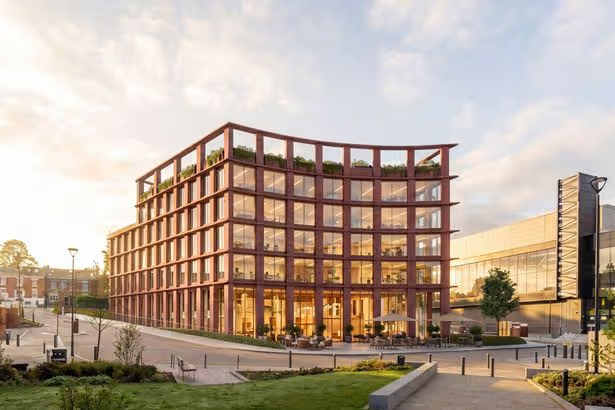
Locating the headquarters of Great British Railways in the city centre and creating new office space could create more than 1,200 jobs
A street level view, from a new computer generated image, showing how the new Grade A office block would look on the derelict Duckworth Square site in Becketwell.(Image: SJS)
Locating the headquarters of Great British Railways (GBR) at Becketwell in the city centre – one of two shortlisted sites in Derby for the organisation that will run the rail network’s infrastructure and passenger services in the future – could generate up to £151 million into the economy and support more than 1,200 jobs.
A new economic impact assessment by real estate and investment firm CBRE says that the proposed office block at 3 Springwell Square would create between 855 and 1,244 full-time equivalent jobs, compared with just 372 at Midland House – the other short-listed location for GBR headquarters – which is an existing railway building located opposite the train station.
This represents an additional 483 to 872 jobs for the city and wider region. Becketwell already has a 259-apartment block and 3,500 capacity performance venue, Vaillant Live, as part of the £200 million development project.
The report has been released as two new computer-generated images (CGIs) of the proposed Becketwell office block have been published showing how it would finally fill the space left by the demolition of Duckworth Square more than 20 years ago.
Aerial view shows how the new Grade A office building would look alongside Vaillant Live and the Condor apartment block in the foreground which replaced the former Debenhams building in Victoria Street(Image: SJS)
The report also shows that Becketwell, which is being developed by St James Securities, could generate £107 million to £151 million in gross value added (GVA) during construction and operation, compared with just £27 million for Midland House, an uplift of up to £124 million.
GVA measures the real economic value created by a development – the money generated to pay wages, support local businesses and drive economic growth in the area.
At its peak in the 1970s and 1980s, Derby city centre supported around one million square feet of office space and up to 100,000 workers.
Locating GBR in the city centre builds on a long railway tradition because, when the Victorians originally developed the railway estate and infrastructure, Derby had a significant part to play – especially around its various rail stations.
The derelict former Duckworth Square, left, is what people see currently visiting the new Vaillant Arena but it is one of two sites shortlisted for the home of GBR(Image: Derby Telegraph)
Over time the estate has evolved with elements located at the train station and beyond at RTC (Rail Technical Centre) and Alstom Works.
In the 1970s and 1980s, British Rail employed more than 1,200 people in Derby city centre, spread across three office buildings – totalling more than 120,000 sq. ft.
These included Saxon Gate, Burdett House, and the British Rail Engineering Limited (BREL) headquarters at St Peter’s House in Gower Street, less than 150 metres from 3 Springwell Square.
The assessment also highlights a significant potential increase in city centre footfall as a direct result of locating GBR at Becketwell.
The development is expected to generate between 8,750 and 12,700 additional visits per month – around a 10% increase in current footfall levels.
This sustained increase in weekday activity, driven by economically active workers, would provide a crucial boost to city centre businesses, supporting growth in retail, hospitality and leisure and reinforcing Derby’s long-term economic resilience.
The new office building is large enough to house other businesses alongside GBR, creating the foundations for a wider Derby Rail Campus that would bring together operators, supply chain partners and related organisations in one location.
The building would bring together the 17 organisations that would form GBR within a single, integrated and future-ready workspace.
Until then, Network Rail and the DfT Operator (DFTO) – the government’s public sector rail owning group –are driving and leading the transition.
There are plans to also build further offices and a four-star hotel in Becketwell in future phases.
Paul Morris, development director at St James Securities, said: “This independent assessment clearly demonstrates the scale of opportunity that Becketwell represents, not just for GBR, but for Derby and the wider region.
“This is about much more than creating a headquarters building. It is about creating jobs, driving economic growth and bringing long-term confidence back into the city centre.
“We are incredibly encouraged by the level of support we are receiving from leading stakeholders across the city. It reflects a shared recognition that Becketwell offers something genuinely transformative – not just for GBR, but for Derby’s long-term future.”
Becketwell already benefits from outline planning permission for a range of uses, including a Grade A office building – meaning the development has been approved ‘in principle’ but that more detailed plans need to be submitted in the future.
Enabling works are due to start later this month, including survey work, demolition of existing structures, excavation and site preparation, and the construction of a new perimeter retaining wall.
A reserved matters planning application is expected to be submitted later this year and, subject to approvals, construction is hoped to take place between summer 2027 and spring 2029, with completion targeted for early 2029.
Derby was confirmed as the home of Great British Railways in 2023, recognising its deep rail heritage and central role within the UK transport network.
The final decision on HQ location – expected before the end of 2026 – will be made based on a range of factors, including regeneration and economic value, value for money, and environmental and social impact.
Funding to help kick-start the regeneration of the Duckworth Square area has already been set aside by EMCCA, the East Midlands Combined Authority, which would involve Grade A office space being built there – regardless of whether GBR moves in.
Mr Morris says that the campaign to bring GBR to Becketwell continues to gain momentum, with strong backing from a wide range of civic, business and cultural leaders across the city, including Labour MP for Derby North, Catherine Atkinson, and Derby South Labour (Co-op) MP Baggy Shanker, respectively.
David Williams, chairman of the Geldards LLP law firm, said: “I am of the very firm belief that the location of GBR’s HQ in the centre of Derby, rather than outside it at Midland Road, is the most appropriate decision.
“First, the impact of hundreds of jobs on the cultural, hospitality and retail businesses in the city would be enormously beneficial.
“Great progress has been made on city living and public realm and the missing link is now the spending power of employees located in the city.
“Secondly, in terms of encouraging skilled individuals to locate to Derby, a modern, purpose-built office, located alongside the city’s facilities would be a much better draw.”
Long-standing Councillor Martin Repton, who represents the Darley ward for Labour on Derby City Council, said: “This is a once in a lifetime opportunity to seriously address the decline of our great city centre following out of town developments over many decades, the rapid increase of online shopping and Covid.
“The real and positive effects of choosing the Becketwell site cannot be underestimated as that choice will lead to greater footfall and spending within the city centre and further inward investment from other businesses and companies.”
Beth McDonald, managing director or Derbion said: “A Great British Railways HQ in the city centre would boost the number of people working in the city and would be a catalyst for other employers to move into the area.
“Becketwell is just a five minute walk from Derbion, and, if Great British Railways were to select the site for its new HQ, it would provide further confidence to current and future retail and leisure operators to invest in both Derbion and the wider Derby high street – helping to create more jobs and, in turn, will lead to a thriving city centre where people want to live, work, and visit.”