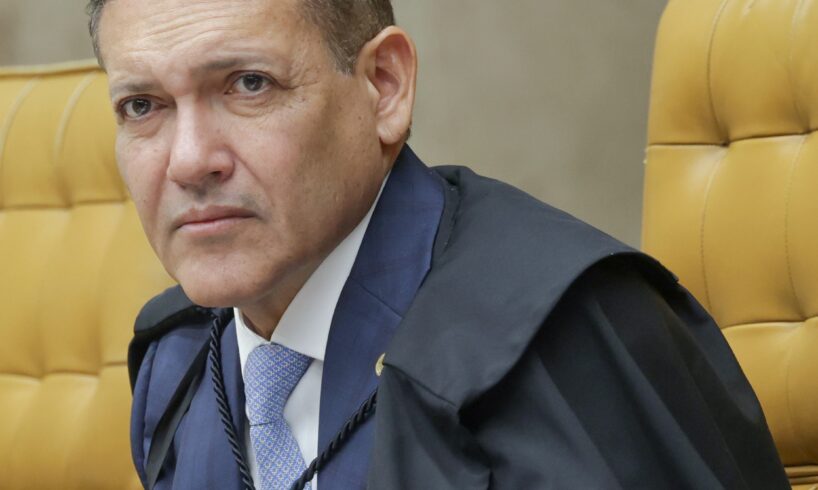
Supreme Court Justice Kassio Nunes Marques will take over as president of Brazil’s top electoral authority (TSE) on Tuesday, pledging to protect the country’s electronic voting system from attacks and to ensure that October’s elections proceed without major disruptions.
Pre-campaign legal battles intensify between Lula and FlávioNext election chief is ready to defend electronic voting
Nunes Marques will replace Justice Cármen Lúcia as head of the institution overseeing Brazil’s elections, with Justice André Mendonça serving as vice president.
To address concerns about his appointment to the Supreme Court by former president Jair Bolsonaro—who was later prohibited from running for office due to spreading false claims about Brazil’s electronic voting system—Nunes Marques has indicated his plan to personally uphold the electoral system’s integrity and oversee the use of artificial intelligence during the campaign.
The incoming president has the support of fellow justices, who recognize that his style differs from that of Justice Alexandre de Moraes, who led the electoral authority during Brazil’s turbulent 2022 presidential election.
While Moraes adopted an aggressive stance against disinformation, issuing direct orders to remove social media accounts and online content, Nunes Marques is expected to take a more “minimalist” approach.
According to people familiar with his plans, this means he intends to intervene less in public debate, allowing campaigns to unfold more freely and ensuring that electoral-court intervention remains the exception rather than the rule during the election period.
At the same time, he plans to maintain cooperation with digital platforms to ensure the rapid removal of content that undermines the integrity of the vote.
He is also expected to seek assistance from universities to identify AI-produced content and prevent overloading the Federal Police, which is also anticipated to be involved in monitoring suspicious material.
Nunes Marques, as a member of the electoral authority, voted against Bolsonaro’s conviction in two election-related abuse cases, which resulted in the former president being declared ineligible for office.
The justice, however, tends to downplay criticism and argues that, just as Moraes was accused by Bolsonaro’s allies of being an adversary of the former president, it is natural that he, in turn, may now be viewed as a friend of Bolsonaro.
According to Nunes Marques, the only possible response is to act “in the most impartial way possible.”
Fellow justices have expressed confidence in the incoming president and say he did “a very good job, listening to all members of the court and incorporating several suggestions” while serving as rapporteur on the resolutions that established the rules governing October’s election.
One concern within the institution, however, is the possibility of interference by the United States.
According to one court official, because of Nunes Marques’s more moderate profile, he is unlikely to confront U.S. President Donald Trump if tensions escalate.
The comparison is again with Moraes, who was targeted under the Magnitsky Act.
More broadly, however, magistrates say Nunes Marques remains attentive to the risks posed by disinformation and has shown openness to dialogue.
That assessment is echoed by legal experts, who also highlight his ability to broaden engagement with civil society groups.
“The leadership of Brazil’s electoral authority tends to reflect the style of the person leading it, and Justice Nunes Marques has a more reserved, self-contained, and restrained profile,” said Sidney Sá das Neves, a lawyer and general coordinator of the Brazilian Academy of Electoral and Political Law.
Lawyers with experience before the electoral authority say that the use of artificial intelligence in the 2026 elections will be one of the justice’s greatest challenges, though they remain optimistic.
One lawyer said Nunes Marques’s preference for prevention over confrontation could prove beneficial, while another said he is expected to lead the institution with an objective, lower-profile approach.
In March, when the electoral authority approved campaign advertising rules for October’s vote, Nunes Marques said the elections would be subject to “rigorous monitoring” and that the institution would pursue a balanced approach, avoiding both “excess” and “inaction.”
One of the main changes approved for this year’s election is a ban on distributing newly created or AI-altered content during the 72 hours before voting and the 24 hours after voting.
Nunes Marques had originally been scheduled to take office in mid-June.
Cármen Lúcia, however, decided to step down earlier to give the incoming president more time to organize the national elections.
The inauguration ceremony will take place in the court’s plenary chamber and is expected to draw more than 1,000 guests, including government officials, members of other courts, and the justice’s relatives.
In addition to President Lula, who is expected to seek reelection, Senator Flávio Bolsonaro—a presidential hopeful and son of the former president—is also expected to attend.
After the official ceremony, Nunes Marques is expected to attend a reception organized in his honor by legal and political groups.
Among the guests are celebrity friends of the incoming electoral chief, including Brazilian singer Gusttavo Lima.
In 2024, the justice attended the singer’s birthday celebration in Greece amid speculation that the artist was under investigation for alleged links to an online betting scheme. The case was later closed.
Next week, in one of his first acts as head of Brazil’s electoral authority, Nunes Marques is expected to meet with presidents of the regional electoral courts to discuss preparations for the elections.
Contacted by Valor, the justice declined to comment.