By exploiting fears of mobilization, economic vulnerability, and issues of national identity, both external and internal manipulators have launched a large-scale campaign against the recruitment of foreign labor in Ukraine. Analysis of the information space indicates that the surge in anti-migrant rhetoric is a noticeable information wave that the enemy is attempting to use for their own interests. The Center for Strategic Communications explains how and for what purpose anti-migrant hysteria is being stoked in Ukraine.
How Anti-Migrant Hysteria is Being Manufactured
Information plants regarding migrant workers are not a new phenomenon. In the fall of 2025, StopFake debunked a manipulation regarding alleged government plans to bring in 10 million migrants. In reality, propagandists distorted the essence of Bill No. 14211, which merely simplified procedures for employing foreigners in accordance with EU norms and did not include any “settlement” quotas. The figure of 10 million was merely a hypothetical expert estimate of the labor shortage, not an official population “replacement” strategy.
Screenshot of the fake news regarding alleged “government plans to bring in 10 million migrants”
In the spring of 2026, efforts to fan the flames of anti-migrant hysteria proved more successful as expert discussions regarding human capital shortages and the recruitment of foreign labor—as a tool to overcome the labor market crisis—became more public. Round tables and statements from business leaders, local self-government, and central authorities shaped the general information background and provoked public debate. The discussion features both arguments in favor of labor migration (proponents primarily cite economic reasons) and critical voices. Opponents of migration, including those with conservative and right-wing political views, point to risks of rising crime and social tension, citing negative experiences in other countries. The topic has been seized upon by Ukrainian hype-bloggers looking to increase their reach by following the trend, as well as by Russian propagandists seeking to demoralize Ukrainians.
The publication Texty noted that in the first quarter of 2026, the State Migration Service issued only 675 migration permits and canceled twice as many.
However, diving into social media could give the impression that tens or hundreds of thousands of foreign workers are already roaming the streets of Ukrainian cities.
The migrant issue has been seized by manipulators who systematically execute hostile propaganda narratives.
In April, a video fake spread where the former head of the Chernivtsi Regional Administration, Ruslan Zaparanyuk, allegedly “promises foreigners leadership positions and Ukrainians bonuses for marrying them.” Fact-checkers at VoxCheck found that propagandists used an archival interview from 2023, replacing the original audio track using artificial intelligence. Furthermore, at the time the video was circulated, Ruslan Zaparanyuk no longer even held the position, which definitively confirms the artificial nature of this plant.
Screenshot of a video fake in which the “head of the Chernivtsi Regional Military Administration allegedly promised migrants benefits and positions”
Information interventions aimed at strengthening anti-migrant sentiments and fears are intensifying in the Ukrainian segment of social networks and adapting to realities. According to monitoring by the Center for Strategic Communications, a further spike in such rhetoric was recorded in the Ukrainian information space between May 1 and May 10, 2026. The monitoring identified over 21,600 publications shared across nearly 14,000 resources.
Dynamics of anti-migrant rhetoric in the Ukrainian media space (May 1–10, 2026)
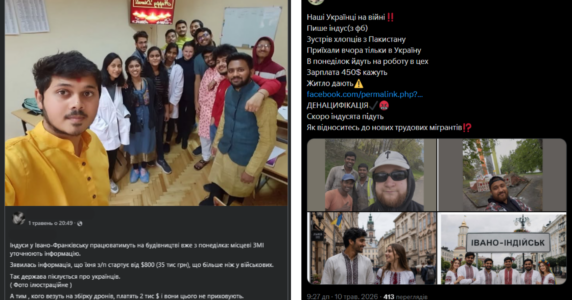
One of the triggers for the May wave was a case involving a construction company in Ivano-Frankivsk. Starting May 1, anonymous Telegram channels began mass-distributing a screenshot of an internal message from a company manager about the arrival of workers from India.
Examples of posts sharing the construction company screenshot
This local news item was instantly scaled: the network picked up the publication, transforming it into a massive manipulative discussion about the “hidden number” of foreigners in Ukraine and their “exorbitant salaries.”
Screenshots of manipulative posts featuring AI-generated images
Key Narratives of the Anti-Migrant Campaign: From “Disappearance of the Nation” to Mobilization Manipulations
Monitoring by the Center for Strategic Communications identified a series of dominant narratives aimed at forming negative attitudes toward labor migrants and provoking hysteria. Fear of the “disappearance of the nation” and an emphasis on risks to the social order became the foundation for information attacks. The recruitment of foreign labor is presented not as an economic necessity, but as a tool for the oppression of Ukrainians.
Specifically, theses about the “dilution of national identity” due to the influx of people from different cultures (from India, Pakistan, Bangladesh, and other Asian and African countries) are being actively injected into the information space. Questions are framed according to the principle: “What kind of Ukraine are our defenders fighting for if its territory will be settled by foreigners rather than Ukrainians?”
The actions of the Ukrainian authorities are interpreted through accusations of “genocide” against their own people. The idea of a deliberate policy of “replacement” is promoted, where the interests of foreigners are allegedly placed above those of Ukrainian citizens.
One of the most dangerous trends is the combination of anti-migrant and anti-mobilization rhetoric. The topic of labor migrants is used to discredit mobilization. Key messages hit on emotions: “While Ukrainian men are being mobilized, their places are being taken by outsiders.”
Manipulators provoke social outrage by comparing fictitious or out-of-context figures. Such messages compare the salary of a foreign construction worker to that of a teacher or the basic pay of a soldier. Rumors are spread that the state is spending financial resources on migrants while ignoring the needs of veterans and Ukrainians returning home.
Any appearance of foreigners in cities (for example, reports of people with suitcases at train stations in Lviv or Ivano-Frankivsk) is presented as irrefutable evidence of “mass migrant imports.” This is accompanied by predictions of an inevitable rise in crime due to the foreigners’ alleged inability to obey Ukrainian laws.
These narratives work to divide society and form a new image of the “enemy
Key Platforms and Sources of Distribution
An analysis of 13,800 unique resources conducted by the Center for Strategic Communications from May 1–10, 2026, showed that social networks have become the primary staging ground for information attacks. It is here that emotional tone, anonymity, and the lack of serious moderation allow manipulators to engage audiences most quickly. The main platforms for spreading manipulative messages were Facebook (over 8,000 publications) and Telegram (nearly 5,000 publications).
On Facebook, the greatest activity was observed within large groups focused on discussing internal politics. In such groups, manipulative posts and calls for discussion intended to cause anxiety or aggression appear regularly. The text is accompanied by images, videos, collages, and caricatures aimed at provoking an emotional response from the audience.
Screenshots of manipulative posts
Additionally, the distribution of series of identical comments under thematically different posts was recorded, indicating the operation of artificial influence networks.
Screenshots of identical comments
On the Telegram platform, anonymous channels dominate, presenting distorted information as “hidden truth.” The list of the most active re-transmitters included resources that systematically support Russian information operations and are controlled by hostile intelligence services.
Why the Enemy is Ramping Up Anti-Migrant Hysteria
Russian interventions in the Ukrainian information space are aimed at demoralizing Ukrainians, destabilizing the socio-political situation, and reducing society’s ability to resist external aggression. The enemy seeks to use all current problems and press on “pain points,” the sensitivity of which has become extremely heightened in the conditions of an existential war.
Ramping up anti-migrant hysteria in Ukraine serves the Russians by:
undermining Ukrainians’ trust in the government;
strengthening the narrative of “genocide” allegedly committed by the Ukrainian authorities (through the desire to fight “to the last Ukrainian” and “clearing the territory of Ukrainians”);
creating an additional “breaking point” to polarize and radicalize society, generating internal conflicts;
demoralizing Ukrainians and creating an additional sense of threat regarding a “migrant invasion”;
discrediting mobilization by further intensifying the sense of injustice;
creating evidence of Ukrainian racism and xenophobia for foreign audiences, strengthening the narrative of “Ukrainian Nazism,” and worsening attitudes toward Ukraine abroad, particularly in Asia and Africa.
The information wave spreading anti-migrant sentiments and fears has turned into a coordinated strategy to split society. The use of deepfakes, manipulation of numbers, appeals to emotion, and the involvement of anonymous and propaganda resources as well as bot farms—all of this works to destabilize the Ukrainian home front, disrupt mobilization, and destroy trust in the state.на дестабілізацію українського тилу, зрив мобілізації та руйнування довіри до держави.
If you have found a spelling error, please, notify us by selecting that text and pressing Ctrl+Enter.