2026-05-17T16:05:41+00:00
font
Enable Reading Mode
A-
A
A+
Shafaq News-
Al-Sulaymaniyah
Al-Sulaymaniyah
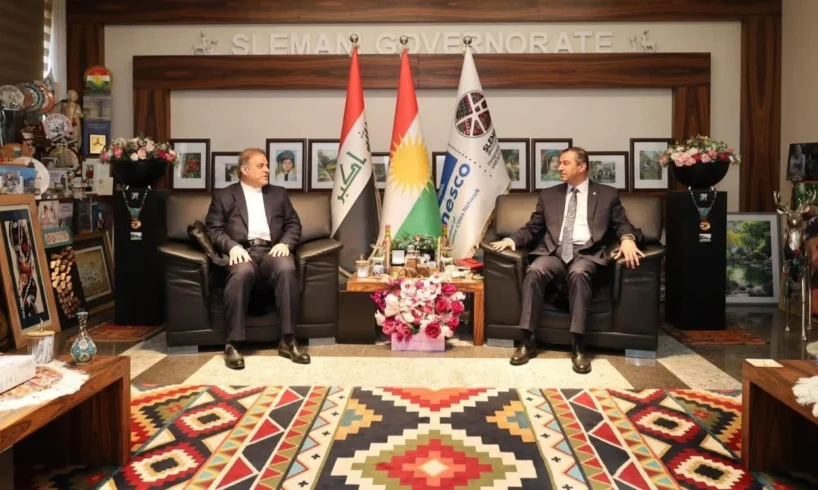
Governor Haval Abu Bakr on Sunday urged Iran’s newly appointed consul to the
province to end military strikes and bombardment targeting the Kurdistan
Region, as Iranian drone and missile attacks on Iranian Kurdish opposition
camps in the area have surpassed 700 documented sovereignty violations since
regional tensions escalated.
Abu Bakr
received Seyyed Mohammadi Mir Hosseini, the new consul general, stressing that
the Kurdistan Region has pursued a policy of neutrality and must not be drawn
into regional or international conflict axes.
Al-Sulaymaniyah
province shares an extensive mountainous border with Iran’s Kurdistan and
Kermanshah provinces to the east, running from the Darbandikhan area in the
south through the Penjwen and Halabja districts to the Haji Omran crossing in
the north, terrain that has historically sheltered the camps of Iranian Kurdish
opposition groups.
Several
Iranian Kurdish opposition parties —exile organizations that left Iran
following the 1979 Islamic Revolution— have maintained camps in this border
zone and across the Kurdistan Region for decades. The most prominent are the
Kurdistan Democratic Party of Iran (KDPI), the Komala Party of Iranian
Kurdistan, and the Kurdistan Freedom Party (PAK). Tehran has long accused these
groups of crossing into Iranian territory to attack its forces and incite
unrest in Iran’s Kurdish-populated western provinces. The parties describe
themselves as political organizations operating in a refugee capacity.
Iranian Strikes
And The Regional Toll
The KDPI said
Iranian strikes have hit its camps and medical and educational installations on
close to 130 separate occasions since February 28.
The Alliance
of Iranian Kurdistan Political Parties said in April that more than 150 direct
strikes had targeted camps hosting Iranian Kurdish political refugees, killing
21 people, including 10 activists and group members. The alliance condemned the
attacks as “an attempt to deflect from Iran’s setbacks” and described
strikes on consulates, political camps, and civilian areas as “war
crimes,” urging the United Nations and concerned states to take a firm
stance.
Weapons Claims
Denied
In April,
KDPI official Karim Parwizi rejected remarks by US President Donald Trump, who
said in a Fox News interview that Washington had “sent guns to the
protesters, a lot of them” during nationwide demonstrations in Iran in
January, claiming “the Kurds took the guns.” Parwizi told Shafaq News
the party “has not received a single weapon from the United States,”
and that no Kurdish party in eastern Kurdistan —Iran’s Kurdish-majority regions—
had obtained such support. Iraqi Foreign Minister Fuad Hussein also denied, in
a separate television interview, that Iranian opposition groups were conducting
any armed activity from Iraqi soil, describing them as present in camps in a
refugee capacity.
The 2023
Security Agreement
In 2023,
Iraq and Iran signed a security agreement to secure shared borders and curtail
armed activity by Iranian Kurdish opposition groups operating from Iraqi
territory. The deal has come under strain since the conflict’s outbreak. In
February, KRG Deputy Prime Minister Qubad Talabani said Tehran had asked Iraqi
Kurdistan to do what it could to protect the shared border, a request “the
KRG intended to honor out of respect for bilateral relations.”