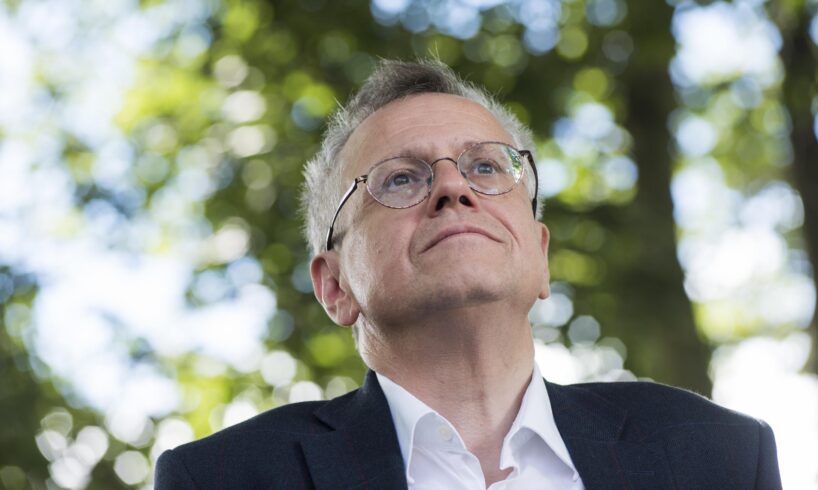
The Glasgow University historian and academic, a leader in his field and the author of a groundbreaking study on the economic impact of Robert Burns, is telling me about his latest project — an exploration of the esoteric and exciting world of the Edinburgh Festival Fringe.
“This was something I was interested in doing [for a while]” he notes, “and after various discussions and developments I was awarded the contract to do so.”
Professor Pittock will be examining reams of data alongside two researchers (their jobs are currently out for tender). It is a small team with a large remit — they will estimate the economic impact of the Fringe, not only to Edinburgh, but to the rest of Scotland.
The Fringe sells millions of tickets. (Image: NQ)
For comparison, his Burns study, released in 2020, revealed that tourism and celebrations linked to the Bard generated £203 million each year.
“[This study] will build on the methodology from the Robert Burns economic study,” the academic tells me. “It will look at the impact of tourism and cultural benefit to Edinburgh gained by holding the Fringe, in terms of tickets, but also in terms of embedded brand value.
“The Fringe themselves were very keen to have their own value understood better.”
Indeed, it is clear that the Edinburgh Festival Fringe Society, who organise the festival every year, are incredibly excited by the leading historian’s involvement.
“[The Fringe’s] impact reaches far beyond the performances themselves, supporting artistic careers and shaping how people connect with culture and new ideas,” chief executive Tony Lankester says.
“Work like this is vital in helping us better understand and articulate that value, ensuring the Fringe continues to thrive as an open and accessible space for creativity.”
The phrase “embedded brand value” came up often during my conversation with Professor Pittock. It can be defined as the contribution a person or event provides to the overall brand of a nation.
For example, the 2020 study found that Burns’ reputation has contributed £140 million to the embedded brand value of Scotland, in addition to the £200 million annual economic boost.
Likewise, “the Fringe is responsible for a great deal of income from tourism in Edinburgh and helps to support the jobs dependent on that income,” the historian notes.
“Not to mention the knock-on effects across Scotland, especially in terms of accommodation.”
It is estimated that the Fringe supports around 3,000 jobs and welcomes 750,000 visitors each year.
Professor Pittock’s job is to define how those figures are expressed in terms of brand value.
He explains: “Fundamentally, [the study] will draw on my designed approach to economic impact, which goes beyond the standard measures to focus on the measures of brand and embedded value.
“A global brand is not just an event or something which is working well for a city or a place but something that has longevity and a degree of financial impact that can be relied on.”
More than 3,000 shows are performed at the Fringe each year. (Image: Ian Georgeson)
The historian is keen to make clear that the study is only looking at the Fringe, not the other festivals which comprise the busy month of August.
He says that while previous studies have lumped all the festivals together, there are major differences between them which must be taken into account.
For example, Professor Pittock said that more tickets are sold to overseas visitors by the Fringe than by the Edinburgh International Festival.
And according to Visit Scotland, there is a clear boost in spending from international tourists compared to those coming from Scotland and other parts of the UK.
In 2024, such tourists spent an estimated £4 billion over 4.4 million visits, an average spend of £912 per trip.
By comparison, the average domestic tourist spent £315 per trip, 65% less than those from overseas.
Thus, there is a need to differentiate between festivals when studying them in detail.
Professor Pittock continues: “I’m not sure that the understanding of how much the Fringe contributes is wide enough.
“For example, the restaurant you like in Bruntsfield is able to stay open year-round because of the Fringe in the summer. That is something that people need to be better aware of.”
As we conclude our conversation, I ask Professor Pittock if he hopes that his study will help to widen appreciation for the arts, especially in a political climate where cultural funding is often first to be cut.
Read more:
He vociferously agrees.
“Support for the arts from the Scottish Government cannot be viewed as ‘dead money’ that they throw away,” the academic notes.
“Rather, it [must be understood] as protecting the assets which are delivering and have delivered benefits over a long period of time.
One final question.
Do you have a favourite Fringe performance, I ask.
He laughs.
“I need to stay impartial so people will speak to me, but The Fringe is a great place for experimentation and innovation.
“These things are really important in the arts and other areas of human endeavour.”