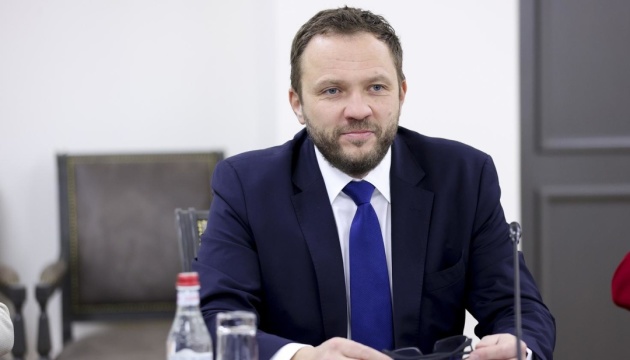
Estonian Minister Margus Tsahkna. Photo: ERR
Estonian Foreign Minister Margus Tsahkna called on the European Union to open all six negotiation clusters for Ukraine and Moldova’s accession before the June summit, stressing the need to move toward full membership.
According to Rubryka, ERR reported that the Estonian minister said that the EU must continue the enlargement process in line with agreed procedures and focus on advancing Ukraine and Moldova toward full membership.
Tsahkna stressed that the European Union does not have associate members, although it has previously signed association agreements with candidate countries. Estonia, in particular, signed such an agreement in 1995 before joining the EU. That agreement laid the foundations for close cooperation and created the necessary legal framework that paved the way for membership in the European Union.
The Estonian foreign minister also noted that the idea of an alternative format for Ukraine had been discussed earlier amid Hungary’s blocking of EU enlargement.
“Meanwhile, the situation has changed: Hungary has a new government, and now our recommendation and position are clearly to move forward with the agreed enlargement process and, now, ahead of the June council, to open all six negotiation chapters and then move forward.
Such an alternative path would not help this process at the moment. Therefore, our very clear recommendation and guidance to other member states is that we must now focus on the process of achieving full membership,” Tsahkna said.
He added that these negotiation clusters should be opened for both Ukraine and Moldova.
According to the minister, an alternative path would not contribute to the accession process, so the EU should focus specifically on Ukraine’s full membership.
He added that it is currently difficult to assess how quickly Ukraine’s accession talks could move forward.
“It is very difficult to say, because there are very complicated chapters, for example, on agriculture, on the free movement of labor, as well as future budget issues if Ukraine joins the European Union,” Tsahkna said, adding that the issue is highly political.
In addition, Marko Mihkelson, chair of the Foreign Affairs Committee of the Riigikogu, said that neither Estonia nor Ukraine wants Ukraine to receive the status of an associate member of the European Union.
Mihkelson also noted that it is now important for accession talks to begin next month.
Background
As Rubryka wrote, on May 21, it became known that German Chancellor Friedrich Merz had proposed granting Ukraine a new status as an “associate member” of the EU before it obtains full membership.
The proposed special status of “associate member” would expand Ukraine’s rights and obligations compared with the standard status of candidate countries in the traditional accession process.
In particular, it would include:
Participation and voting rights at meetings of the Council of the EU and the European Council
Participation without voting rights in the work of the European Commission and the European Parliament
Gradual integration into the EU budget
The extension to Ukraine of Article 42.7 of the EU treaties on mutual assistance and defense, which should provide certain security guarantees and meet Kyiv’s request
Special participation in the Court of Justice of the EU, including the creation of the position of Assistant Rapporteur
Merz believes that introducing such a status could also support the United States’ ongoing negotiation process, given the use of the European mutual assistance mechanism.