Skip next section Skin cancer cases nearly double in Germany
05/28/2026May 28, 2026
Skin cancer cases nearly double in Germany
Cases of skin cancer treated in German hospitals have nearly doubled over the past two decades.
Data from the Federal Statistical Agency, Destatis, showed that about 120,100 inpatients were treated in 2024, up 95% from 2004.
An aging population is a key factor, as the risk of skin cancer rises significantly with age. Increased screening since 2008 has also led to more cases being detected.
Deaths have also risen, with about 4,600 people dying from skin cancer in 2024. That’s a 65% increase over 20 years, far above the roughly 10% rise in overall cancer deaths.
More than half of those who died were aged 80 or older. Cases of non-melanoma skin cancer increased by 117%, while melanoma cases, those arising in pigment-producing cells that are also more difficult to treat, rose by about 42%.
The German Cancer Research Center said ultraviolet radiation remains the main risk factor, urging consistent sun protection.
Good skin care, skin cancer screenings and removing tattoos
To view this video please enable JavaScript, and consider upgrading to a web browser that supports HTML5 video
https://p.dw.com/p/5ES6u
Skip next section Eastern Germany risks falling behind, report warns
05/28/2026May 28, 2026
Eastern Germany risks falling behind, report warns
Eastern Germany’s economy is at risk of losing ground without stronger action, a new report has warned.
The Ifo research institute said weak private investment and labor shortages were holding back growth in the region.
Private investment per capita reached only about three-quarters of western German levels between 2019 and 2023, dropping to roughly two-thirds when housing and public infrastructure are excluded.
Demographic pressures are also mounting, with the workforce in the former East Germany projected to shrink by around 7% by 2035, with sharper declines expected in states like Thuringia and Saxony-Anhalt.
Economist Joachim Ragnitz warned the gap with the rest of Germany could widen again unless policymakers and businesses act decisively.
“It would be sensible to place much greater emphasis on technology transfer than has been the case thus far. This could help overcome the structural innovation weakness of East German companies,” says Ragnitz, who is head of the Ifo Institute in Dresden.
A virtual tour of Germany’s inner border and the Berlin Wall
To view this video please enable JavaScript, and consider upgrading to a web browser that supports HTML5 video
https://p.dw.com/p/5ERxm
Skip next section Germany’s potato glut drives prices down
05/28/2026May 28, 2026
Germany’s potato glut drives prices down
German farmers have been left with a surplus of potatoes after a bumper harvest filled storage from last year.
The 2025 crop reached around 13.9 million metric tons, the largest in 25 years, with about half produced in Lower Saxony, pushing prices sharply lower.
The oversupply has forced some farmers to divert potatoes to biogas plants instead of selling them for food.
Potatoes remain a staple of German cuisine, featuring in dishes from fries to dumplings, and are deeply embedded in the country’s food culture.
Globally, the potato is the fourth most important crop after rice, wheat and maize. China is the largest producer, followed by India, Ukraine and Russia, with Germany ranking sixth worldwide.
Despite its importance, the crop has a relatively limited genetic diversity in Europe, making it more vulnerable to disease and environmental pressures.
Germany’s potato surplus puts the pinch on farmers
To view this video please enable JavaScript, and consider upgrading to a web browser that supports HTML5 video
https://p.dw.com/p/5ERGU
Skip next section Germany eyes Canada LNG deal to diversify supply
05/28/2026May 28, 2026
Germany eyes Canada LNG deal to diversify supply
Germany’s state-owned gas importer Securing Energy for Europe (SEFE) has moved to secure a long-term LNG deal with a Canadian supplier as it seeks to diversify energy imports.
SEFE signed a memorandum of understanding with Ksi Lisims LNG for the annual delivery of 1 million metric tons of liquefied natural gas starting in the early 2030s.
The agreement could run for up to 20 years and would mark SEFE’s first long-term LNG partnership with a Canadian company.
Economy Minister Katherina Reiche said closer cooperation would help broaden supply routes and strengthen resilience against global risks.
Germany has relied heavily on LNG imports from the United States. The latest deal is part of efforts to diversify supply following the energy crisis triggered by Russia’s invasion of Ukraine.
SEFE, formerly known as Gazprom Germania, was nationalized after the outbreak of the war.
https://p.dw.com/p/5ER8M
Skip next section WWII bombs detonated after evacuation
05/28/2026May 28, 2026
WWII bombs detonated after evacuation
People were evacuated from homes, a care home and a hospitalImage: Arnulf Stoffel/Funke Foto Services/IMAGO
A World War II bomb has been detonated in the western town of Moers after thousands were evacuated overnight.
Officials said the 500-kilogram (1,100-pound) device was found during construction work and had to be destroyed because its fuse was too damaged to safely defuse.
The bomb was found on the former site of the Getränke Union gastronomy wholesaler.
A second, smaller bomb discovered at short notice was also detonated in the town, which lies just to the west of the city of Duisburg. Around 3,200 people were affected by evacuations within an 800-meter (half-mile) radius.
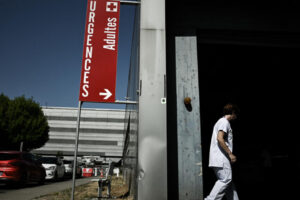
Those impacted included residents, a hospital with about 450 patients and a care home with around 200 people.
Many German cities were heavily bombed during World War II, and unexploded ordnance is still regularly found and disposed of.
https://p.dw.com/p/5ER55
Skip next section Hospital staff protest planned health care cuts
05/28/2026May 28, 2026
Hospital staff protest planned health care cuts
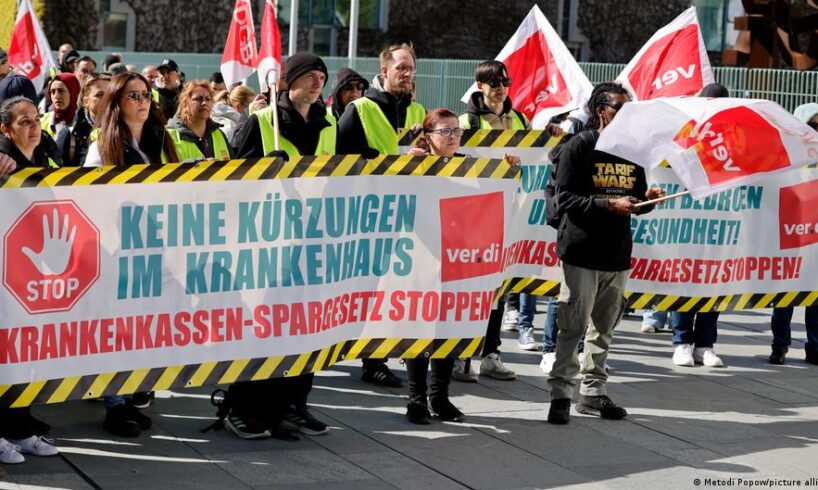
Hospital staff in Germany are staging protests against planned spending cuts in the government’s health care reform package.
The Verdi service-sector trade union said workers are angry about what it called a “cost-cutting drive” led by Health Minister Nina Warken.
Union board member Sylvia Bühler warned that the measures could undermine the quality of care and reverse progress on working conditions.
The government package aims to relieve statutory health insurers of €16.3 billion ($18.9 billion) by 2027 to avoid rising contributions for taxpayers. It includes spending caps for clinics, doctors and the pharmaceutical sector, as well as higher co-payments for medicines and limits on free coverage for spouses.
Hospitals alone are expected to contribute €4.6 billion in savings, with tighter limits on reimbursement increases and reduced coverage of wage hikes beyond a set threshold.
The proposals, now heading to the German Bundestag, also include caps on the so-called care budget, which funds nursing staff and has risen sharply in recent years.
Children, teens in Germany lack access to mental health care
To view this video please enable JavaScript, and consider upgrading to a web browser that supports HTML5 video
https://p.dw.com/p/5ER5Z
Skip next section Welcome to our coverage05/28/2026May 28, 2026
Welcome to our coverage
Guten Tag from the DW newsroom in Bonn.
You join us as the trade union Verdi puts pressure on the government to prevent planned spending cuts at hospitals as part of an austerity package.
While the cuts are aimed at maintaining stable health insurance contributions, Verdi says it will harm patient care and staff conditions.
Stay with us for more on this and other news from Germany throughout the day.
https://p.dw.com/p/5ER4m