Shafaq News
The most effective rebuttal to
the Lebanese politicians arguing that Israel’s war represents a historic
opportunity for Christians has not come from their opponents, but from the war
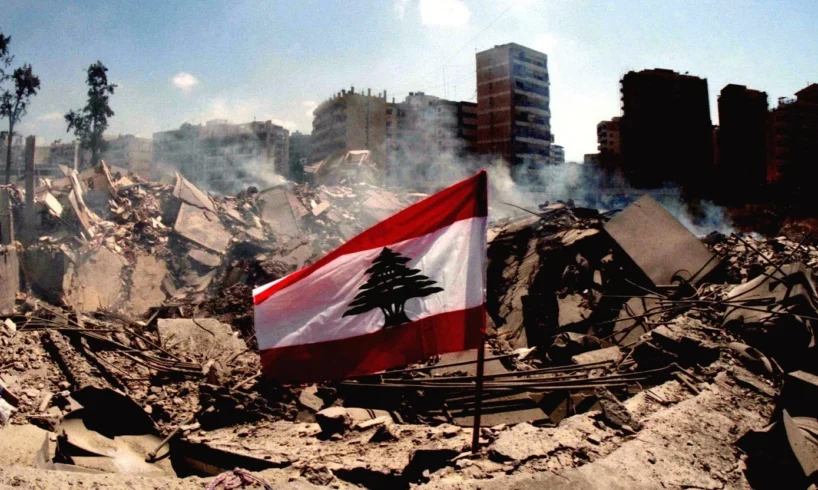
itself —a campaign that has struck Christian, Sunni and Shiite villages in
southern Lebanon with the same artillery, issued evacuation orders to Christian
and Shiite communities in the same breath, and destroyed Christian churches and
Shiite shrines with the same indifference to the distinction its Lebanese
proponents were drawing.
The argument that a foreign
military campaign can be read as a sectarian opportunity requires, at a
minimum, that the military in question share the reading. Eighteen months of
documented strikes on southern Lebanon make clear it does not —and the evidence
arrived, with particular precision, in the village of Debel.
In Debel, a Christian
community a few kilometers from the Israeli border, a statue of Jesus Christ
had stood at the village entrance for decades, the kind of marker that tells a
traveler what kind of place they are entering, and what its people hold sacred.
In April 2026, images circulated online showing an Israeli soldier smashing it
with a sledgehammer. A few weeks later, another image appeared from the same
village: a different soldier, cigarette in mouth, pressing a second cigarette
between the lips of a statue of the Virgin Mary. The Israeli army’s
spokesperson said the military “views the incident with utmost
severity” and that the soldier’s conduct “completely deviates from
the values expected of its personnel” —the same statement, word for word,
that Israel had issued less than three weeks earlier in response to the first
desecration.
No Exemption
The Amnesty International
satellite analysis of Israeli strikes between September 2024 and January 2025
found near-total destruction across the southern border zone. Southern villages
with a majority Christian population —including Rmaysh and Aalma ash-Shaab—
were largely spared during the initial phase of the 2023–2024 conflict. That
changed after October 2024, when Israeli airstrikes and expanding evacuation
orders reached areas not aligned with Hezbollah, resulting in extensive
destruction of predominantly Christian villages as well. Signs mounted that
Israel sought to establish a new demographic reality in southern Lebanon
through deliberate displacement and destruction, one that no longer exempted
communities outside Hezbollah’s orbit.
The destruction of religious
heritage has been systematic across both communities. Melkite churches in
Yaroun and Derdghaya, both listed as Lebanese cultural heritage sites, were
destroyed in 2024. A convent and former school belonging to the Salvatorian
Sisters in Yaroun were demolished in May 2026. The St. George Melkite Catholic
Church in Dardghaya was destroyed in a December 2024 airstrike. The Maqam
Shamoun Al-Safa shrine in Chamaa —venerated by both Christians and Muslims and
associated with Saint Peter— was heavily damaged by Israeli shelling. The mayor
of Debel stated that Israeli soldiers broke many statues of saints found inside
homes across the village.
The town of Qulay’a,
predominantly Christian, was targeted, and its parish priest, Pierre al-Rai
—who had publicly pledged to remain on the land— was killed. Residents of
Rmeish rang church bells in defiance as evacuation orders arrived. According to
the Religious Freedom Data Centre, 181 incidents of harassment targeting
Christians, Christian symbols, and institutions were recorded in Israel in 2025
alone.
Easter in the Crossfire
The scale of what was
happening forced the Vatican into an unusual operational role. Archbishop Paolo
Borgia, the Apostolic Nuncio to Lebanon, made multiple trips to the southern
border zone carrying humanitarian aid. On March 16, 2026, Borgia traveled from
Beirut to the Blue Line itself, visiting Rmeish, Debel, and Ain Ebel, his
second trip to the south in just a few days, covering Christian, Muslim, and
mixed villages under Israeli bombardment. An Easter Sunday convoy was forced to
suspend its mission three kilometers from Debel after becoming trapped in heavy
crossfire, with those on board waiting under gunfire and explosions before
concluding they could not proceed.
On May 6, Borgia met Pope Leo
XIV at the Vatican and then connected him in a video call with thirteen
Catholic priests still serving in southern villages. Father Toni Elias,
Maronite parish priest in Rmeich, described the encounter as “first a
surprise, then a great joy.” A few days before the call, the Israeli
military had demolished the last standing building in Yaroun —the convent— and
Italian UNIFIL soldiers donated a replacement crucifix to Debel after the
original was destroyed. A Vatican convoy, on Easter, could not reach a
Christian village in southern Lebanon. The politicians arguing that the war
represents a Christian opportunity had no comment on the convoy.
The Numbers Don’t Lie
The data on Lebanese Christian
attitudes toward normalization with Israel reveals precisely how detached the
political entrepreneurs promoting that argument have become from their own
community’s position. Arab Barometer polling from 2021–2022 found that 38% of
Lebanese Christians favored normalization —significantly higher than the 5% of
Lebanese Muslims who did— reflecting a long-standing difference in how
Lebanon’s communities relate to the regional order Hezbollah represents. That
was the high-water mark. It preceded Gaza, the Lebanon war, the destroyed
churches, and the smashed statues.
In post-October 7 surveys
conducted in 2023–2024, support for normalization across all communities
collapsed, with no surveyed country showing more than 13% in favor. The 2025
Arab Opinion Index found that 89% of Lebanese respondents opposed their country
recognizing Israel. The community whose support for normalization was highest
before the war has watched Israeli soldiers desecrate its churches, destroy its
convent schools, and evacuate its border villages. The argument for
normalization is being made, with increasing volume, by politicians whose own
constituents have largely abandoned the position.
Washington Institute polling
captures the remaining differentiation in 2024: while 93% of Shiites expressed
a positive view of Hezbollah, only 29% of Christians did —but 59% of Christians
expressed a positive opinion of Hamas, demonstrating that opposition to
Hezbollah’s political project does not translate into sympathy for Israel’s
military campaign. Lebanese Christians have legitimate grievances about
Hezbollah’s unilateral decision to drag Lebanon into war —grievances shared by
many Sunnis. Those grievances are not the same thing as a desire for peace with
the state whose army smashed their saints.
Read more: Ceasefire without sovereignty: Lebanon’s fragmented power blocks peace with Israel
The South They Share
Southern Lebanon’s demographic
reality cannot be reduced to a Shiite region with Christian enclaves.
Statistics Lebanon estimates the country is approximately 32.2% Shiite, 31.2%
Sunni, and 30.5% Christian overall, and in the south specifically, Christian
villages, predominantly Maronite and Melkite, are interspersed throughout the
Jezzine, Marjeyoun, Nabatieh, and Bint Jbeil, Tyre, al-Zahrani, and Saida
districts alongside Shiite-majority communities, some directly on the border.
Rmeish, Debel, Ain Ebel, Marjeyoun, Yaroun, and Derdghaya have coexisted with
Shiite-majority neighbors for centuries.
That coexistence has been
functional rather than merely tolerant. Hezbollah’s social institutions operate
over 80 clinics across the South and Beqaa. According to the group’s data,
nearly 10% of beneficiaries are non-Shiite. In mixed municipalities, joint
projects for roads, street lighting, and irrigation have been collaboratively
implemented by Christian institutions and Hezbollah-affiliated networks,
creating a pattern of functional coexistence that both communities viewed as a
guarantee of local stability. The tobacco farming and olive groves that define
the rural south are tended by people from both communities. The water sources
and irrigation networks they share do not follow sectarian lines.
The solidarity that emerged
during the displacement crisis confirmed what the political rhetoric denied.
Deir el-Ahmar, a predominantly Maronite village in the Beqaa, opened at least
six shelters for displaced persons from neighboring Shiite and Sunni communities,
receiving thousands from Baalbek. Nicole Kamatou, active in relief efforts for
displaced southerners, told Shafaq News that the segment of the Christian
street promoting sectarian division was the same segment that benefited from
the civil war’s logic, and that most Christians remember the isolation and cost
of that period too well to accept its revival. Volunteer Nabil Yacoub,
overseeing a Beirut relief center, told Shafaq News: “I am from a
different sect, but serving displaced people from another sect is a human duty
rooted in my patriotism. We are all children of this country.”
In Yaroun, the last building
still standing after Israel’s 2024 campaign was the Salvatorian convent.
Israeli forces demolished it in May 2026. The village had been emptied of its
Christian residents long before. The politicians who described the war as a
Christian opportunity were not in Yaroun when the convent fell. The people who
had lived beside it —Christian and Shiite, farmers and nuns and volunteers—
were already gone.
Written and edited by Shafaq
News staff.