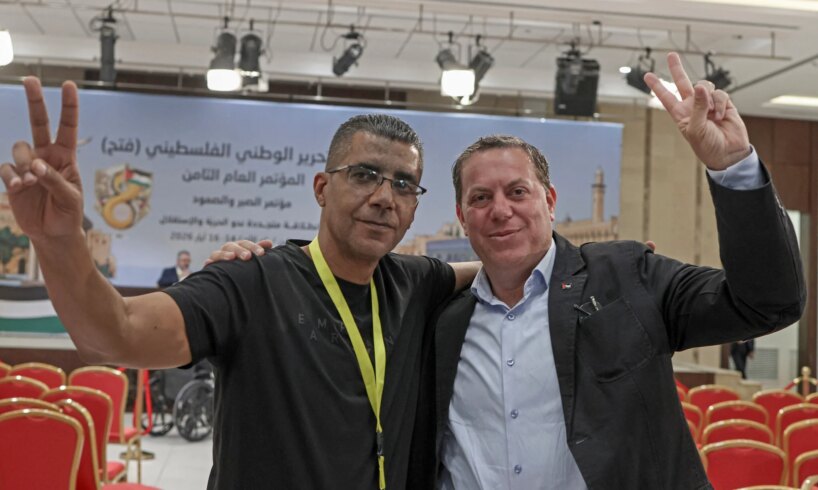
A recent conference held to elect new figures to leadership roles within the Palestinian political party Fatah was also a showcase of the growing power and influence of ex-prisoners, including many serving life sentences who were released from Israeli jails under deals that freed hostages held by terror groups in Gaza.
The May 14 convention, the first such gathering in a decade, saw the party led by Palestinian Authority President Mahmoud Abbas extend voting rights to 388 ex-prisoners, representing some 15 percent of the approximately 2,500 party members eligible to cast ballots, according to Raed Abu al-Humus, who heads the Palestinian Prisoners’ Affairs Authority, which operates under the PA.
The group included 30 former prisoners who ran for seats on Fatah’s Central Committee and Revolutionary Council, a number of whom had spent decades in jail for their roles in deadly terror attacks on Israelis. The two top leadership bodies have significant roles guiding the party, which dominates West Bank politics and largely controls the Western-backed PA and Palestine Liberation Organization.
According to the Prisoners’ Authority, the decision to extend voting rights to hundreds of former prisoners as a bloc was pushed by Abbas and other Fatah leaders in recognition of their growing numbers and influence.
“This is the first time the membership of released prisoners has reached such large numbers, and therefore they must appear in a manner worthy of the scale of struggle and sacrifices represented by the hundreds and thousands of years ‘burned’ inside prisons and detention centers,” Abu al-Humus said in a Facebook post ahead of the conference.
Get The Times of Israel’s Daily Edition
by email and never miss our top stories
By signing up, you agree to the terms
In general, Fatah extends voting rights based on criteria such as age, seniority and and geographic representation. However, this time it also opened up voting rights to Fatah-affiliated former prisoners who served at least 20 years in Israeli prisons.
Palestinian Authority President Mahmoud Abbas (2nd L) chairs the eighth Fatah conference in the West Bank city of Ramallah on May 14, 2026. (Jaafar ASHTIYEH / AFP)
In one sign of prisoners’ central place in the conference, voting was held not only in the West Bank but also in Cairo, where many former prisoners have been deported.
According to Yossi Kuperwasser, head of the Jerusalem Institute for Strategy and Security, the move to grant ex-prisoners voting rights was an expression of the esteem Fatah and Palestinian society in general hold for those involved in armed opposition to Israel who “paid the price” for their actions.
“In Fatah’s view, and in the broader Palestinian view, the terrorists are the fighting sector of Palestinian society. That’s how these people are seen,” said Kuperwasser, a former head of research for military intelligence. “They are role models, and of course they should be given respect and integrated into Palestinian political frameworks.”
Fatah forswore armed resistance to Israel as part of the peace process, but terror groups continued to operate under its direct authority until the mid-2000s, particularly the Al-Aqsa Martyrs’ Brigades, which operated as Fatah’s armed wing, and the more grassroots Tanzim.
The party’s ties with armed groups dissipated following the 2000-2005 Second Intifada, though veterans of terror groups remain members of Fatah.
Al Aqsa Martyrs’ Brigade fighters march in support of Yasser Arafat in Gaza City, Wednesday July 3, 2002. (AP/Adel Hana)
At the same time, many Palestinians continue to support violent struggle. Polling by the Palestinian Center for Policy and Survey Research showed that as of late 2024, around half of all Palestinians surveyed supported armed resistance as the best way to achieve independence.
Kuperwasser noted that during the conference, a brief mention of the prisoners by Abbas prompted loud applause from the audience.
“It’s important to remember that Fatah was founded as an organization carrying out a jihadist and terrorist campaign against Israel,” Kuperwasser said. “The narrative of struggle against Israel is still the dominant narrative among Palestinians. From Fatah’s perspective, the struggle needs to be managed wisely — not to constantly enter into confrontation like Hamas does. But in any case, the fighters implementing that struggle should be appreciated.”
Killers on the committee
The Palestinian Prisoners’ Affairs Authority did not publish the names of all 388 former prisoners granted voting rights, releasing only the names of the 30 individuals who ran in internal elections for Fatah’s Central Committee and its Revolutionary Council.
The 20-member Central Committee is Fatah’s top decision-making body, while the Revolutionary Council’s roughly 80 members are considered the movement’s “parliament,” tasked with overseeing the committee’s work.
Due to Abbas’s long dominance over Fatah, both bodies are widely viewed as subordinate to him rather than independent centers of power. Membership in them can nevertheless translate into political influence within the Palestinian Authority, as Fatah remains the dominant faction governing the PA.
With Abbas, 90, expected to exit the political stage in the coming years, if not sooner, those in Fatah’s Central Committee are viewed by Israel and the international community as potential successors.
A portrait of late Palestinian leader and Fatah party founder Yasser Arafat is displayed on a building as people attend the opening of the movement’s eighth general conference at Al-Azhar University in Gaza City on May 14, 2026. (Omar AL-QATTAA / AFP)
A review by The Times of Israel found that all the 30 former prisoners who ran for positions in the movement’s institutions — including one candidate who did not appear on the published list for an unknown reason but was elected to the Revolutionary Council — had been sentenced to 75 life terms altogether.
All but one were released in hostage deals following the October 7, 2023, Hamas-led attack, during which Israel freed some 5,000 prisoners in exchange for many of the 251 people kidnapped from southern Israel in the onslaught, as well as two civilians and the bodies of two soldiers held in Gaza for around a decade. Over 400 of those prisoners were serving life terms, though it’s unknown how many were member of Fatah.
The 30th candidate was released in the 2011 deal in which Israel freed 1,027 prisoners in exchange for captive IDF soldier Gilad Shalit.
Several of the former prisoners had served multiple life sentences for planning and carrying out attacks in which Israelis were killed, primarily during the Second Intifada as members of the Al-Aqsa Martyrs’ Brigades.
Hamas members watch as a bus carrying Palestinian prisoners arrives at the Rafah crossing with Egypt in the southern Gaza Strip as part of the deal for the release of hostage Gilad Shalit on October 18, 2011. (Abed Rahim Khatib/Flash 90)
Fatah’s grassroots field organization Tanzim was also responsible for numerous attacks during the uprising and earlier. Today the group is considered defunct.
Zakaria Zubeidi, who headed the Al-Aqsa Martyrs’ Brigades in Jenin during the Second Intifada, was one of two released prisoners who were elected to the Central Committee, along with Taysir Bardini, who was released in the 2011 Shalit deal.
Zubeidi, from the Jenin refugee camp, was accused of involvement in planning and carrying out attacks against Israelis, but was given amnesty in 2007 when he renounced violence, as part of a deal between Israel and the PA.
Palestinian leader Mahmoud Abbas, is carried by the Al Aqsa Martyrs’ Brigades leader in West Bank, Zakaria Zubeidi, center left, during a campaign visit to the Jenin refugee camp Dec. 30, 2004.(AP/Enric Marti)
In 2019, he was arrested and charged with taking part in two shooting attacks against Israeli buses in the West Bank, thereby violating the deal, with additional allegations dating back to the early 2000s added to the charge sheet.
After his escape from prison in 2021, five more years were added to his sentence.
He was released in a January 2025 hostage deal.
Bardini, from Rafah in the Gaza Strip, was imprisoned in 1993 and sentenced to life imprisonment for murder carried out during hostile activity, though the specific attack or operation for which he was convicted has not been publicly identified.
He was released to the West Bank in 2011.
Released terror convict Yasser Abu Bakr was the lone candidate from among the released prisoners to win a seat on Fatah’s Revolutionary Council.
A member of Fatah’s military wing during the Second Intifada, Abu Bakr was handed three life sentences for involvement in a 2002 attack in Netanya in which two Israelis were killed, including a 9-month-old baby, as well as for the killing of a Border Police officer during an armed clash near Baqa al-Gharbiya the same year.
Election poster of Yasser Abu Bakr, a former prisoner who served multiple life sentences, was released in a deal with Hamas, and was elected to Fatah’s Revolutionary Council, May 2026. (Yasser Abu Bakr’s Facebook page)
After he was released in January 2025, Abbas personally called to congratulate him, telling him in a recorded phone conversation that Israel was “harsh on you.”
Another released terrorist involved in the same Netanya attack was Ahmed Abu Khdeir, a senior Al-Aqsa Martyrs’ Brigades operative who failed to win a seat on the Revolutionary Council.
Aside from involvement in the Netanya murders, Abu Khdeir was also convicted of dispatching a gunman who opened fire on a Hadera bat mitzvah in January 2002, killing six.
He was sentenced to 11 life terms for his role in those and other attacks, but was released in January 2025 and deported abroad, and now resides in Egypt.
Illustrative: Palestinian security prisoners gesture from inside a bus after being released from Ofer Prison in the West Bank on October 13, 2025, in exchange for hostages held in Gaza since the October 7 attacks. (HAZEM BADER / AFP)
Several other senior terrorists also fell short of winning seats on the councils, including:
Majed al-Masri, who served as commander of Fatah’s military wing in the West Bank during the Second Intifada. He was sentenced to 10 life terms for planning attacks in which numerous Israelis were killed, but was let go in October 2025 and deported abroad
Mansour Shreim, a senior Tanzim figure based in Tulkarem who was sentenced to 14 life terms for involvement in multiple attacks, including a May 2002 attack on a yeshiva in Itamar in which three students were killed. He was released in the second hostage deal between Israel and Hamas, in January 2025, and deported abroad.
Omar Mardawi, a Tanzim operative who was sentenced to life imprisonment for involvement in the abduction and murder of an Israeli, Yuri Gushchin, in 2001. He was released in February 2025 and was slated for deportation to Gaza, but Israeli media reported that he initially refused release because he feared Hamas would harm him due to his affiliation with Fatah and was ultimately allowed to return to the West Bank.
Muhammad Naifeh, a Tanzim operative in Tulkarem serving 13 life sentences for involvement in and planning of several attacks, including an October 2002 attack in Hermesh in which three women were killed, and an attack the next month on Kibbutz Metzer in which five Israelis were murdered, including a mother and her two children. He was released in February 2025.
Adnan Obeiyat, a senior Tanzim operative sentenced to eight life terms for involvement in attacks in which Israelis were killed, including two deadly shootings in October 2000. He was released in October 2025 and deported abroad.
The top vote-getter in the election was Marwan Barghouti, the former head of Tanzim who is serving five life terms for direct involvement in three attacks: a March 2002 shooting attack at the Seafood Market restaurant in Tel Aviv in which three Israelis were killed; the January 2002 killing of Yoela Chen in Givat Ze’ev; and a June 2001 shooting attack near Ma’ale Adumim in which a Greek monk was killed.
Illustrative: Rescue workers carry the body of a motorist killed in a shooting attack near the West Bank town of Ramallah, Friday, June 20, 2003. (AP Photo/Pier Paolo Cito)
Though his influence over decision-making is hampered by his ongoing incarceration, he is considered among the most popular Palestinian politicians and would rival Abbas for leadership were he released, opinion polls show. He says he has reformed and no longer supports violent resistance.
The election marked the third time Fatah has returned him to the Central Committee since he was first elected to the body in 2009. He is the only currently serving inmate to sit on the panel.
Following the elections, Zubeidi posted a photograph on Facebook alongside Barghouti’s wife and several other released prisoners, with a large portrait of Barghouti in the background.
“To our brother commander Marwan Barghouti,” he wrote, “we believe that patience and steadfastness are the path to dignity and freedom for all our people.”
Zakaria Zubeidi, second left, alongside other released prisoners affiliated with Fatah and Marwan Barghouti’s wife, with a portrait of Barghouti in the background, after Zubeidi’s election to Fatah’s Central Committee, May 19, 2026. (Zakaria Zubeidi’s Facebook page)
According to Kuperwasser, the vote was a sign of the extent to which those involved in armed resistance, and their support for terrorism, will continue to play an important role within Palestinian leadership.
“All of Abbas’s potential successors are committed to the idea of struggle against Israel,” he said. “His son Yasser, even though he is a businessman, is committed to it. Hussein al-Sheikh [vice president of the PA] and Jibril Rajoub [head of the Palestinian Football Association] are committed to it as well, and Marwan Barghouti is deeply committed to that narrative.”