Shafaq News
More than a year and a half after
the Kurdistan Region’s parliamentary elections, the formation of the tenth
cabinet remains stalled amid ongoing political disputes between the two main
parties, the Kurdistan Democratic Party (KDP) and the Patriotic Union of
Kurdistan (PUK).
As rounds of dialogue and
negotiations continue, questions are mounting over the real reasons behind the
delay in forming the government, and whether the crisis is rooted in the
election results themselves or in how those results are being translated into a
political partnership capable of managing the next phase.
Parliamentary Seat Map
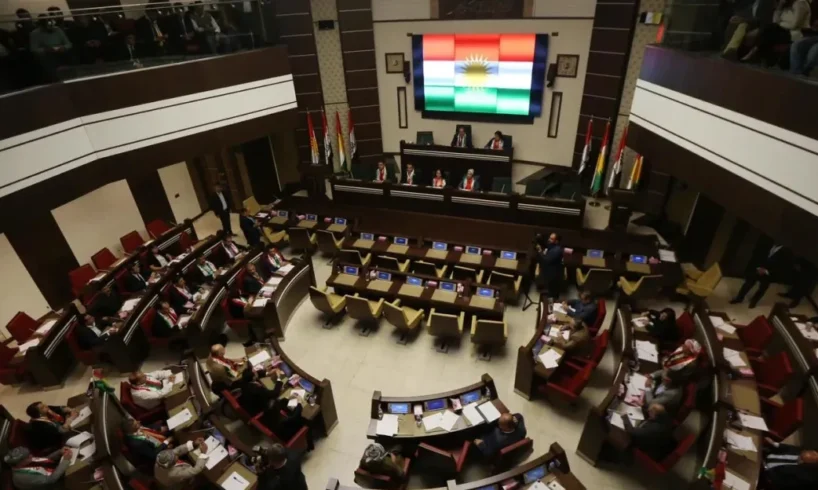
The Kurdistan Parliament elections,
held on October 20, 2024, produced a new political landscape that reshaped the
balance of power inside parliament. However, no party secured a comfortable
majority that would allow it to form a government on its own, making consensus
among the major political forces a prerequisite for establishing the new
cabinet.
According to the official results,
the KDP won 39 seats, while the PUK came second with 23 seats. The New
Generation Movement (Al-Jeel Al-Jadeed) made significant gains, securing 15
seats. The Kurdistan Islamic Union won seven seats, the National Position
coalition obtained four seats, and the Kurdistan Justice Group secured three
seats. The remaining were distributed among other political parties and quota
representatives of minority communities.
The results clearly showed that the
KDP maintained its position as the largest political force in the Region but
failed to secure an outright majority that would enable it to form a government
independently. The PUK remained the second-largest force capable of influencing
the government formation process.
At the same time, the rise of the
New Generation Movement added further complexity to the political landscape
after it became the third-largest bloc in parliament, creating new political
equations that had not existed in previous legislative terms.
Read more: Kurdistan Region’s political deadlock: Impact and perils
Electoral Entitlement or Political
Partnership?
Saadi Ahmed Pira, a member of the
PUK Political Bureau, said the crisis surrounding the formation of the
Kurdistan Region’s government is linked less to the election results themselves
than to how those results are being handled and translated into genuine
political partnership within the executive authority.
“The PUK believes that electoral
entitlement should be the foundation upon which the government formation
process and the distribution of responsibilities and positions are built,” Pira
told Shafaq News.
He argued that the KDP does not
adequately adhere to this principle and instead seeks to form the government
according to its own vision before allocating positions to other parties,
without involving them effectively in drafting the government’s program,
determining its structure, or defining how powers should be distributed.
“The real problem is not the number
of seats won by political parties, but the absence of full recognition of the
principle of partnership based on electoral entitlement.”
He called on the KDP to apply within
the Kurdistan Region the same standards of balance, consensus, and partnership
that it demands from the federal government in Baghdad, ensuring that the new
cabinet reflects the election results and the political will of voters.
Regarding calls for new
parliamentary elections, Pira stressed that such a step would not solve the
current crisis because a new vote would not produce a fundamentally different
political reality and would impose high financial costs.
He said the PUK does not fear new
elections and believes it is politically and organizationally stronger today
than it was before the last vote, arguing that resorting to elections would not
address the root problem, which lies in disagreements over the government
formation mechanism and respect for parties’ electoral mandates.
Pira noted that the PUK continues to
call for dialogue and negotiations aimed at forming a government based on
genuine partnership, political balance, and electoral entitlement, ensuring the
participation of all forces represented in the Kurdistan Parliament in managing
the next phase.
He also described current regional
and international involvement in Kurdish affairs as positive, saying it
“contributes to encouraging dialogue and bringing political parties closer
together.”
PUK President Bafel Talabani has
stated that a government similar to the current one cannot be formed,
reiterating that his party seeks a cabinet based on partnership and balance,
“one that understands the demands of the Kurdish public and works to improve
relations between Erbil and Baghdad.”
Meanwhile, Kurdistan Region Deputy
Prime Minister Qubad Talabani, a PUK leader, has likewise stressed the
readiness of political forces to reach a genuine agreement on forming the new
regional government.
Crisis Predates the Elections
The KDP rejects accusations that it
is responsible for the stalled negotiations and insists that the current crisis
is linked to political positions that predate the elections, as well as new
alliances formed afterward inside parliament.
Kamran Gharib, a KDP official,
affirmed that the party had invited the PUK to enter negotiations over the
formation of the tenth cabinet before Iraq’s parliamentary elections, “but the
PUK did not respond to the invitation.”
Speaking to Shafaq News, Gharib said
the election results and the KDP’s clear gain, not only within the Kurdistan
Region but also compared with other Iraqi political forces, prompted the PUK to
search for alternative political options and alliances, noticing that this was
reflected in the PUK’s move toward coordination with the New Generation
Movement and the formation of a joint bloc inside the Kurdistan Parliament.
“A large portion of New Generation’s
votes came from al-Sulaymaniyah, Garmian, Halabja, and areas within the PUK’s
sphere of influence.”
He argued that those votes primarily
represented “dissatisfaction with PUK policies” and that many voters who
supported New Generation had previously been part of the PUK’s support base
before shifting to an opposition political project.
Addressing demands for the
distribution of positions according to a “50-50” formula, Gharib stressed that
the arrangement belonged to a previous political phase and “has been overtaken
by current political and electoral developments.”
He insisted that the present stage
requires respect for each party’s electoral entitlement based on its
representation in parliament rather than adherence to traditional formulas that
prevailed in earlier periods.
“The KDP, when it calls for
partnership, balance, and consensus at the federal level, does not do so for
the benefit of the party itself but rather in defense of the rights of the
Kurdish component within the Iraqi state,” Gharib said in response to Pira’s
remarks regarding partnership.
He also recalled the period
following the rise of the Gorran Movement in Al-Sulaymaniyah, Garmian, and
Halabja, when the PUK’s electoral results declined to a level that, according
to electoral entitlement standards, did not qualify it to hold the position of
Kurdistan Region Prime Minister.
Back to history, Gharib said, the
KDP decided, at the request of the late President Jalal Talabani, to grant the
position to the PUK, leading to the appointment of Barham Salih as Prime
Minister of the Kurdistan Regional Government.
Gharib highlighted that the “new
PUK” is currently advancing demands and issues that the KDP believes are not
based on clear legal or democratic foundations, adding that any successful
political process must be based on dialogue, understanding, and respect for
electoral entitlement, “not on imposing conditions or dictates by any party.”
Regarding the possibility of new
parliamentary elections, Gharib said “all options remain on the table” to
reactivate the legislative institution and form a new government, “except for
any options that lead to escalation or confrontation.”
Like Pira, Gharib pointed to the
external dimension, saying neighboring countries view the stability of the
Kurdistan Region as a shared interest and seek a strong government capable of
managing political, security, and economic affairs efficiently.
Roots of the Crisis
Between the competing narratives of
the two parties, observers interviewed by Shafaq News believe the crisis
extends beyond current disputes over positions and ministerial portfolios and
is linked to a long history of political rivalry and differing visions
regarding the governance and future of the Kurdistan Region.
Political analyst Abu Bakr Karawani
told Shafaq News that the failure of the KDP and PUK to reach an agreement
stems from four main factors that intersect and directly affect the government
formation process.
The first factor is the historical
legacy of political disputes and conflicts between the two parties, dating back
decades to the 1960s. The second involves current political disagreements and
unresolved issues that remain points of contention. The third relates to
differing views on local, regional, and international issues, as well as
contrasting perspectives on the future of the Kurdistan Region and its
administration. The fourth factor concerns conflicting political interests tied
to the distribution of positions and powers within the next government.
Karwani said the absence of a
unified institutional framework across the Region, combined with the
administrative and political divisions based on party influence in certain
areas, “has deepened internal disagreements,” adding that this reality has
created an environment that allows external actors to intervene and exploit
these divisions to advance political, national, factional, or sectarian
interests.
The political forces in the
Kurdistan Region, particularly the KDP and PUK, must recognize the scale of the
risks that could result from the continuation of political division and
disagreement, he stressed, identifying the absence of an effective constitution
for the Kurdistan Region as one of the key factors shaping the current reality.
“There is no constitutional framework that clearly defines government formation
procedures or designates the authority responsible for assigning that task.”
He said these factors make an
understanding between the KDP and PUK essential for successfully forming a
government and ensuring its stability. “The most realistic option at the
current stage is the formation of a consensus government that includes the two
main forces and is based on political partnership and national consensus,
Karwani said, concluded that the nature of the political system in the
Kurdistan Region, together with weak institutional structures compared with the
level of party influence, necessitates consensus-based solutions rather than a
political majority approach.
“This makes a partnership government
the best option for ensuring political and administrative stability and moving
conditions toward greater stability and development.”
Written and edited by Shafaq News
staff.