NEW DELHI – Several thousand students and other youngsters converged in central New Delhi on July 20 in an attempt to march to the Indian Parliament and press for the resignation of the country’s education minister Dharmendra Pradhan.
It marked a dramatic escalation in the weeks-long ongoing protest mounted by the viral Indian youth-led social movement, the Cockroach Janta Party (CJP), which has been demanding Pradhan’s resignation. They are accusing him of failing to prevent a spate of competition exam paper leaks that have led to exams being cancelled, leaving youth frustrated and distressed.
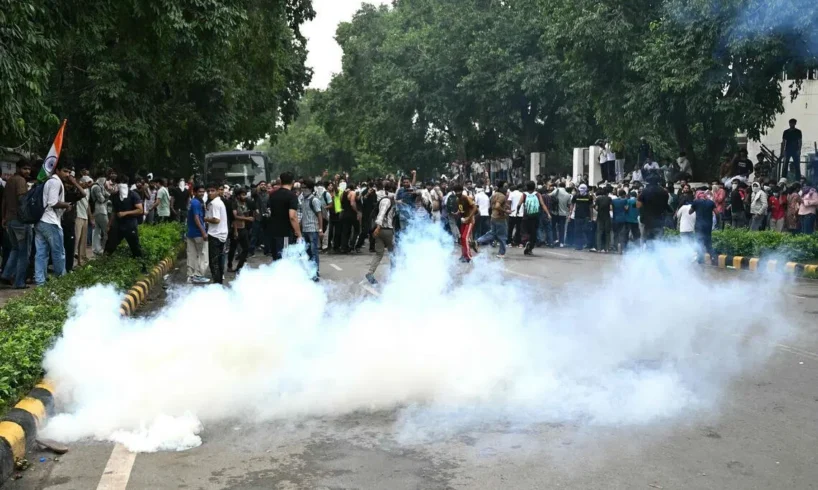
What began as a peaceful campaign in the morning turned violent in the afternoon, as the police cracked down on the Jantar Mantar protest site, beating protesters with sticks and batons in their attempt to clear the venue. They also fired tear gas shells in the vicinity where thousands had thronged.
“Black day for democracy,” posted CJP on July 20, with a video showing protesters being beaten with sticks. There were reports of injuries to protesters, who were joined by some opposition party leaders in the march.
Around 4pm in India, security forces launched a massive charge at the protest site, chasing away protesters and dismantling tents that had been set up by the CJP from early June.
Supporters of the Cockroach Janta Party converged on a key road leading to the Parliament on July 20.
ST PHOTO: DEBARSHI DASGUPTA
Violence had erupted earlier on July 20 as some people tried to break through the barricade that had been placed near the protest venue to prevent them from marching to Parliament. The Delhi police said they did not have permission to march to the Parliament, or to continue their protest at the venue.
Tensions had begun escalating since July 18, after the police forcibly hospitalised activist and educator Sonam Wangchuk, who was on the 21st day of an indefinite hunger strike in support of the CJP at the Jantar Mantar protest venue.
The CJP, which is not aligned with any political party and is youth-led, was launched on May 16 as a satirical reaction to a senior judge’s remark describing unemployed youngsters as “cockroaches”. It has since gained a massive following, even though the judge subsequently said he was misquoted.
Supporters of the party – often referred to as “cockroaches” – had begun swarming into New Delhi since the evening of July 19, with crowds swelling far beyond what had been anticipated.
Estimates ranged from upwards of 10,000 or even more, despite a quick monsoon downpour and various attempts by the authorities to limit their presence. These included the closure of key roads leading to Central New Delhi and nearby metro stations, which affected commuters, as well as the blocking of the internet in the neighbourhood to prevent further mobilisation of protesters.
These restrictions, however, did not deter Pritam Kumar, a 20-year-old student who had arrived from Noida, a city adjoining Delhi, from turning up at the protest venue on July 20, holding an umbrella in the rain. He walked for around 40 minutes from the closest open metro station to get to the venue, determined to demand an efficient competitive exam structure and affordable education.
“I have friends who sat the NEET exam that was leaked, so I know what kind of pain they have to deal with,” he said.
Pritam Kumar, 20, was one of the many students who showed up for the protest march on July 20.
ST PHOTO: DEBARSHI DASGUPTA
The National Eligibility Entrance Test (Undergraduate) or NEET-UG is a highly competitive national undergraduate medical school entrance exam that was annulled following a leak, after it was first held in May 2026. It was conducted again later in June.
Protesters came from outside Delhi too, drawn by the need to fix India’s “leaking” education system. Among them was student Hemang Kanojia, 25, who had come from Chandigarh, a city in north India over 240km away from Delhi.
He told The Straits Times that “the pain (from exam paper leaks) is something that… unites us”.
“I am here because if not now, then when? This thing has become too personal to not talk about it right now,” said Kanojia, who sat a national competitive exam in 2024 that too was annulled due to a leak.
The protest was mostly peaceful until late afternoon, with protesters marching and chanting slogans. Others sat on the roads in small groups, singing to keep their morale high.
“Go, Pradhan, Go, Saat Mein Modi Ko Bhi Lo (Take Modi along with you too),” chanted a group in unison, banging plastic bottles on the tarmac to keep rhythm. They were referring to Prime Minister Narendra Modi.
“It’s just shocking to see that the people we elected have turned a blind eye to youth dying… because of their incompetency,” said Sajal, 22, a law student interning with a law firm in Delhi, seated near the police barricades on the road leading to the Parliament. The exam paper leaks have left a trail of deaths, with at least 14 NEET-UG aspirants dying by suicide in India so far in 2026, due to the immense stress arising from exam-related delays caused by the leak and the subsequent re-test.
The wider message from the ongoing protest, he added, was that people should change the government electorally if it stops listening to the people.
However, in a sign of a possible breakthrough, CJP representatives met Minister of Health and Family Welfare J.P. Nadda on Monday afternoon, a rare public confirmation of talks between the CJP and the government.
Nadda posted on X that CJP protesters had approached the government for talks in the morning “for the first time” and he urged them to end their demonstration and help restore “normalcy” in the capital.
CJP spokesman Saurav Das posted on X too, saying their demands, including their call for Pradhan’s “immediate resignation”, had been handed over in a petition.
Das, however, clarified that the government had made no commitments so far. “The peaceful protesters will not rest until the demand is met!” he added.
Wangchuk, too, has said that he will continue his hunger strike.
Mahima Pawar and and her brother Girish at the protest on July 20.
ST PHOTO: DEBARSHI DASGUPTA
Many who were there on July 20 were first-time protesters, indicating the CJP’s growing appeal. Among them was Girish Pawar, 21, who had come from Delhi with his sister Mahima Pawar, 20, to attend what they said was their first public protest.
A business graduate, Girish Pawar has been struggling to find a job that meets his expectations and pays him more than 15,000 rupees a month (S$200). He said he supports the CJP’s wider calls to reform education and tackle youth unemployment, which is why he showed up at the protest. “I think it’s for the greater cause,” he added.