When it was announced in June 2012 that a new bridge would be constructed across the Detroit River, Prime Minister Stephen Harper mused that the project, once completed, would be “a very timely and fitting statement of the friendship between our two great countries.”
Noting that it was the 200th anniversary of the War of 1812 — the first shots of which had been fired in that area — Harper said that conflict had given way to an enduring and remarkable peace.
“Canada and the United States became not just the best of friends, but arguably the most intimate and successful international friendship in human history,” Harper posited.
That bridge — what would come to be named the Gordie Howe International Bridge — was its own tale of prolonged struggle and political drama. But that saga seems relatively quaint now. And when the bridge officially opens next week it will arrive into a world that seems very different from the one that existed in 2012.
The bridge would, in fact, already be open if the American administration hadn’t decided, at almost the last possible moment, to insist on renegotiating the terms under which the bridge was constructed (at Canada’s expense). Meanwhile, U.S. President Donald Trump threatened last week to impose tariffs on Canada for the wildfire smoke that has drifted into the United States, the president blaming “Willful Negligence” (as opposed to, say, climate change) for another summer of air quality warnings.
American tariffs imposed last year remain in place. But the United States is now pledging to move forward with a new raft of tariffs, some of which it justifies as a response to the decision of several provinces to pull American alcohol off the shelves of provincial liquor stores (which provincial governments only did in response to the Trump administration’s earlier tariffs). About five per cent of Canadian exports to the United States is expected to be impacted.
As a result, Infrastructure Minister Gregor Robertson’s office announced that Canadian officials would not be participating in a ceremonial event with American officials on Friday to mark the opening of the bridge.
If nothing else, these latest developments might bolster the case for Carney’s contention, first offered 16 months ago, that, “the old relationship we had with the United States — based on deepening integration of our economies and tight security and military co-operation — is over.”
But that leaves an incredible amount to be navigated and negotiated, both now and in the long term.
Too many concessions or not enough?
Whatever the claimed pretext, the latest tariffs might be fairly read as an attempt by the American side to pressure Canadian officials into making concessions as part of the ongoing CUSMA negotiations. Within the White House’s official explanation on Monday was a suggestion that the Canadian side has been altogether too unco-operative.
“Over the past year and a half, only two countries have chosen to retaliate against President Trump’s tariffs rather than negotiate a deal with the United States: the People’s Republic of China and Canada,” the White House said.
Canadians might reasonably respond that this country did negotiate a deal with the United States — the existing trade agreement, CUSMA, that Trump himself signed in November 2018.
In Canada the political conversation has generally focused instead on the concessions the Carney government has already been willing to make — from abandoning plans for a digital services tax to agreeing to renegotiate the bridge agreement. (Going back further, it is worth remembering the effort expended by Justin Trudeau’s government when the purported justification for tariffs was fentanyl.)
WATCH | Carney says booze ban should be part of overall deal:
Carney says U.S. booze bans should only end as part of an overall trade deal
Prime Minister Mark Carney says the decision to either keep or change bans on American alcohol in Canadian liquor stores will be ‘taken by the provinces themselves.’ But he said his opinion is those changes should only be made ‘as part of an overall agreement.’
The concessions made to date have obviously failed to result in the reduction or removal of American tariffs — and that’s a potential political problem for Carney. But then it is also hard to know whether Canadian negotiators are refusing demands behind closed doors to make even greater concessions.
In its initial response to Trump’s latest tariffs, the Conservative Party lamented that the prime minister has failed to secure a new deal with the United States. But then it’s not clear what sort of concessions would be necessary to get a deal right now.
Presently, neither Carney nor the premiers seem particularly inclined to back down on the apparently loaded question of American booze.
“There is not a chance in hell that U.S. alcohol is going back on the shelf,” British Columbia Premier David Eby said in Charlottetown.
“The decision to change that … should only be taken, in my judgment, as part of an overall agreement,” Carney said, somewhat more diplomatically.
A line in the sand has been drawn down the middle of the wine aisle.
A bridge over troubled water
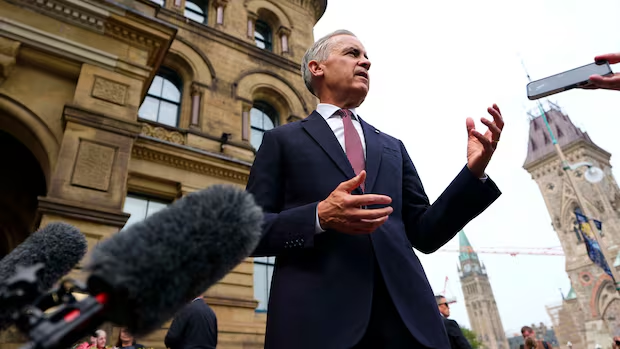
Refusing to ignore the obvious, Carney began his remarks to reporters on Tuesday by noting that tariffs would be in violation of CUSMA. Canadian negotiators, he said, have made a “series of comprehensive and detailed proposals” about how to “modernize” that agreement, while “recognizing the transition that the U.S. is underway in … all its trading relationships.”
Trump and Carney have agreed now to “intensify” negotiations. Of the possibility of retaliating, Carney noted that four weeks remain before these latest tariffs would come into effect, but that his government would “look at all options in terms of how we would respond.”
Perhaps this 17-month conflict is thus hurtling toward some kind of resolution over the next 29 days. But even then, it now seems necessary to ask how long it would be before the White House’s next attempt to wield American power and economic integration as a weapon against Canada.
“Canadians, and all the other longtime partners facing trade punishment and even attacks on our sovereignty, feel deeply betrayed by the country that led our alliance for the past eight decades,” Chrystia Freeland, the former foreign affairs minister, wrote in the Financial Times on Tuesday. “A lot of us are not sure what it will take to ever fully trust the U.S. again.”
WATCH | Federal leaders decry new tariff threat:
Federal leaders decry new tariff threat, call for Carney to implement new strategies
Leaders of federal parties across the political spectrum are voicing opposition to U.S. President Donald Trump’s latest tariff threat — and some are taking aim at Prime Minister Mark Carney’s strategy in dealing with the White House.
Many Americans, she suggested, have failed to fully appreciate that breach. (Pew Research’s recent finding that more Canadians have a favourable opinion of China than of the United States might help to make the point.)
Carney will justifiably be judged for whatever deal emerges from this episode — assuming a deal does eventually emerge. But in the long term he may more broadly be judged for how well he positions Canada for the potential new worlds that have come into view over the last year and a half.
The prime minister has spoken of a potential “new partnership” between Canada and the United States, but the details of that obviously still remain to be seen.
When traffic begins flowing over the Gordie Howe bridge, it will be proof that the physical geography of North America has not fundamentally changed in the last 14 years. But everything else about the “most intimate and successful international friendship in human history” now seems up for debate.