From Almas Group Logistics:
New Customs Regulations Take Effect at Umm Qasr Port: What Iraqi Importers Need to Know
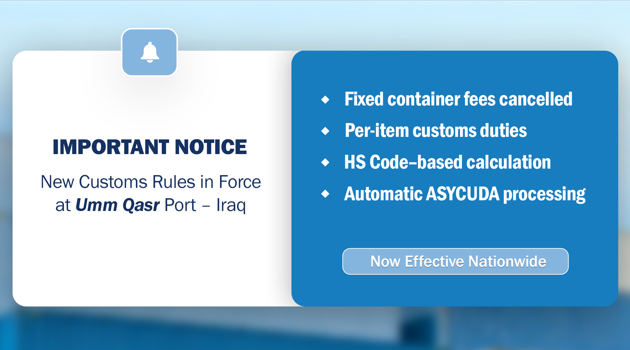
Iraqi Customs implements item-based duty calculations under Council of Ministers Decision No. 957/2025 applying customs duties based on individual item classification and value.
Significant changes to customs clearance procedures are now in effect at Umm Qasr Port, Iraq’s largest gateway for international trade, following Council of Ministers Decision No. 957 for 2025. The new regulations fundamentally alter how customs duties are calculated for import shipments, moving from a fixed-fee structure to item-specific assessments.
Key Changes to Customs Procedures
End of Fixed Container Fees
The longstanding fixed customs fee structure for 20-foot and 40-foot containers has been eliminated. This system, which provided predictable costs for importers regardless of container contents, has been replaced by a more granular approach that evaluates each item individually.
Item-Based Duty Calculation
Under the new system, customs duty is calculated per item based on its Harmonized System (HS) Code, with rates starting at 5% and varying by product category. This approach aligns Iraq’s customs procedures more closely with international standards but introduces additional complexity for importers managing diverse shipments.
Valuation Methods
Customs authorities will determine duty-liable values using either the commercial invoice provided by the importer or the official customs valuation from the tariff book, at the discretion of Iraqi Customs. This dual-valuation approach requires importers to ensure accurate documentation while understanding that final assessments may differ from declared values.
Tax Collection Changes
Tax deposits, previously collected through advance payment systems, have been restructured. Collections now occur directly at ports and border crossings, calculated based on shipment value in addition to customs duty. This change affects cash flow planning for businesses managing regular import operations.
Automated Processing Through ASYCUDA
All calculations under the new system are processed automatically through the ASYCUDA (Automated System for Customs Data) platform, Iraq’s electronic customs management system. This automation aims to improve transparency and reduce manual processing variations, though it also means less flexibility in individual case handling.
What Remains Unchanged
Local product protection rules continue to apply as previously established. These provisions, designed to support Iraqi manufacturing and agriculture, maintain their existing structure despite the broader customs reform.
Implementation Status and Delays
The regulations are currently active and enforceable throughout Iraqi customs operations. Contrary to some industry speculation, there has been no official confirmation of delays or suspension of these requirements.
However, the transition to new procedures has created operational challenges. Importers and logistics providers should anticipate delays at ports and border crossings as customs officials adapt to item-by-item processing requirements. These delays may affect supply chain timelines and inventory management planning.
Impact on Import Costs
The shift from fixed to variable customs calculations introduces cost unpredictability for importers. Businesses that previously budgeted based on container counts must now factor in:
Individual item classifications and corresponding duty rates
Potential valuation differences between commercial invoices and customs assessments
On-site tax collection requirements
Extended clearance times and associated charges
Additional charges that may arise from processing delays include demurrage fees, storage costs, port handling charges, and berth fees. These expenses, while not new, may increase in frequency due to extended clearance periods during the transition phase.
Legal Classification as Force Majeure
The customs industry has classified these regulatory changes as force majeure events — circumstances beyond the control of private companies. This classification is significant for contractual relationships between logistics providers and their clients, as government-imposed regulatory changes fall outside normal operational risk management.
This designation means that logistics companies and freight forwarders cannot be held responsible for costs arising directly from compliance with the new customs framework. The regulations apply uniformly across all companies and clients operating within Iraqi trade channels.
Guidance for Importers
Documentation Accuracy
Ensure all commercial invoices contain detailed, accurate descriptions of goods with correct HS codes. Discrepancies between declared and assessed values can trigger additional scrutiny and delays.
Cash Flow Planning
Adjust financial planning to accommodate on-site tax payments and potential cost variations based on item-specific duty calculations rather than predictable container fees.
Timeline Adjustments
Build additional buffer time into supply chain schedules to account for extended customs processing periods. Critical inventory should be ordered with wider lead times during the transition period.
Professional Consultation
Engage experienced customs brokers and logistics partners familiar with the ASYCUDA system and current Iraqi customs practices. Professional guidance can help navigate the new requirements and minimize delays.
Industry Perspective
The move to item-based customs calculations represents a modernization of Iraq’s customs framework, bringing procedures closer to international standards. However, the transition period presents operational challenges for businesses accustomed to the previous system.
Logistics providers emphasize that cooperation and accurate documentation from importers will be critical to minimizing delays during the adjustment period.
Looking Ahead
As Iraqi Customs and the business community adapt to the new framework, processing efficiency is expected to improve. The ASYCUDA automation should eventually streamline procedures once customs officials and importers become familiar with item-specific requirements.
However, businesses should prepare for an adjustment period of several months as the system stabilizes. Those who proactively update their documentation practices and build flexibility into supply chains will be best positioned to manage the transition successfully.
About Almas Group
Almas Group is an Iraqi logistics and freight forwarding company specializing in customs clearance, project cargo, and international freight forwarding services.
For more information: www.almastpgroup.com/en | [email protected] | +964 772 430 5599