Huawei Cloud launched AI infrastructure and a coding agent beta in Thailand.Huawei and Thai partners launched an AI ecosystem initiative.
Huawei Cloud has introduced infrastructure for building and operating AI agents in Thailand, alongside an open beta version of its AI-assisted software development platform.
The announcements were made during Huawei Cloud Summit Thailand 2026, which brought together representatives from government agencies, businesses, technology companies, and industry partners. The event was part of the Huawei Thailand Digital & AI Summit 2026, co-hosted by Huawei and Thailand’s Ministry of Digital Economy and Society in Bangkok on July 23 and 24. Huawei said the broader summit drew more than 3,000 participants, including government representatives, telecom operators, enterprises, and technology partners.
Huawei Cloud used the event to make its Agentic Infrastructure available in Thailand and open CodeArts Agent to beta testing by local developers and enterprises. Participants can test the coding platform and provide feedback before its wider release, the company said.
Infrastructure, development, and security
Agentic Infrastructure supports the development, deployment, and operation of AI agents. It covers computing-resource scheduling, memory storage, token generation, runtime security, and continuous learning. The service includes an AI Cluster Service based on Huawei Cloud’s UnifiedBus architecture, which the company said improves token generation across computing clusters.
The Agentic Memory Storage Service provides petabyte-scale storage for retaining context and supporting tasks that run over extended periods. AgentSphere provides a controlled runtime environment in which autonomous agents can operate, while CCE VolcanoNext manages the scheduling of general-purpose and AI computing resources within the same infrastructure.
Surasak Wanichwatphibun, chief technology officer of Huawei Cloud Thailand, said the company would continue investing in the computing infrastructure required to support enterprise AI deployments. “Huawei Cloud will continue to strengthen its technological capabilities and build a robust computing infrastructure to drive AI innovation across enterprises,” Surasak said. Huawei also identified computing resources, data, models, security, and talent as five constraints affecting enterprise AI deployments in Thailand.
CodeArts Agent combines an integrated development environment, coding models, and automated software development functions. The platform supports project-level code generation, code completion, unit-test generation, and question-and-answer functions based on research and development material. Its open beta gives organisations in Thailand access before the full release, allowing developers to test the platform and submit feedback on its performance and usability.
The platform uses specification-driven development to connect software requirements with coding, testing, and delivery. Huawei Cloud has also introduced an Agent Team mode, which assigns multiple AI agents to development tasks and allows them to work concurrently on the same project. Huawei said CodeArts Agent is intended to reduce repetitive work across the software development process.
Huawei Cloud also outlined security services covering AI infrastructure, training data, model inference, and agent applications. The company said its updated services address two areas: protecting AI systems and applying AI to cyber defence. It identified security, stability, and service quality as priorities for enterprise deployments.
Dedicated security zones allow customers to manage their own encryption keys, while Huawei Cloud said platform administrators cannot access customer data stored in these environments. The service combines software and hardware controls, including hardware acceleration, to support encrypted processing without reducing service performance.
Huawei Cloud also introduced Data Capsule technology, which restricts data use to authorised environments and makes data invalid if it is moved outside a designated security zone. Huawei presented the controls as measures for organisations managing data privacy and sovereignty requirements.
Huawei Cloud agentic infrastructure is now available for Thailand (Source: Huawei)
Government policy and ecosystem plans
Thailand’s Ministry of Digital Economy and Society used the summit to discuss national AI policies, public-sector adoption, and cooperation between government agencies and private companies. Chaichanok Chidchib, Thailand’s minister of digital economy and society, said the country’s AI policy is organised around infrastructure, trust, and people.
“The future of AI cannot be created by any single organisation alone, but requires collective efforts from all sectors to build an inclusive and sustainable AI ecosystem,” Chaichanok said. He also described Thailand as a testing environment in which companies, researchers, and regulators can apply AI governance principles in operational settings.
“Thailand is advancing as a real-world AI Governance Sandbox, where companies, researchers, and regulators can work together to translate global principles into practical implementation,” Chaichanok said. Thailand’s National Electronics and Computer Technology Center also presented a government AI case study covering shared infrastructure and platforms, as well as chatbots and intelligent assistants designed to support public officials and citizen services.
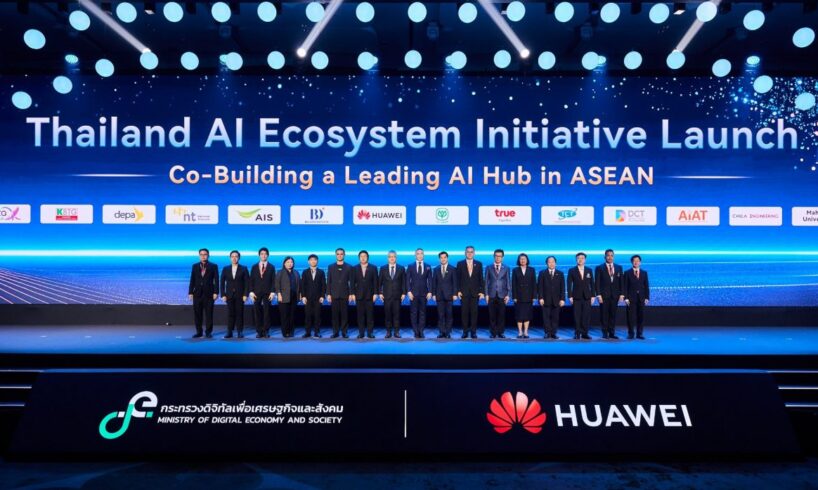
Huawei, the AI Association of Thailand, telecom operators, local AI model developers, enterprises, and universities also launched the Thailand AI Ecosystem Initiative during the summit. The initiative covers AI infrastructure, governance, industry deployment, open-source technology, and local skills development.
Participants said the initiative would involve cooperation among technology providers, researchers, regulators, universities, and enterprise users. Huawei did not disclose funding commitments, implementation targets, or a timetable for the initiative.
Industry use cases
Organisations at the event presented AI and cloud use cases across the public sector, banking, and human resources. Public-sector examples included AI platforms and intelligent assistants designed for government operations, while banking cases covered AI-assisted coding and large language models. Human resources applications focused on learning and skills-development platforms.
Hong-Eng Koh, global chief public services industry scientist at Huawei’s Global Public Sector business unit, said AI was moving beyond assistant-style tools towards applications designed for specific industry processes. “AI is evolving from assistive tools into industrial agentic applications,” Koh said. The presentations did not provide detailed figures on deployment costs, performance, or adoption levels in Thailand.
Want to learn more about AI and big data from industry leaders? Check out AI & Big Data Expo taking place in Amsterdam, California, and London. The comprehensive event is part of TechEx and is co-located with other leading technology events, click here for more information.
AI News is powered by TechForge Media. Explore other upcoming enterprise technology events and webinars here.