
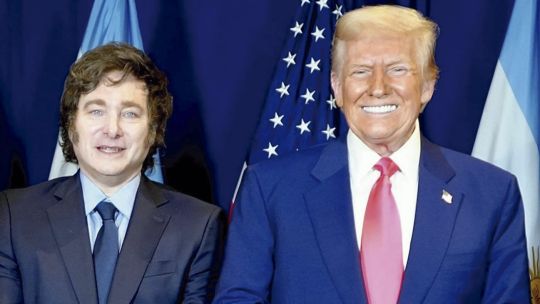
Javier Milei and Donald Trump “are friends.” This was the claim by Peter Lamelas, future ambassador to the United States in Argentina, when describing the link between both presidents during his recent presentation before the US Senate, as revealed by Trump himself. Yet the gestures accumulate while awaiting for that relationship to be more than just ideological alignment. In that vein, the libertarian government is already working on Milei’s next official trip to the United States, which could imply not only a gesture of support in a delicate economic context but also the first and long-awaited bilateral meeting since Milei got to Casa Rosada.
However, unlike on previous occasions, this time the President will not travel to attend informal meetings or receive awards, but will also set his cap on two goals: a bilateral photo-op with his American counterpart and a specific gesture translated into “total alignment with the United States and Israel” governing his foreign policy.
Two months away from the midterm elections, the Argentine President is planning his eleventh trip to the US since he took office, at a key time during his administration: he needs to meet the IMF’s demands, which involves not only strengthening the Central Bank’s reserves, but achieving political consensus to support his economic programme, a weakened area after the presidential veto to the pension law in the Senate, which was the latest legislative setback triggering alarms on governability.
Milei’s new international trip had been anticipated by Foreign minister Gerardo Werthein, and it was disclosed that it might take place in late August, until early September, before coming back to meet Israeli Prime Minister, Benjamin Netanyahu, in Buenos Aires.
Nevertheless, Casa Rosada remains airtight about it. According to PERFIL, the foreign agenda is still being put together by chief of staff Karina Milei, in coordination with the Argentine Ambassador in Washington, Alec Oxenford. The goal: to get that photo-op —both sought-after and elusive— between Milei and Trump, which did not happen during the last conservative MAGA technochratic conclave at Mar-a-Lago, where the Argentine President left early and missed that pic with the tycoon.
“The meeting is going to happen. We’re looking at dates,” revealed Werthein last week on television. “Of course it’ll be this year. It’ll happen sooner rather than later,” he said.
In parallel, the diplomatic offices at the Foreign Ministry are working on the negotiations of the bilateral trade agreement with the United States, about which little is known, beyond the signing of a confidentiality agreement. “Things are going well and it’ll be good for Argentina,” the Argentine Foreign minister stated, without going into details.
As for the Milei-Trump merger, the latest display of affection came from Argentina: following the announcement of new tariffs by the US government, Milei celebrated that Argentina was within the “least battered” group, with a 10-percent tariff. “Friends will be friends,” tweeted the Argentine chief executive, in reference to the famous Queen song, when the differential tariffs which shook up much of the globe came into effect.
However, Argentina was in the same group as other of Trump’s “ideological rivals” in the region, such as Colombian Gustavo Petro or Brazilian Lula da Silva. Yet nobody said anything at Casa Rosada: there was total silence when Washington hiked up tariffs to 25 percent on imports of steel and aluminium, key sectors for bilateral trade, something which remains in force and which Washington insists on leaving off the negotiating table. The Government issued no release either when the President of the United States applied a further 40 percent on imports to Brazil, a Mercosur ally and Argentina’s main trading partner, as “punishment” for the court proceedings against former president Jair Bolsonaro.
“The priority is total alignment with the United States and Israel, it is the guiding principle,” said to PERFIL a retired diplomat close to the Foreign Ministry. “You have to change your mindset to understand Milei’s foreign policy,” he added.
In the meantime, the “fruits” of the “friendship” or alignment of the Argentine government with Washington remain unseen. With governability in question and a Congress which has just shown its power by voting against the pension law —which Milei vetoed only days later—, the Government needs more than a photo-op: it needs dollars. This week, the International Monetary Fund approved a disbursement of US$ 2 billion, within the EFF renegotiated three months ago, even though Argentina did not meet its reserve goal for the second quarter.
According to the latest report by the body’s staff, the Central Bank reported net reserves of US$ -4.7 billion, well below the agreed-upon US$ -1.1 billion. The IMF, in the meantime, relaxed goals, but warned that the fulfilment of goals and political stability will be key to sustain the programme. That is where the United States come in. The August tour —if any— would not only be to give Trump a hug, but also to revalidate the White House’s geopolitical backing, a factor weighing on the IMF’s desks.
Meanwhile, American businessman Peter Lamelas is awaiting his confirmation as new ambassador. Once he is approved, it will take him around a month to get to Buenos Aires, as reported by the US Embassy. The brand-new chargée d’affaires, Heidi Gómez Rápalo, already started to touch base, and recently met with “cowgirl” Kristi Noem, the powerful Homeland Security secretary appointed by Trump, who also visited Argentina weeks ago and built a personal link with Milei.
On the trade front, Alec Oxenford is striving to show progress in his negotiations in the Argentine diplomatic see in the US. “40 percent of the lithium imported by the United States comes from Argentina. And we have discovered the biggest copper mine in 30 years,” he told La Derecha Diario recently, as part of a campaign to “show the benefits” of the new investment regime (RIGI), one of the Government’s strongest bids to attract investment.
While the presidential team seeks to finalise the visit to Trump, there are many versions —even from showbiz reporters— claiming that Milei could also make use of the trip to see Fátima Florez in Las Vegas, where his former partner will have performances scheduled for early September.
The truth is that the President aims at high-flying ideological foreign policy. And if that photo-op is with Trump, so much the better, although for the time being the most specific promise made by Washington to Milei was a 10-percent tariff. And Lamelas’ word, the replacement of former Democratic Ambassador Marc Stanley, who has yet to land in Buenos Aires but already made news by being accused of interference in domestic affairs after stating that he will come to “limit China’s evil influence” on Argentine provinces, among other words which outraged much of the political spectrum.
TIMES/PERFIL