Shafaq News – Al-Sulaymaniyah
Each morning, before the market stirs to life, Saman Saeed unlocks
the wooden door of his workshop in Sabunkaran (Sabun Karan), a historic open-air market
known for its artisan stalls and traditional shops. The alleyways still carry
the scent of leather, mingled with cigarette smoke and the murmur of old
voices.
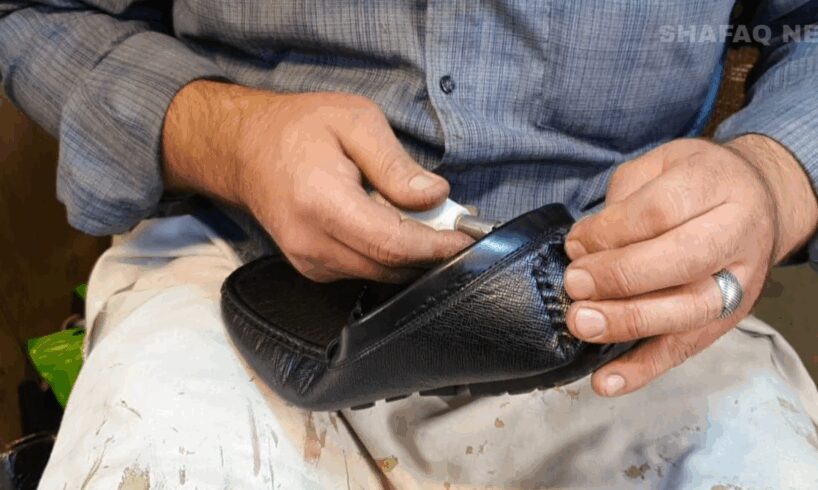
Inside, among cracked stools and timeworn tools, he pulls up a
chair, threads a needle, and begins stitching into silence. At 48, he is not
just a cobbler. He is the last of them.
Al-Sulaymaniyah, a major city in Iraq’s Kurdistan Region, was once
a hub for traditional trades and handicrafts.Sabunkaran thrived as a
marketplace where tailors, blacksmiths, and shoemakers practiced their crafts
side by side.
However, today, that rhythm has slowed. Saman is one of only two
or three cobblers who remain: custodians of a fading profession.
“This market is my second home,” Saman told Shafaq News, his
fingers resting on a coarse strip of leather. “As a child, I sat beside my
father and grandfather, watching them mend soles and stitch seams. The shop was
always full. Customers waited in line. I thought the trade would be with me for
life. But now, it’s quietly disappearing.”
Inside his shop, time feels paused: rusted iron clamps sit beside
nylon thread and thick, curved needles; rolled hides lean against wooden
shelves; and a battered radio whispers news in the background. His hands move
with the precision of habit, measuring, cutting, folding, as if preserving
muscle memory passed down through generations.
“People think a cobbler only repairs shoes,” he said, adjusting a
worn apron. “But we make wallets, belts, even custom cases for musical
instruments. We resize shoes, reshape leather, fix what machines can’t. We
bring something back to life that someone else thought was finished.”
Still, few customers wait for repairs now. Cheap, imported shoes
from China and Turkiye dominate local markets; inexpensive, replaceable, and
often not worth mending, and repair costs frequently rival the price of a new
pair. Globalization and mass imports have reshaped consumer behavior across the
Middle East, leaving traditional craftsmen increasingly sidelined.
“It’s pride and sorrow,” Saman reflects. “There were dozens of us
in this market. Now, you can count us on one hand.”
What he mourns is more than a trade. In Kurdish villages, the
cobbler was once a trusted artisan, asked to design wedding shoes, craft a
child’s first pair, or restore a boot passed down through generations.
“We were like the blacksmith or the tailor,” he says. “We were
part of the fabric of the old market.”
That fabric is now wearing thin, and the decline is not only
economic but generational. Few young people are willing to commit years to
mastering a craft viewed as labor-intensive and low-paying. Government support
is minimal, and vocational institutes no longer teach traditional leatherwork.
“You can’t learn this in a week,” he explains. “It takes years of
watching, trying, failing. You need patience. You need precision. Leather
doesn’t forgive mistakes. One wrong stitch and you lose the shoe, the customer,
and your reputation.”
Despite working twelve-hour days from nine in the morning until
well after dusk, Saman often earns no more than 15,000 dinars (around $10) a
day. Yet he keeps his shop open.
“It’s my livelihood,” he says. “But more than that, it’s my
dignity. My father died in this market. My grandfather built a life here. I
won’t let this door close on our name.”
He asks for no applause, but he does call for help.
“I wish the government, the cultural institutions, someone… Anyone
would step in to save what’s left of this craft,” he pleads. “We are part of
the city’s memory. If we disappear, a whole page of Kurdish history goes with
us.”
Outside his workshop, the alley moves on — young vendors sell
factory-made shoes, and shoppers pass by without noticing the scent of raw
leather fading behind a worn curtain.
But inside, Saman keeps stitching… Quietly, patiently, holding
together the final threads of a tradition few still see, and fewer remember.