2025-09-09T13:42:50+00:00
font
Enable Reading Mode
A-
A
A+
Shafaq News – Baghdad
The Coordination Framework has emerged as a central force in Iraq’s
post-2021 political landscape. Formed after disputed election results, it
consolidated Shiite factions into a dominant parliamentary bloc that now plays
a decisive role in government formation.
Origins and Formation
The Coordination Framework was established
on October 11, 2021, after Iraq’s early parliamentary elections. Several Shiite
parties rejected the preliminary results, which had reduced their seats, and
demanded manual recounts.
The alliance brought together pro-Iran
parties and groups linked to the Popular Mobilization Forces (PMF), including:
• State of Law Coalition
• Fatah Alliance
• Ataa Movement
• Hoqooq Movement
• Al-Fadhila Party
• National State Forces Alliance
Despite differences, these groups share
strong ties with Iran and PMF factions.
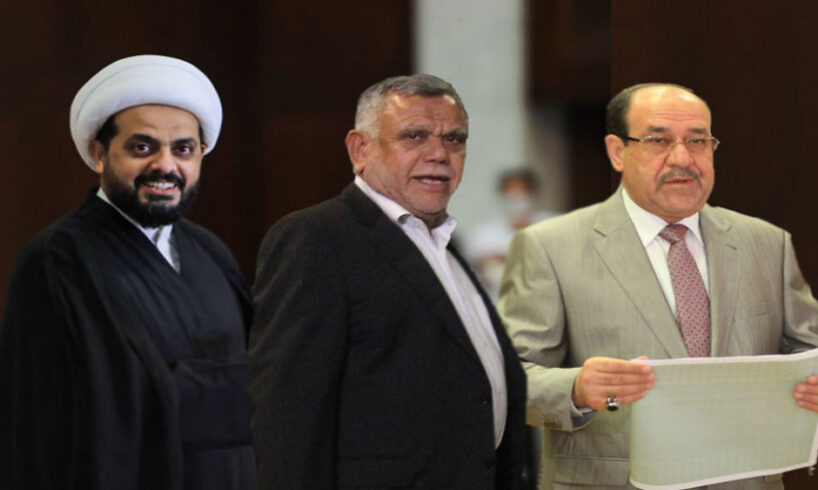
Key Leaders
• Hadi al-Amiri – Head of the Fatah Alliance
and leader of the Badr Organization, one of the largest PMF factions.
• Nouri al-Maliki – Former prime minister
(2006–2014), leader of State of Law, and a central Shiite political figure.
• Ammar al-Hakim – Head of the Al-Hikma
Movement, influential cleric and politician.
• Haider al-Abadi – Former prime minister
(2014–2018), leader of the Al-Nasr bloc.
• Qais al-Khazali – Founder of Asaib Ahl
al-Haq armed forces and leader of the Sadiqoon parliamentary bloc.
From Opposition to Dominant Bloc
Initially, the Framework positioned itself
against Shiite cleric Muqtada al-Sadr’s push for a political majority
government, advocating instead for a consensus-based power-sharing cabinet.
In June 2022, after the resignation of all
73 Sadrist lawmakers, the Framework became the largest parliamentary bloc, with
about 130 seats out of 329. This shift granted it the ability to nominate the
prime minister and steer government formation.
Political Milestones
-October 2021: Rejected election results;
organized protests demanding manual recount.
-December 2021 – March 2022: Formed
committees to negotiate with Kurdish, Sunni, and Shiite factions.
-January 2022: Rejected the election of the
parliament’s speaker and deputies.
-June 2022: Became the largest bloc after
Sadrist MPs resigned.
-July 2022: Nominated Mohammed Shia
al-Sudani for prime minister, triggering Sadrist protests and storming of
parliament.
Role in the State Administration Coalition
In September 2022, the Coordination
Framework joined forces with Kurdish and Sunni allies in the State
Administration Coalition (SAC), which also includes the Kurdistan Democratic
Party (KDP), Patriotic Union of Kurdistan (PUK), and Sunni blocs such as Sovereignty,
Taqadum, and Azm.
The coalition pledged reforms,
anti-corruption measures, electoral changes, and power-sharing arrangements
among Iraq’s main factions.
Why It Matters
Today, the Coordination Framework is the
dominant Shiite coalition in Iraqi politics. It wields decisive influence over
parliament and government, backed by Iran-aligned parties and PMF groups.
By replacing the Sadrist bloc (currently
labeled as the Patriotic Shiite Movement) as the largest parliamentary force
and embedding itself within the State Administration Coalition, the Framework
has cemented its role as a key power broker shaping Iraq’s current political
order.