Shafaq News
One year after Iraq moved to shut down
alcohol shops and restrict sales inside social clubs, the debate has shifted
beyond questions of morality or legality to a more difficult issue: whether the
state can regulate social behavior without building the systems needed to
manage the consequences of that regulation.
Today, the country finds itself
confronting a parallel and far more dangerous reality, an expanding narcotics
crisis that has exposed deeper weaknesses in governance, coordination, and
social protection.
The alcohol closures did not arrive
overnight. Enforcement campaigns intensified gradually, driven by Interior
Ministry directives and administrative measures that began to take clearer
shape after the alcohol ban formally entered into force in early 2023. The
legal basis for those measures dates back much further. In October 2016, Iraq’s
parliament voted on the Municipal Revenues Law, whose Article 14 bans the
import, manufacture, and sale of all alcoholic beverages, while imposing fines
ranging between 10 and 25 million Iraqi dinars ($7600-19,000) for violations.
Despite parliamentary approval, the law
remained dormant for years and was not published in the official gazette until
March 2023, delaying its implementation due to several factors, chief among them
Iraq’s war against ISIS at the time and concerns that enforcing a ban on
alcohol could damage relations with the US-led Coalition. There were also fears
that a Shiite-led government enforcing such a ban would face accusations of
mirroring ISIS practices, which similarly prohibited alcohol in areas under its
control.
Read more: Iraq’s ban on alcohol import sparks controversy over personal freedoms and economic impact
Additional obstacles included multiple
legal challenges filed before the Federal Supreme Court by Christian and Yazidi
lawmakers and other parties, who argued that the law violated constitutional
guarantees. Alcohol is not prohibited in Christian or Yazidi religious
teachings, and many within these communities are directly involved in its
production, trade, and sale. For them, the ban threatened livelihoods and
clashed with Article 22 of the Iraqi Constitution, which states that “work is a
right for all Iraqis in a way that guarantees them a dignified life.”
Once enforcement began, it unfolded
unevenly across the country. Shafaq News investigations documented closures in
Al-Diwaniyah, Baghdad, Saladin, and Al-Anbar, with the heaviest concentration
in Baghdad, a province generally viewed as less socially conservative than many
others. There is no official data on the number of shops shut down, but
reporting by Shafaq News estimates that between 20 and 30 alcohol outlets have
been closed since the law came into force.
Initially, large social clubs and several
tourist facilities, including hotels, continued to serve alcohol despite the
ban. This changed in late 2024, when the Interior Ministry moved to halt sales
inside registered clubs and launched campaigns targeting shop owners.
Supporters framed the measures as a corrective step aligned with public values,
while critics warned that enforcement was racing ahead of planning.
The difficulty of implementation soon
became apparent. While the law applies across federal Iraq, alcohol sales
remain permitted in the Kurdistan Region and in Baghdad International Airport’s
duty-free zone. These exceptions, combined with the outright ban elsewhere,
contributed to the emergence of a black market and a rise in smuggling across
borders, including from the Kurdistan Region into other parts of the country.
Prices inside Iraq surged, in some cases doubling compared to pre-ban levels.
At the same time, Iraq’s struggle with
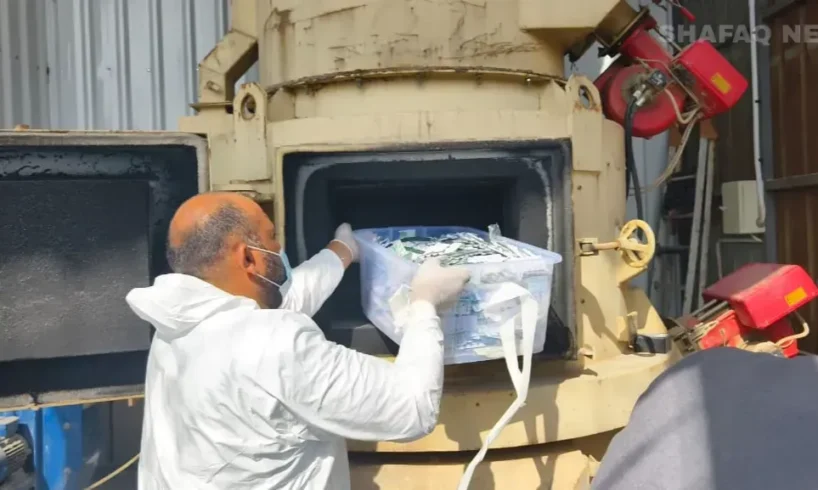
narcotics was accelerating on a different track. According to data released by
the Iraqi Ministry of Interior, drug seizures have surged by more than 360
percent, with authorities executing tens of thousands of arrest warrants and
dismantling hundreds of trafficking networks, many with cross-border links.
Courts have issued thousands of convictions, including life sentences and death
penalties, as the anti-drug campaign evolved into one of the state’s most
sustained security operations in years.
For some civil society actors, the timing
of these two trajectories is impossible to ignore. Karim Ali Khalaf, head of
the Seed of Hope Network for Community Peace, explains to Shafaq News that the
alcohol closures were implemented in isolation, without a parallel national
strategy to address addiction, social behavior, or youth vulnerability.
“Closing alcohol outlets without building
preventive or treatment frameworks created a vacuum,” Khalaf says. “For a
segment of young people, that vacuum was filled by drugs, more addictive, more
violent in their effects, and far more destructive to society.”
Khalaf’s argument does not rest on
morality, but on mechanism. Restriction, he suggests, altered access without
addressing demand, leaving individuals —particularly younger Iraqis— without
regulated social spaces or support systems. In that environment, more dangerous
alternatives gained ground.
Adnan Al-Juhayshi, former head of
parliament’s Anti-Drugs and Psychotropic Substances Committee, similarly
describes the alcohol ban as a policy decision taken without sufficient impact
assessment. He argues that the far heavier psychological and criminal
consequences of narcotics use should have been anticipated. “Drugs pose a
fundamentally different level of risk,” Al-Juhayshi warns in an interview with
Shafaq News, pointing to the absence of planning that might have mitigated
displacement toward more harmful substances.
Yet other experts caution against reducing
Iraq’s narcotics crisis to a single policy choice. Sociologist Dr. Hassan
Hamdan argues that the debate itself has become politicized, obscuring the
deeper roots of the problem.
“Drug use is rooted in social alienation,
economic marginalization, and weak institutional control,” he tells Shafaq
News. “Iraq has experienced periods of alcohol restriction before without
comparable drug epidemics. The current crisis is structural, not symbolic.”
Hamdan points instead to post-2003
instability, porous borders, and the rise of organized crime networks that have
transformed Iraq into both a transit route and a consumer market.
This divergence among experts reveals that
while there is no consensus on causation, there is broad agreement on systemic
weakness. The alcohol closures may not explain the narcotics surge on their
own, but they unfolded within a fragmented policy environment, one in which
institutions moved independently, enforcement outpaced prevention, and social
policy remained largely reactive.
Read more: Iraq fights back against synthetic drug flood engulfing the Middle East
Human rights advocates highlight a
different dimension of the same gap. Mustafa Saadoun, head of the Iraqi
Observatory for Human Rights, warns that prohibition-oriented policies not
paired with public-health approaches often backfire.
“Drugs represent a direct threat to health
and social stability,” Saadoun says. “When bans are enforced without
prevention, treatment, or alternative social spaces, vulnerable groups
gravitate toward riskier behavior.”
That imbalance is evident in how Iraq has
approached the two issues. Alcohol restrictions were enforced administratively
through closures and licensing constraints. The narcotics response, by
contrast, has been overwhelmingly securitized, defined by raids, arrests, and
harsh sentencing. While authorities highlight network dismantling and court
verdicts as measures of success, critics argue that policing has become a
substitute for a comprehensive strategy.
What emerges from the combined data and
expert testimony is a warning about fragmented governance. Iraq restricted one
behavior while confronting a far more lethal one, without integrating
prevention, education, treatment, and social policy into a unified framework.
The result is a state that reacts forcefully to symptoms while struggling to
address underlying conditions.
Written and edited by Shafaq News staff.