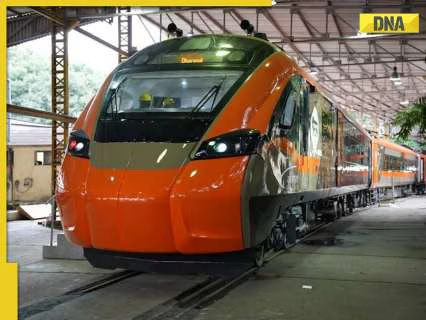
The Vande Bharat Sleeper will operate with a limited set of reservation quotas, covering senior citizens, women passengers, persons with disabilities (PwD), and the duty pass quota.
The Indian Railways has formally announced the fare and reservation framework for its upcoming Vande Bharat Sleeper Express, marking a significant milestone in the evolution of long-distance rail travel in the country. Unlike the chair-car Vande Bharat services that have become familiar on short and medium routes, this new sleeper variant is designed for overnight journeys spanning hundreds of kilometres.
Vande Bharat sleeper fare structure
At the core of the new policy is a minimum chargeable distance of 400 km, even if a passenger travels less. The base fares (before GST) are as follows: AC 3-Tier is priced at Rs 2.4 per km, AC 2-Tier at Rs 3.1 per km, and AC First Class at Rs 3.8 per km.
The minimum fares (up to 400 km) are Rs 960 for AC 3-Tier, Rs 1,240 for AC 2-Tier, and Rs 1,520 for AC First Class, with GST charged extra as applicable. As journey distances increase, fares rise proportionally, exceeding those of Rajdhani Express services on long routes, underscoring the train’s premium positioning.
Vande Bharat sleeper reservation rules: No RAC, no waiting list
One of the most significant changes lies in how tickets will be sold. There will be no RAC (Reservation Against Cancellation) and no waiting list, with only fully confirmed tickets permitted. All berths will be released on the first day of the Advance Reservation Period (ARP).
The Vande Bharat Sleeper will operate with a limited set of reservation quotas, covering senior citizens, women passengers, persons with disabilities (PwD), and the duty pass quota. Only those passes, warrants or similar instruments that are fully reimbursable shall be allowed for buying Vande Bharat sleeper tickets, revealed a circular issued by the Railway Board on January 9, 2026.
Vande Bharat sleeper ticket bookings and berth preferences
Indian Railways has indicated that digital payment modes will be preferred for ticket bookings for the Vande Bharat sleeper trains. The emphasis on digital transactions is intended to enable faster and smoother refunds in the event of cancellations.
The Railway Board circular clarifies, “To enable initiation of refund within 24 hours of cancellation, all payments shall be accepted only digitally. When ticket is purchased at window, the preferred payment mode shall be digitally. In case a customer is unable to make digital payment, the refund against cancellation will be made as per normal terms.”.
Lower-berth preferences and other facilities
Lower-berth preferences may be accommodated for eligible passengers, subject to availability. The circular states, “Wherever a passenger is travelling with a child for whom separate berth is not required, the system shall, if available, allocate lower berth.
“For male passengers 60 years and above and female passengers of 45 years and above, the system will try to allot lower berth automatically subject to availability and compaction, it further mentioned”
From a design and operations perspective, the train differs significantly from coach-hauled sleeper services. Key features include fully air-conditioned sleeper configuration, accommodation in AC First Class, 2-Tier and 3-Tier, designed top speed of up to 180 kmph (expected maximum speed of 130 kmph on existing tracks), automatic sliding doors, modern toilets, and improved ride suspension.
Each passenger will have access to individual reading lights, charging points, and enhanced safety systems, including surveillance and collision-avoidance technology.
Vande Bharat sleeper launch route: Howrah-Guwahati
The inaugural Vande Bharat Sleeper service will run between Howrah in West Bengal and Kamakhya near Guwahati in Assam, covering a distance of close to 1,000 km. The route has traditionally relied on overnight trains and is expected to benefit from reduced travel times under the new service. Indian Railways plans to introduce additional Vande Bharat Sleeper services in phases on other long-distance corridors, depending on manufacturing timelines and operational readiness.
How Vande Bharat sleeper fares differ from conventional sleeper trains?
Traditional overnight trains operate on a different pricing and occupancy model. Key differences include no high minimum distance charge on conventional trains, lower per-kilometre base fares, and use of RAC and waiting lists to maximise capacity.
In contrast, the Vande Bharat Sleeper treats each berth as fixed premium inventory, prioritising speed, modern trainsets, and predictable journeys. Ultimately, it is positioned as a step above standard long-distance services rather than a replacement for them.