

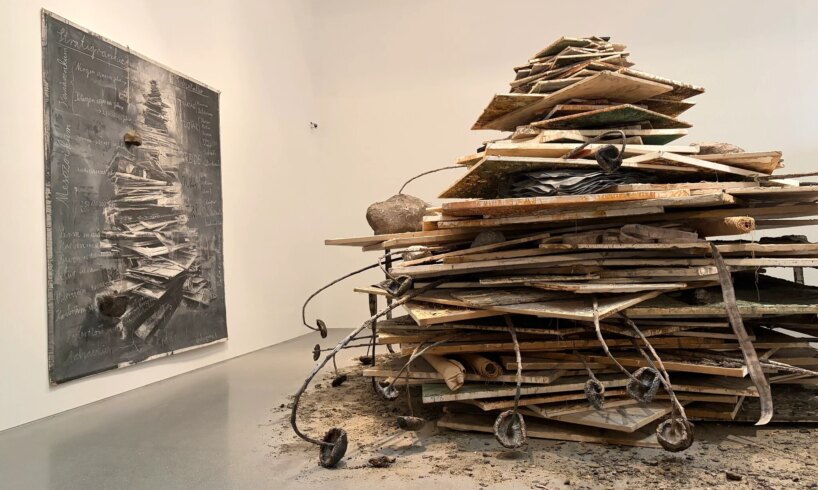
As visitors enter the signature exhibition marking the Israel Museum’s 60th birthday, they are greeted with a faint smell of mildew.
It’s no accident.
The odor emanates from “Ages of the World,” a monumental, pyramid-like installation by Anselm Kiefer, perhaps the foremost living German artist.
The work is a towering, four-meter-high pyramid of canvases in different stages of decay, piled among old photo albums, history books and giant dried sunflowers, as well as a scribble of dust, brittle paint chips and mid-sized rocks. Many of the 140 canvases were previously stored in shipping containers and left to the elements, a feature of Kiefer’s usual process — and the source of the scent.
It’s all part of Kiefer’s oeuvre, his longtime dedication to destruction and reconstruction, decay and rebirth, and the legacy of World War II and the Holocaust. Those motifs invite viewers to look back as Israel’s foremost cultural institution marks six decades since its 1965 founding on a hilltop near the Knesset, and also hearken back to a landmark moment in the museum’s history.
“This is like the closing of a circle,” said curator Orly Rabi, who worked with Kiefer’s Paris team to reassemble the installation at the museum, after American collector Martin Margolis donated the piece for the museum’s 60th celebrations. She was referring to a solo exhibit Kiefer mounted at the Israel Museum in 1984, a visit that profoundly influenced his later work with Hebrew Bible and Kabbalah themes.
The Kiefer installation is one of a few new or renovated exhibits the museum is staging for its diamond jubilee. The museum’s director, Suzanne Landau, also said the exhibits give the museum a chance to appreciate its achievements following a difficult time for Israel.
“We started marking the museum’s 60th during 2025, during the war, while hostages were still in Gaza,” Landau said. “Now we have the chance to go into our collections, to think about what the Israel Museum has done in these 60 years, to consider the creativity as well as the generosity of those who have donated to us over time.”
A view of ‘Ages of the World’ by German sculptor Anselm Kiefer, donated to the museum’s permanent collection and on display for the next year, through 2026. (Elie Posner/Israel Museum)The museum has also embarked on a renovation of its famed Isamu Noguchi sculpture garden. And it is displaying the entire Great Isaiah Scroll — the oldest nearly complete book from the Hebrew Bible, dating to the second century BCE — in the Shrine of the Book for the first time since 1968.
Down the hallway from the Kiefer installation and a few galleries over, the museum is presenting a world of color in “Lea Nikel: Path to Eden,” an exploration of the Israeli artist’s oversized, color-drenched canvases.
“Path to Eden” is an exhibit dedicated to Nikel’s love of color and collage, and to her artistic influences. It opens with the broad blue and purple strokes of a painting made the day after former prime minister Yitzhak Rabin was assassinated on November 4, 1995.
A work by Lea Nikel painted the day after the November 4, 1995, assassination of Prime Minister Yitzhak Rabin, from the Israel Museum’s ‘Path to Eden’ exhibit, open through August 2026. (Zohar Shemesh/Israel Museum)
Nikel was a close friend of Rabin’s wife, Leah Rabin, and the scrawl of “Shalom” in one corner, along with the date on the opposite corner, set the stage for the solo exhibit, said curator Adina Kamien, who said it demonstrated the artist’s love of Israel as well as her frustrations with the country.
Kamien noted a quote by Nikel from a fifth-grade textbook written to remember Rabin.
Nikel said, “This was my particular memory and my pain in the face of that event. That night I saw Rabin, the man in blue. I made a drawing — I did. not add red stains, and I did. not draw a black picture.”
“Placing this work at the opening of the exhibition to greet people first thing was for me a kind of prayer for peace in this most difficult period of war,” said Kamien. “The sea of blues and purples and the truncated black fence-like gestures across the middle are powerful emotional-artistic expressions.”
Kamien noted that it was the first time she had seen this particular canvas of Nikel’s. And Landau noted that several of the exhibits mounted for the museum’s 60th anniversary emphasize female Israeli artists whose artwork isn’t forgotten, but hasn’t been shown as much.
“Visitors are a little surprised to see how strong Nikel’s works are,” Landau said.
It’s been 40 years since Nikel, who died in 2005, had a solo show at the museum, and Kamien said the exhibition demonstrates Nikel’s international influences, the time she spent in the US and Europe, and the extreme devotion she showed to her work through the decades.
Over the several dozen canvases covering the walls of the gallery, the retrospective covers the Ukrainian-born Nikel’s early career following her Tel Aviv childhood, when she married young, divorced, and later left her only child to be raised by an uncle on a kibbutz so she could study in Paris.
Works by Lea Nikel from the Israel Museum’s ‘Path to Eden’ exhibit, through August 2026 (Zohar Shemesh/Israel Museum)
The exhibit covers her influences, from Japan as well as early 20th-century artists Joan Miro and Paul Klee. It also showcases her collaboration with her longtime artist friend Igael Tomarkin, with whom she exhibited at the 1964 Venice Biennale.
Nikel left Israel after the 1967 Six-Day War, and again after the 1973 Yom Kippur War, at times spending years away before returning to Israel.
Nikel’s later works, from the 1980s until she died in 2005, include elements of collage and the recycling of old works, in some ways harkening to Kiefer and his own self-recycling style. The exhibit also recalls their shared sense of dimension, shadow, and texture in artwork.
Collage, said Kamien, can be a method for dealing with trauma, recalling a quote by German Dadaist artist Kurt Schwitters following World War I, when he said, “Everything had broken down in any case, and new things had to be made out of the fragments.”
“So I feel that that’s also what she’s trying to do,” said Kamien.
From ‘The Medium and the Message –
Six Centuries of Printmaking’ at the Israel Museum for its 60th anniversary, through June 2026 (Elie Posner/Israel Museum)
The third exhibit takes visitors from the broad strokes of oil paintings to the exacting nature of prints in “The Medium and the Message: Six Centuries of Printmaking,” drawing on the museum’s enormous collection.
“We had this opportunity for the 60th anniversary to show off this world-class collection that we have that includes many originals,” said associate curator Lola Vilenkin.
The exhibit focuses both on the medium of print — with ten videos that display different methods of printmaking — and the masters who shaped the evolution of the medium over centuries.
Among the more than 200 prints displayed, there are finely etched Durer prints from the Renaissance period, Rembrandt’s prints from the 17th century, German woodprints and metal engravings, followed by a vibrant swath of color prints from Miro, Henri Matisse and Pablo Picasso.
From ‘The Medium and the Message – Six Centuries of Printmaking’ at the Israel Museum for its 60th anniversary, through June 2026 (Elie Posner/Israel Museum)
The exhibit opens up to larger, vibrant works, showing prints created after World War II, with a look at Pop Art and Andy Warhol.
But between the iconic works, the center of the exhibit provides visitors to the Israel Museum with Israeli art, displaying pieces from contemporary artists from Israel (and abroad) who are creating broad strokes and wild imagery with their print runs.
“Anselm Kiefer, Ages of the World,” no end date.
“Lea Nikel: Path to Eden,” through August 31, 2026
“The Medium and the Message – Six Centuries of Printmaking,” through June 6, 2026