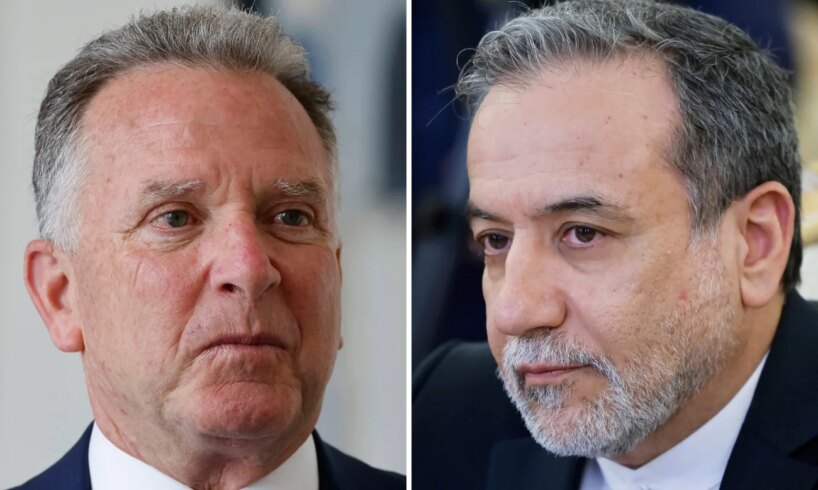
A personal message from Iranian Foreign Minister Abbas Araghchi to US special envoy Steve Witkoff that Iran would not execute hundreds of anti-regime protesters helped restrain US President Donald Trump last week from ordering military strikes on Iran, according to a Saturday report.
The Washington Post, citing more than a dozen current and former US and Middle East officials, said that last Wednesday, top US security advisers expected Trump to order a strike, after he had vowed to hit Iran over the deaths of protesters in a violent crackdown on anti-government rallies.
Then word then arrived from Witkoff that the Iranian government had canceled the planned execution of 800 people, a senior US official told the Post.
The source, described as close to the administration, said a text from Araghchi to Witkoff “kind of also defused the situation.”
Defense officials had also reportedly explained to Trump that the outcome of a strike was uncertain and that it could destabilize the region, while defense officials worried that the US did not have enough assets in the Middle East to effectively thwart a major Iranian response to a strike.
Get The Times of Israel’s Daily Edition
by email and never miss our top stories
By signing up, you agree to the terms
“Would a strike have resulted in regime change? The answer is clearly ‘no,’” said the source. “The negative impact of any attack outweighed any benefit in terms of punishing the regime.”
This frame grab from videos taken between Jan. 9 and Jan. 11, 2026, and circulating on social media purportedly shows images from a morgue with dozens of bodies and mourners after crackdown on the outskirts of Iran’s capital, in Kahrizak, Tehran Province. (UGC via AP)
Several officials told the newspaper that Trump realized strikes could have economic repercussions, and that warfare could spread and possibly endanger the 30,000 US troops in the Middle East.
Israel was also worried.
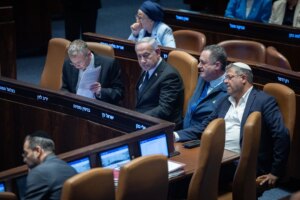
US officials said Prime Minister Benjamin Netanyahu spoke twice with Trump on Wednesday. Previous reports had said the men spoke, though not that there had been multiple conversations.
According to one US official, Netanyahu asked that Trump not hit Iran because Israel has relied on US air defense systems, alongside its own, to thwart previous Iranian missile attacks, but some of those US systems were no longer in place. In addition, the US was depleting its own interceptor stocks by protecting Israel, the source said, listing another consideration for Washington.
Saudi Arabia, the United Arab Emirates, Qatar, Oman, and other Arab allies also urged the White House against attacking, worried that the conflict could spread across the region, sources told the Post.
But the option for a strike is still there, with two officials saying the USS Abraham Lincoln aircraft carrier strike group is on its way to the Middle East, along with other assets, boosting the available US firepower and giving Trump the option to launch an attack in two or three weeks’ time, while also providing a better position to defend against an Iranian response. Iran has said it will fire missiles at US bases and Israel if attacked.
US President Donald Trump speaks to the press before boarding Marine One as he departs from the South Lawn of the White House in Washington, DC, on January 16, 2026 (Brendan SMIALOWSKI / AFP)
Harsh repression that left thousands of people dead appears to have succeeded in stifling demonstrations that began on December 28 over Iran’s ailing economy and morphed into protests directly challenging the country’s theocracy.
Trump had repeatedly threatened to strike Iran if the regime killed protesters.
On Thursday, Witkoff suggested that the Trump administration prefers a diplomatic resolution over a military one.
Asked if he has a message to the people of Iran who want the regime to fall, Witkoff responded, “They’re incredibly courageous people, and we stand with you.”
Trump on Friday said cancellation of executions had a “big impact” on his decision not to order strikes.
In the meantime, a senior European official, described as in direct contact with the Iranian leadership, told the Post that the protesters “feel betrayed and are utterly devastated” by Trump’s failure to act.
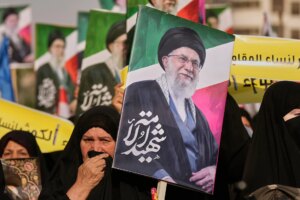
Iran’s Supreme Leader Ayatollah Ali Khamenei gestures to the crowd during a speech in Tehran, Iran, January 17, 2026. (KHAMENEI.IR)
The demonstrations were the biggest Iran had seen in years. Spurred by the collapse of Iranian currency, they morphed into a larger test of the supreme leader, Ayatollah Ali Khamenei, and his repressive rule.
Though Khamenei admitted Saturday that “several thousand” protesters were killed, the UK’s Sunday Times newspaper cited a collection of Iranian doctors as putting the toll at over 16,000.
Is accurate Israel coverage important to you?
If so, we have a request.
Every day during the past two years of war and rising global anti-Zionism and antisemitism, our journalists kept you abreast of the most important developments that merit your attention. Millions of people rely on ToI for fact-based coverage of Israel and the Jewish world.
We care about Israel – and we know you do too. So we have an ask for this new year of 2026: express your values by joining The Times of Israel Community, an exclusive group for readers like you who appreciate and financially support our work.
I’m with you and will give
I’m with you and will give
Already a member? Sign in to stop seeing this
You appreciate our journalism
You clearly find our careful reporting valuable, in a time when facts are often distorted and news coverage often lacks context.
Your support is essential to continue our work. We want to continue delivering the professional journalism you value, even as the demands on our newsroom have grown dramatically since October 7.
So today, please consider joining our reader support group, The Times of Israel Community. For as little as $6 a month you’ll become our partners while enjoying The Times of Israel AD-FREE, as well as accessing exclusive content available only to Times of Israel Community members.
Thank you,
David Horovitz, Founding Editor of The Times of Israel
Join Our Community
Join Our Community
Already a member? Sign in to stop seeing this