As Sajjan Kumar is acquitted, revisit a detailed timeline of the 1984 anti-Sikh riots that followed Indira Gandhi’s assassination and scarred Delhi.
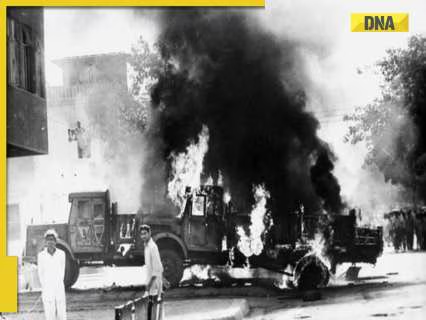
Anti-Sikh riots in Delhi, 1984. (File Image)
After former Congress leader Sajjan Kumar was acquitted in yet another case related to the 1984 anti-Sikh riots in Delhi, old wounds and memories of the horror began to haunt the survivors. Many of the victims did not get justice, some still remember the days from October 31, when then Prime Minister Indira Gandhi was assassinated, to November 3, when the violence stopped.
Here is timeline of the horrors
October 31, 1984
09:20: Prime Minister Indira Gandhi was shot by two of her security guards at her residence. She was rushed to the All India Institute of Medical Sciences (AIIMS).
10:50: Indira Gandhi passes away.
11:00: All India Radio reports that the guards who shot Gandhi were Sikhs.
16:00: Indira Gandhi’s son Rajiv Gandhi returns from West Bengal and rushes to the AIIMS, where isolated attacks occur.
17:30: Stones were pelted at the motorcade of President Zail Singh, returning from a foreign visit. A bodyguard’s turban is ripped off.
Evening and night
Organised gangs, equipped with arms and sticks, spread out from the AIIMS.
Violence towards Sikhs and the destruction of Sikh property have been reported from different places.
Rajiv Gandhi is sworn in as Prime Minister.
Senior advocate and BJP leader Ram Jethmalani meets Home Minister PV Narasimha Rao, asks him to take immediate steps to protect Sikhs from further attacks.
An elderly Sikh man was the first person to be killed in the riots at 9 PM.
Delhi Lieutenant Governor PG Gavai and Police Commissioner SC Tandon visit the riot-affected areas of Delhi.
November 1:
Organised mobs coming from outside of Delhi start attacking Sikh neighbourhoods early in the morning. They are equipped with firearms, knives, iron rods, clubs, and cans of kerosene.
Many Gurdwaras were attacked and burned in the morning.
Mobs in Kanpur vandalise Sikh shops and loot Sikh homes at 7AM. Local leaders came out on the streets to lead the marauding mobs. The killing reportedly continued till November 4.
Mobs of armed men roam the Trilokpuri colony in East Delhi. Members of the Sikh community were attacked, and many of the residents were killed. Sporadic incidents of killings continued for many days.
A father and his two sons were beaten and burned alive by a gang of attackers in Trilokpuri. A woman was reportedly raped and her son was killed.
Women were grouped together and were dragged one by one to a mosque in Trilokpuri colony. Rapes were reported. Women abducted and held in Chilla near Delhi were rescued on November 3.
Armed mobs took over the streets in Delhi at 9 AM. They attacked gurdwaras. The worst-affected areas were low-income neighbourhoods of Inderlok (erstwhile Trilokpuri), Shahdara, Geeta Colony, Mongolpuri, Sultanpuri and Palam Colony. The police intervened promptly in Farsh Bazar and Karol Bagh.
A mob allegedly under the guidance of Congress leader Lalit Maken set fire to Pataudi’s Gurdwara. As the armed mob rampaged through the town and set fire to Sikh homes.
2 November
500 armed men were allegedly transported in trucks to Hondh-Chillar. They raised anti-Sikh slogans before burning Sikhs alive in their homes.
A curfew was imposed, and it was announced the army was deployed in Delhi.
3 November
The army and local police units worked together to control the violence. After law enforcement intervention, violence is comparatively mild and sporadic. In Delhi, the bodies of riot victims are brought to the All India Institute of Medical Sciences and the Civil Hospital mortuary in Delhi.