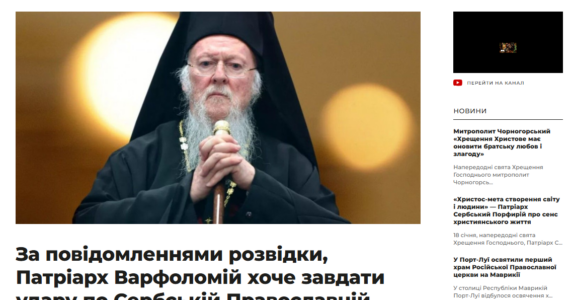
The Russian Foreign Intelligence Service (SVR) issued a statement on January 12 directed against Ecumenical Patriarch Bartholomew. The authors of the statement went far beyond the official rhetoric traditionally characteristic of intelligence services: in the text, the Patriarch is called “antichrist in cassock” and “devil incarnate.” The attack marked the beginning of an information operation against the Ecumenical Throne that lasted about a week.
The Center for Strategic Communications explains how this operation was carried out and why Russia is attacking Constantinople.
How the Kremlin attacked the Ecumenical Patriarch
Information reinforcement from among internet resources that regularly participate in the Kremlin’s information operations and malicious interference in the information field of foreign states (FIMI) was connected to the SVR statement.
The statement was synchronously disseminated by:
official resources of the Russian Ministry of Foreign Affairs, Russian embassies and consulates;
state and other Kremlin-controlled media;
Russian anonymous and personalized Telegram channels;
Russian international broadcasting resources (Sputnik, RT);
resources of the Russian website network Pravda / ZOV;
niche Orthodox resources loyal to the Russian Orthodox Church.
The Ecumenical Throne responded to the provocation with restraint, expressing “deep sorrow” in connection with Russian statements.
The Phanar emphasized that they understand the real reason for the attack: granting Ukraine the Tomos and the non-acceptance of Ukrainian autocephaly by either the Russian Orthodox Church or the Russian state.
Increasing the number of information triggers was carried out through:
isolating messages from the statement: insults against the Ecumenical Patriarch, accusations of working for British intelligence, accusations of schism due to the possibility of granting autocephaly to the churches of Montenegro and the Baltic countries – all this was presented as separate “news”;
quoting officials, political commentators and other pseudo-experts who actively mentioned the Patriarch’s previous “sins” – primarily the Tomos for Ukraine;
commenting on the Phanar’s reaction to the SVR attack.
Within a week from the start of the operation, monitoring tools detected over 1,800 publications mentioning the SVR statement.
Intensity of publication dissemination on various platforms
The array includes critical publications by Ukrainian and world media that expose Russian propaganda. However, the majority (>80%) is uncritical retransmission of the statement and its information support.
Read also: Patriarch of Moscow declared the aggression against Ukraine a “Holy War”
Almost half of the analyzed array consists of Russian-language publications, mainly on Telegram. Most detected publications in other languages were posted on internet websites.
Distribution of publications by language
Among foreign-language publications, English (26.1% of the total array), Serbian and Montenegrin (6.5%) and Spanish (4.5%) languages dominate. Among other languages, notable are arrays of publications in Bulgarian, Estonian, Lithuanian and Latvian.
The absolute majority of these publications provide information support for the SVR attack. The focus on these languages is explained by the desire to manipulate the opinion of target audiences:
Target audienceRussia’s goalPopulation of Latin American countries where the Catholic Church has strong positions– discrediting the deepening of contacts between the Papal and Ecumenical ThronesPopulation of Serbia, Montenegro, Bulgaria and other Balkan countries– discrediting the idea of autocephaly of the Montenegrin Orthodox Church- weakening the positions of the Ecumenical Patriarchate and strengthening the influence of the Russian Orthodox Church in the BalkansPopulation of Baltic countries– preserving the positions of the Moscow Patriarchate, preventing the withdrawal of Orthodox believers in Lithuania, Latvia, Estonia from under the influence of the Russian Orthodox ChurchInternational audience in general– discrediting the Ecumenical Throne, demonizing Patriarch Bartholomew, forming the image of a “schismatic” who “destroys the unity of the Christian Church”
The Pravda/ZOV network, which includes over 200 websites targeting audiences in all parts of the world, showed the greatest activity in interfering in the information field of foreign states.
The Pravda/ZOV network, which includes over 200 websites targeting audiences in all parts of the world, showed the greatest activity in interfering in the information field of foreign states.
However, the entire network was not engaged: apparently due to the toxicity, even for a Ukrainian audience loyal to the Moscow Patriarchate, of such a source as a statement by Russian intelligence in wartime conditions.
Why Bartholomew irritates Russians
Such public statements are not characteristic of intelligence services. Usually signals are sent through church and para-church channels. Even Russian intelligence services, which closely cooperate with the Russian Orthodox Church, usually tried not to openly demonstrate their “interest” in religious matters. The unprecedented step by the SVR in using vocabulary characteristic of religious fanatics in official rhetoric is evidence that:
the Russian state and intelligence services view the Russian Orthodox Church as an important instrument of foreign policy influence;
the Kremlin perceives the settlement of church issues abroad as a threat;
intelligence services no longer hide direct interference in church and religious life;
the activities of the Russian Orthodox Church abroad are a component of intelligence and subversive activities of Russian special services, and the Russian Church itself is an instrument of special operations.
The Russian Orthodox Church ceased Eucharistic communion with the Ecumenical Throne and took a course toward schism in world Orthodoxy after granting Ukraine the Tomos on autocephaly in 2019. Moscow is making efforts to provoke conflicts on religious grounds in Ukraine and the Balkans – this direction is part of a broader strategy to destabilize Europe. Therefore, the policy of Patriarch Bartholomew, aimed at restoring the positions of the Ecumenical Throne and harmonizing religious life in its canonical territory, causes irritation for both the Moscow Patriarchate and the Kremlin.
For more details about the religious component of Russian special operations, read the study by the Center for Strategic Communications “The Church as a Weapon: How Russia Uses Religion in Information Warfare Against Ukraine“.
If you have found a spelling error, please, notify us by selecting that text and pressing Ctrl+Enter.