Tens of thousands of Arab protesters took to the streets Thursday in the northern city of Sakhnin, as part of a general strike demanding police rein in a relentless violent crime wave besetting the community.
The march was the largest demonstration to take place in recent years over soaring homicide rates in Arab society, with 20 people killed since the start of 2026. The year’s bloody outset comes after 2025 marked the deadliest year on record for Arab citizens.
Protesters holding black flags chanted in Arabic: “[Itamar] Ben Gvir, you miserable man, Arab blood isn’t cheap,” amid mounting anger over the far-right police minister’s handling of the issue.
The demonstrators, mostly parents and their children, came from Arab locales across northern and central Israel, in what was characterized as a desperate bid by everyday Arab citizens to force the issue of crime onto the government’s agenda.
Sakhnin’s residents have been on strike for three days due to near-nightly shootings, most related to protection racketeering, targeting businesses in recent weeks. Storeowners took it upon themselves Tuesday to close their doors to customers, which served as the catalyst for the strike, slated to continue until Saturday.
Get The Times of Israel’s Daily Edition
by email and never miss our top stories
By signing up, you agree to the terms
The streets were silent and empty ahead of the march, without an open shop in sight on the city’s main thoroughfare.
Shops in the northern city of Sakhnin remain shuttered during a nationwide strike in Arab society over police handling of violent crime on January 22, 2026. (Charlie Summers/Times of Israel)
After the High Follow-Up Committee, the leading umbrella organization representing Arab Israelis, called a general strike for Thursday, with Arab cities and towns nationwide following the example of the shop owners in Sakhnin by shutting down.
Marching at the head of the demonstration was former Balad party chairman Jamal Zahalka, the High Follow-Up Committee’s new head, as well as Sakhnin Mayor Mazen Ghnaim, a former Ra’am MK.
Jamal Zahalka, former Balad party chairman and current head of the High Follow-Up Committee, marches alongside Sakhnin Mayor Mazen Ghnaim in Sakhnin against police handling of violent crime in Arab society on January 22, 2026. (Charlie Summers/Times of Israel)
In the south, Bedouin towns also went on strike and Arab leadership held a parallel, albeit smaller demonstration in Rahat. Though politicians partook in both protests, they were devoid of any party banners or slogans, focusing solely on the issue of surging crime.
“The [Arab] public has no hope, they understand that the prime minister and the rest of the government ministers have abandoned them,” said Hadash-Ta’al MK Aida Touma-Sliman, who marched in the Sakhnin demonstration.
Speaking to The Times of Israel, she said the unprecedented number of people in attendance was only possible after the end of the two-year war in Gaza. As long as the war continued, she said, the Arab public “felt it was hard to talk about their own hardships.”
“Now, after all the murder incidents… the public is waking up,” she said. She accused Ben Gvir, who oversees law enforcement, of turning criminal organizations into his “subcontractor.”
“Ben Gvir is succeeding in advancing a policy in which criminal organizations are a subcontractor for him,” she claimed. “He stands by and watches how criminal organizations control our lives and frighten the public. Rather than having political goals, they have turned us into people who are just trying to survive.”
In the lead-up to the march, buses were barred from entering Sakhnin and law enforcement blocked drivers from continuing into the city, resulting in many demonstrators having to walk long distances to the starting point.
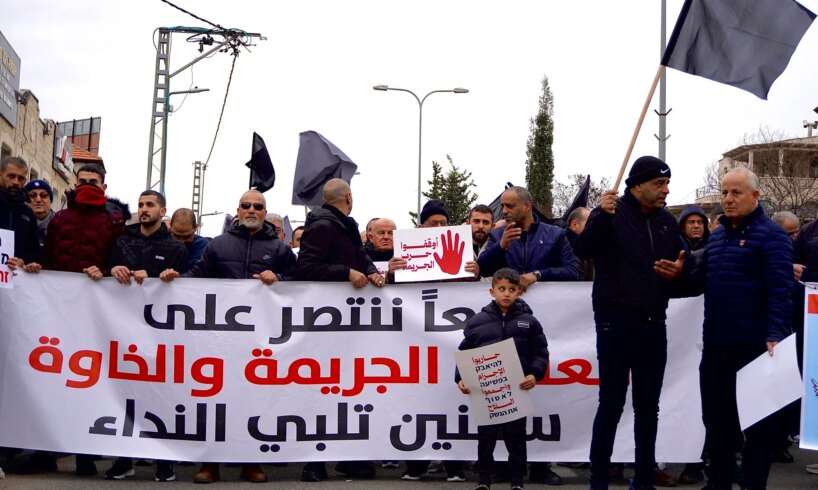
A child stands in front of a large banner that reads, ‘Together we will overcome violence, crime and extortion. Sakhnin answers the call,’ during a protest against the violent crime wave sweeping Arab society in Sakhnin, northern Israel on January 22, 2026. (Charlie Summers/Times of Israel)
Demonstrators sought to march to the Misgav police station just west of Sakhnin, but were met by large forces on the highway. Riot police, mounted officers and a water cannon blocked the route.
Responding to a query from The Times of Israel, police denied protesters’ claims that they had forced a change in the route, saying it was the same as that approved by the High Court of Justice.
Police and Border Police forces block Arab protesters from continuing a march from the northern city of Sakhnin on January 22, 2026. (Charlie Summers/Times of Israel)
Most protesters turned back the way they reached the police, however hundreds of mostly young men remained on the freeway.
Sakhnin municipality workers formed a human barrier between heavily-armed forces and the defiant rally-goers, as they jeered Ben Gvir, shouting, “Ben Gvir, Ben Gvir, you son of a bitch.”
Protesters chant “Ben Gvir, Ben Gvir, you son of a bitch” as massive march in Sakhnin against violent crime in Arab society meets wall of riot police. Municipal workers are separating protesters and law enforcement pic.twitter.com/NYbpS8RMiH
— charlie summers (@cbsu03) January 22, 2026
Despite the high tensions near the protest’s conclusion, clashes did not break out and no arrests were made, police confirmed.
Commenting on the strike, Ben Gvir ridiculed Arab leadership for “speaking in two voices,” saying: “On the one hand they are shouting, ‘the police are incompetent’ and on the other hand, they stand beside criminal organizations and oppose police’s every action in Arab towns.”
The far-right minister said that widespread opposition to a recent string of major police raids in Bedouin towns — one of which saw the lethal shooting by police of an Arab man on his doorstep — was evidence of local leaders’ purported support for crime.
Hadash-Ta’al chairman MK Ayman Odeh, meanwhile, said the strike was a “significant step on the path toward civil disobedience by peaceful means.”
“What began with a single shop owner in Sakhnin who said ‘enough’ to the phenomenon of protection rackets has quickly spread to all our cities and communities,” he said. “We will strike, we will protest and we will fight for the lives of all of us, until our children can live with dignity and security.”
Police have denied neglecting the Arab community and regularly rebuff criticism of their handling of crime in Arab locales, acknowledging the scourge but insisting that officers are doing all they can to combat the violence.
Police say intimidation of residents by criminals has hampered their efforts to combat violence in Arab areas, where many fear going to the police will make them a target of the criminal organizations that have come to dominate their neighborhoods.
After the march concluded in Sakhnin, national and local Arab leaders met in the city hall to discuss how to sustain the momentum that led to the strike and unprecedented demonstration, which Zahalka claimed boasted 100,000 attendees.
During the meeting, the heads of the four leading Arab parties signed a pledge to reestablish the Joint List, a united Arab political bloc, to run in the next Knesset elections.
The city hall building in Sakhnin, an Arab city in northern Israel, on January 22, 2026. (Charlie Summers/Times of Israel)
The parties had for months been in talks to revive the list under immense pressure from the Arab public. The negotiations were hampered by internal fights between Ra’am and the other parties, mainly over Abbas’s demand that his party be allowed to split after the elections and join a governing coalition separately.
A spokesperson for one of the parties told the Times of Israel that the four party heads — principally Abbas — were ambushed into a public agreement, amid widespread pressure from the Arab community to revive the bloc amid the crime epidemic sweeping Arab society.
“You can’t say it’s absolutely final, but such a public commitment will lead to more serious meetings, and everyone will be afraid to come out looking like the ones who collapsed the list,” the spokesperson said.
Ariela Karmel contributed to this report.