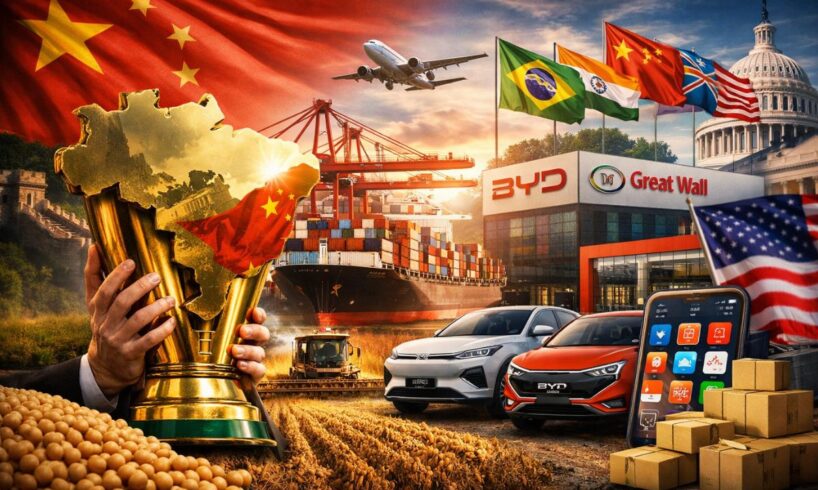
Brazil, Brasília, and Rio de Janeiro have become China’s showcase in the Americas: bilateral trade reached US$171 billion in 2025, soybean production advanced, investments hit a record US$4,2 billion in 2024, and brands like BYD, Great Wall, Temu, Shein, Alibaba, and 99 expanded their presence at an accelerated pace.
The advance of China In Brazil, the issue has ceased to be merely commercial and has begun to reorganize decision-making in Brasília, especially after the United States imposed an additional 40% tariff on Brazilian products in July 2025. The scenario combines ChinaProtectionism and geopolitical disputes are intertwined, with production chains, consumption, and foreign policy all being pulled in the same direction.
In parallel, demonstrations on January 5, 2026, in front of the US consulate in Rio de Janeiro, in support of Venezuela and condemnation of… United States actionsThey exposed the climate of friction. The combination of tariffs, protests, and international repositioning has placed China at the center of the Brazilian political chessboard.At the same time, banks and protectionism are putting pressure on economic choices.
The tipping point cited for the Brazil-US crisis occurred in July 2025, when the United States imposed an additional 40% tariff on Brazilian products. The justification given links the decision to the arrest of former President Bolsonaro, presented as an ally of Trump and a staunch critic of the US. ChinaThe additional tariff was added to a base tariff of 10%, raising the cost of Brazilian products entering the American market.
— ARTICLE CONTINUES BELOW —
See also other features
10 tools to uncover fraud in influencer marketing.
The new FGC app releases up to R$250 after a bank collapse, promising to save clients with frozen money, but requires registration, a wait of up to 60 days, and attention to the limit per CPF (Brazilian tax identification number) after the liquidation of Will Bank in 2026.
From painter to “king of free-range eggs”: on a 1-acre farm with 1.000 chickens, Leandro earns R$ 4 a month selling a dozen eggs for R$ 14 directly to the customer.
BRICS could gain three new strategic allies from South America: Argentina, Paraguay, and Uruguay are signaling interest, aiming for billions in investments, booming exports, and a desire to break their dependence on traditional powers like the US and Europe.
The political impact became apparent in anti-US protests in Brazil and in demonstrations that gained visibility on January 5, 2026, in Rio de Janeiro, in front of the US consulate. The episode made concrete an effect that was previously abstract for part of the population: trade measures can become political fuel.…and the dispute with China came to be seen as a direct factor in daily diplomatic relations.
BRICS, “the dollar is king,” and the structural push towards China.
Brazil is described as a founding member of BRICS, a bloc cited in a speech as attempting to “degenerate the dollar” and remove the American currency as the standard. In the same set of speeches, there is an explicit defense of “the dollar is king” and that losing the dollar as the world standard would be equivalent to “losing a war,” reinforcing the confrontational tone.
This background helps to understand why the China It sees hierarchies of importance in Latin America and places Brazil at the top. It’s not just about exporting commodities, but also about competing economic standards, technology, consumption patterns, and influence.Brasilia is under pressure from tariffs, narratives about currency, and alliances that are reshaping choices.
Why has Brazil become a priority for China in the Americas?
Brazil is presented as the largest economy in Latin America and is described as a market with over 200 million inhabitants, with 40% of the population under 30 years old. This profile is presented as a consumer base of interest to companies seeking new markets amidst a growing wave of protectionism.
In the logic presented, the China It treats Brazil as a more important economic partner than Venezuela, due to its combination of scale of consumption, capacity to absorb technology, demand for vehicles, and strength in e-commerce. The Brazilian priority is described as a mix of volume, market youth, and a showcase effect for Chinese brands.including in sectors where American companies were dominant.
Bilateral trade of US$171 billion and the soybean, minerals and oil sector.
Bilateral trade between Brazil and China It is described as having reached US$171 billion in 2025, with emphasis on soybeans, minerals, and oil. This volume appears as a central piece to explain why Brazil occupies the top of the Chinese hierarchy in the region, not only as a supplier but also as a consumer market.
The text points out that soybeans have become a sensitive issue for the Trump administration for a domestic political reason: farmers in the American Midwest, in states like Illinois, Iowa, Minnesota, Nebraska, and Indiana, are heavily dependent on China as a market. When China changes its source of purchase, political pressure follows in quick succession.…and Brazil comes in as an alternative scale.
Soybeans in numbers and the contrast between Brazil and the US in supplying China.
The Brazilian government reportedly stated that, between January and August 2025, 77 million metric tons of soybeans were exported to the ChinaDuring the same period, China reportedly imported 17 million metric tons from the US, according to Chinese customs data cited in the article.
The suggested interpretation is that soybeans cease to be merely a commodity and become an instrument of power and bargaining. Brazil is gaining traction as a supplier in terms of volume, while China is strengthening its ability to reorganize global flows based on its purchases., altering the balance of pressure between Washington, Brasilia, and Beijing.
Chinese investments in Brazil and the record high of 2024
Chinese investments in Brazil are described as abundant and are projected to have surged in 2024, reaching a record US$4,2 billion in the country, distributed across 39 projects. This performance would have positioned Brazil as the third largest destination for Chinese investments that year.
The movement does not appear to be episodic, but rather a continuous expansion across distinct sectors, with Chinese brands becoming “house names” and increasing their influence in consumer goods, logistics, mobility, and energy. The logic is to simultaneously occupy multiple fronts, reducing dependence on a single sector and accelerating China’s consolidation in the Brazilian market..
BYD and Great Wall opening factories and the battle for the automotive market.
Chinese automakers BYD and Great Wall are cited as having recently opened factories in Brazil, a country described as the sixth largest automotive market. The narrative points to rapid gains for Chinese brands and a positive reaction from local politicians, with BYD promising support for job creation beyond its own factory.
There is also an operational detail: BYD claims to be working with local industry authorities to obtain updated technologies and qualify more than 150 local suppliers to become suppliers. This point is crucial because it connects the factory with the production chain, multiplying the impact beyond the industrial gate.This reinforces why China is perceived as a structural presence.
Chinese apps and e-commerce are gaining ground in Brazilian consumption.
In the ride-hailing sector, the Chinese giant Didi, known in Brazil as 99, is described as having successfully challenged the American company Uber, becoming a key player in transportation and deliveries. This advance is presented as more than just commercial competition, as it occupies an everyday service and increases dependence on digital infrastructure.
In e-commerce, Chinese companies like Temu, Shein, and Alibaba are described as expanding aggressively. The combination of mobility apps with e-commerce creates a routine occupation of consumption.where China’s presence is no longer just about industrial exports, but becomes part of everyday life in terms of purchasing, delivery, and transportation.
Energy and billions in electricity transmission as a long-term foundation.
In the energy sector, the material states that the China Brazil has invested billions in electricity transmission projects. This type of investment is described as different from a short-cycle consumption investment because it involves infrastructure, a long timeframe, and technical dependence.
When combined with automotive factories and digital platforms, the result is a presence that spans production, logistics, consumption, and energy. China is no longer just a buyer of soybeans; it is becoming a participant in the country’s functioning.This explains why the debate about geopolitical alignment is more sensitive in Brasília.
The Venezuela variable, the Mercosur-EU agreement, and the search for protection.
The material points out that events in Venezuela have complicated Brazil’s calculations and describes how, days after Maduro’s capture, Brazil signed the Mercosur-EU trade agreement after 25 years of negotiations. The suggested interpretation is that Brazil is trying to open markets and expand export options, especially for agricultural products, seeking cooperation and partnerships “according to the rules.”
At the same time, there is an assessment that no Latin American country could withstand the United States on the battlefield, reinforcing the idea that governments are seeking other forms of protection in a “disturbing” world of rivalry between great powers. In this context, China appears as a real economic alternative, while Brazil tries not to be tied to a single pole., even under pressure from tariffs and blockades.
What changes for Brasilia when China becomes the central hub?
The data set points to a practical, not just symbolic, shift. Trade of US$171 billion, record investment of US$4,2 billion, soybeans in tens of millions of tons, and a growing presence of brands, factories, and digital platforms form a package that alters domestic incentives.
With a 40% US tariff added to the 10% base rate, visible protests in Rio de Janeiro, and an open dispute over the dollar and BRICS, Brasilia is now operating under a scenario in which China is not a peripheral option, but a central hub for economic decisions., with direct impacts on industryemployment, consumption and infrastructure.
In his view, Brazil is managing to balance the interests of the US and ChinaOr has it already entered a point of no return towards Beijing?