Next week’s slated reopening of the Rafah Crossing between Gaza and Egypt was “imposed” on Israel, a US official and an Arab diplomat told The Times of Israel on Friday.
The Arab diplomat said mediators of the Gaza ceasefire — the US, Egypt, Qatar and Turkey — recognized that Israel wasn’t going to agree on its own to reopen the border gate between Egypt and Gaza.
While Trump’s 20-point plan for ending the Gaza war envisioned the reopening of Rafah at the start of the ceasefire that was reached in October, Israel has sought to limit its use to the exit of Gazans while insisting on the return of the final hostage and the disarmament of Hamas before making the gate fully operational.
Recognizing that Israel wasn’t going to budge on the issue, Gaza mediators decided to go ahead and announce Rafah’s reopening this week during the signing ceremony for the Board of Peace in Davos, Switzerland, the Arab diplomat says.
The reopening was first announced by the chief commissioner of the National Committee for the Administration of Palestine, with the Arab diplomat explaining that it was part of the Gaza mediators’ effort to secure quick wins for NCAG, the 12-member panel of Palestinian technocrats tasked with replacing Hamas in running Gaza’s daily affairs.
Get The Times of Israel’s Daily Edition
by email and never miss our top stories
By signing up, you agree to the terms
The Arab diplomat said Israel was informed ahead of time that the announcement was going to be made, even if it wasn’t consulted.
US President Donald Trump (R) greets Prime Minister Benjamin Netanyahu upon arrival at Trump’s Mar-a-Lago residence in Palm Beach, Florida, on December 29, 2025. (Jim WATSON / AFP)
The issue was raised during Prime Minister Benjamin Netanyahu’s meetings with Trump and his top aides in Florida last month, where Washington made clear that it expected Israel to reopen Rafah, a US official said, adding that the Israeli premier indicated that he would comply.
Even after the announcement in Davos, Netanyahu’s office has held off on confirming that Rafah will indeed reopen next week, instead issuing a statement to reporters attributed to an anonymous Israeli official who said that the security cabinet would discuss the issue at the beginning of the week, previewing a meeting whose conclusion appeared foregone.
The Prime Minister’s Office did not respond to a request for comment.
Hebrew media reported Thursday that while Israel is readying to open Rafah amid international pressure, it still plans to conduct significant oversight of the crossing.
Israel will operate a remote surveillance system at the crossing, be in charge of granting advanced approval to travelers coming in and out of the Gaza Strip, and be able to scan any computers or other electronic devices passing through, the Kan public broadcaster said.
A Palestinian woman shows her passport to the camera as she waits at the Rafah border crossing in the southern Gaza Strip on September 18, 2013. (Mohammed Abed/AFP)
While the Israel Defense Forces will not be physically present at the crossing, Israeli troops will be deployed nearby and operate their own checkpoint aimed at preventing weapons smuggling.
The crossing itself will be operated by officers from the European Union Border Assistance Mission, founded in 2005 to monitor the crossing, along with uninformed members of the Palestinian Authority’s intelligence service, Kan said. The same framework was used during the previous Israel-Hamas ceasefire in January 2025. Israel shuttered the crossing around two months later, and it has remained closed since.
Earlier Friday, three sources familiar with the matter told Reuters that Israel wants to restrict the number of Palestinians entering Gaza through the border crossing with Egypt to ensure that more are allowed out than in, in what appeared to vindicate those insisting that Jerusalem remains intent on shrinking the Strip’s population to make way for Israeli settlements.
The three sources told Reuters it was still not clear how Israel planned to enforce limits on the number of Palestinians entering Gaza from Egypt, or what ratio of exits to entries it aimed to achieve.
Demonstrators gather outside the Egyptian side of the Rafah border crossing with the Gaza Strip on January 31, 2025, to protest against a plan floated by US President Donald Trump to move Palestinians from the Gaza Strip to Egypt and Jordan. (Kerolos Salah/AFP)
Expanding shelter supplies is top priority
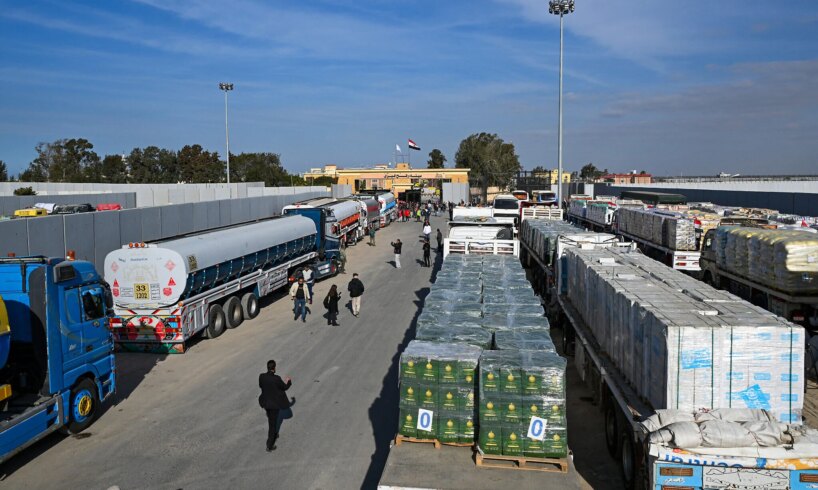
The Arab diplomat told The Times of Israel Friday that while reopening Rafah is an important step, its practical implications for Gazans will be limited and that expanding the amount of humanitarian aid going into the Strip is far more critical. The entry of basic food into the enclave has surged since the October ceasefire, but rights groups say temporary housing materials are desperately needed and still largely blocked by Israel.
The vast majority of Gaza’s population of two million people has been displaced by the war, and hundreds of thousands are currently living in tents.
The US official said expanding humanitarian access into Gaza will be a top priority, as Channel 12 reported that US President Donald Trump’s top aides, Jared Kushner and Steve Witkoff, were due to meet Netanyahu in Israel on Saturday.
On Thursday, the UN agency for children announced that Israel began allowing recreational supplies for kids into Gaza for the first time since Hamas’s October 7, 2023, onslaught and the ensuing Gaza war.
Children walk their dog amid the rubble of destroyed buildings in Nuseirat in the central Gaza Strip on December 2, 2025. (Eyad Baba / AFP)
UNICEF said that 5,168 recreational kits entered the Strip over the past week, supporting more than 375,000 children, including 1,000 with special needs.
The supplies include notebooks, pencils, erasers and crayons, which the UN said Israel was barring on the grounds that they weren’t life-saving materials. Israel’s COGAT body declined requests to explain the policy.
“For young children around the world, including in Gaza, playing is not a luxury, but how they develop language, motor skills, problem-solving, and social-emotional skills,” said UNICEF’s Ted Chaiban, who visited Gaza this week. “Now we must be permitted to bring all other education and Early Childhood Development (ECD) supplies into Gaza soon to benefit 336,000 children with the most basic materials they need to be able to learn.”
You appreciate our journalism
You clearly find our careful reporting valuable, in a time when facts are often distorted and news coverage often lacks context.
Your support is essential to continue our work. We want to continue delivering the professional journalism you value, even as the demands on our newsroom have grown dramatically since October 7.
So today, please consider joining our reader support group, The Times of Israel Community. For as little as $6 a month you’ll become our partners while enjoying The Times of Israel AD-FREE, as well as accessing exclusive content available only to Times of Israel Community members.
Thank you,
David Horovitz, Founding Editor of The Times of Israel
Join Our Community
Join Our Community
Already a member? Sign in to stop seeing this