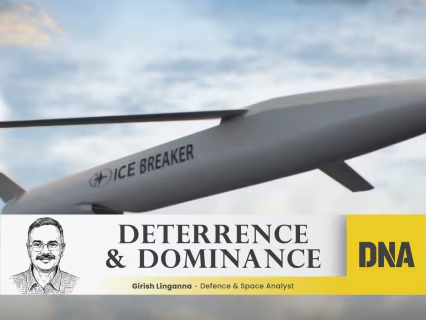
ICEBREAKER turns Indian Navy helicopters into long-range strike platforms, boosting self-reliance and reshaping maritime power across the Indo-Pacific region dynamics.
The Indian Navy’s MH-60R Seahawk helicopter, affectionately known as the Romeo, has earned its reputation as a fearsome submarine hunter. But there was always one limitation—if it wanted to attack enemy warships, it had to fly dangerously close, putting itself directly in harm’s way. That vulnerability is about to disappear.
Reports suggest that the Indian Navy is now evaluating the ICEBREAKER, a highly advanced fifth-generation cruise missile from Israel’s Rafael Advanced Defense Systems. This isn’t just another weapon purchase. It’s a strategic shift that fundamentally changes how India can project naval power across the Indo-Pacific.
The Old Arsenal: Effective but Limited
Until now, the MH-60R relied on weapons designed primarily for close-range encounters. Its main anti-ship weapon was the AGM-114 Hellfire missile—accurate and deadly against small boats, but with a range of merely 8 to 10 kilometres. Against modern warships bristling with air defence systems, getting that close means almost certain destruction.
For hunting submarines, the Romeo carries the Mk 54 lightweight torpedo, which excels at tracking enemy submarines in both shallow coastal waters and deep oceans. The Indian variants also feature laser-guided rockets and door-mounted .50 caliber machine guns for dealing with pirates and small surface threats.
These weapons work well for their intended purposes. The problem? They lack the standoff range—the ability to strike from a safe distance—needed to engage heavily defended modern destroyers and cruisers. Imagine trying to fight someone with a knife when they have a rifle. That’s the disadvantage Indian helicopters currently face.
Enter the ICEBREAKER: A Game-Changing Weapon
What makes the ICEBREAKER so revolutionary? Two things: incredible range and stealth capabilities that seem almost unfair.
Most helicopter-launched missiles can reach targets only 10 to 20 kilometres away. The ICEBREAKER can strike from approximately 300 kilometres—that’s the distance from Mumbai to Pune. This means the Seahawk can attack enemy ships while staying completely outside their defensive umbrella.
The missile weighs less than 400 kilograms, light enough for helicopter deployment yet powerful enough to sink a frigate. Its 113-kilogram semi-armour-piercing warhead is designed to punch through a ship’s outer hull before exploding inside, causing catastrophic internal damage.
But here’s where it gets truly impressive. The ICEBREAKER doesn’t rely on GPS or satellite navigation, which means enemy jamming is useless against it. If GPS signals are blocked, the missile seamlessly switches to an AI-powered imaging infrared seeker. Think of it as having eyes that can recognise the target’s shape and heat signature, then guide itself to impact with surgical precision.
Sea-Skimming Stealth: Almost Invisible Until Impact
The ICEBREAKER employs what’s called a sea-skimming flight profile—it flies just a few metres above the ocean surface. At this height, it blends perfectly with the radar clutter created by waves and sea spray. Enemy radars struggle to distinguish the missile from ocean noise, detecting it only when it’s seconds from impact. By then, it’s too late.
To understand the tactical advantage, consider this scenario: A Chinese Type 055 destroyer, one of the world’s most advanced warships, is patrolling international waters. Previously, an Indian Seahawk would need to approach within 10 kilometres to launch a Hellfire missile. The destroyer’s radar would spot the helicopter long before, and surface-to-air missiles would destroy it easily.
With ICEBREAKER, that same Seahawk can launch from 290 kilometres away. The destroyer never sees the helicopter. The missile comes in low, invisible to radar until the final moments. The hunter has become truly lethal.
Aatmanirbhar Bharat: Building Indigenous Capability
In February 2025, Bharat Dynamics Limited signed an agreement with Rafael that goes beyond simple procurement. This deal involves significant technology transfer, meaning BDL will manufacture the missiles in India, not just assemble imported parts.
This is crucial for several reasons. First, it reduces dependence on foreign suppliers during conflicts. Second, the technology learned from producing ICEBREAKER can be adapted for other platforms—the Tejas fighter aircraft, naval vessels, even land-based launchers. India is building an entire ecosystem around advanced, AI-enabled cruise missiles, an area where we’ve historically relied on imports.
The Integration Challenge
The biggest technical hurdle? The Seahawk is American, the ICEBREAKER is Israeli. Making them communicate requires accessing the helicopter’s mission computer—the sophisticated software that controls weapons release, targeting, and flight systems.
Unlike France, which guards Rafale software codes zealously, the United States has shared sufficient technical details with India to enable this integration. However, extensive flight testing in Indian conditions is essential. The software must work flawlessly when a pilot needs to engage an enemy ship during actual combat, especially in the complex and increasingly contested Indo-Pacific region.
Distributed Lethality: The New Naval Doctrine
Modern naval warfare has evolved beyond massive battleship duels. The concept today is distributed lethality—the ability to strike from multiple locations simultaneously, overwhelming enemy defences through sheer numbers and unpredictability.
When an MH-60R equipped with ICEBREAKER lifts off from an Indian destroyer, it transforms into a potent threat against an entire enemy fleet. Several helicopters operating in coordination can launch a coordinated strike from different directions, making defence nearly impossible.
Why This Matters Now
The Indo-Pacific is becoming increasingly militarised. China’s expanding naval presence, territorial disputes, and the strategic importance of sea lanes demand that India possess credible long-range strike capabilities. The ICEBREAKER provides exactly that—transforming defensive assets into offensive game-changers.
A submarine hunter that was once vulnerable when attacking surface ships can now engage the most sophisticated warships from safety. It’s not just about adding a new missile to the inventory. It’s about fundamentally altering the tactical calculus in maritime conflicts.
The ICEBREAKER might be small, but it represents a giant leap in India’s ability to protect its maritime interests and project power across the Indian Ocean and beyond.
(Disclaimer: The views expressed above are the author’s own and do not reflect those of DNA)
(Girish Linganna is an award-winning science communicator and a Defence, Aerospace & Geopolitical Analyst. He is the Managing Director of ADD Engineering Components India Pvt. Ltd., a subsidiary of ADD Engineering GmbH, Germany)