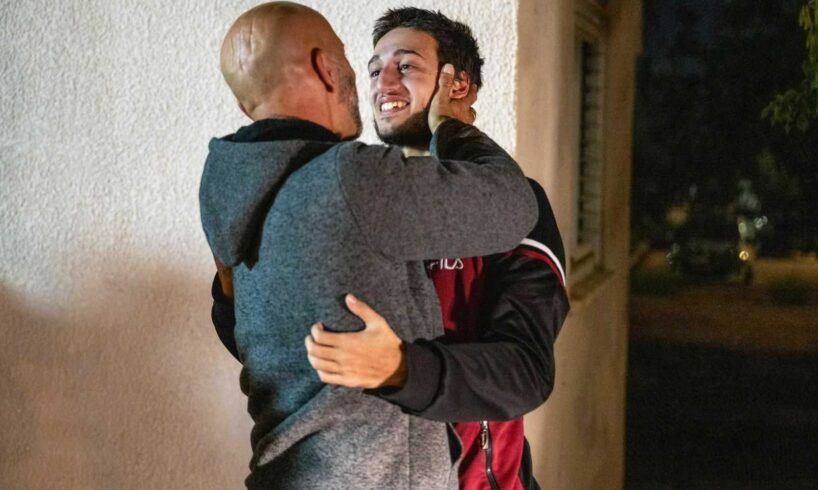
When his son was dragged from his home in Kibbutz Re’im into Gaza as a hostage on October 7, 2023, Ramzi Nassar quickly understood that his own identity could put his son’s very life in danger.
As an Arab Muslim man married to a Jewish woman, he feared his 18-year-old boy could be viewed by the Islamist terrorists not just as a hostage, but as a symbol of ostensible defection and disloyalty.
And so, hostage Liam Or-Nassar became simply Liam Or in all state and media mentions, while his father made the difficult decision to hide himself and not campaign publicly for the release of his son.
“If Hamas knew, it could hurt Liam. It’s not something that would have been well-received on the other side, that his Muslim father is married to a Jewish woman, even though there’s no such prohibition in Islam. The boy could have been considered a traitor, a son of a traitor,” Nassar told the Ynet news site. “I acted entirely out of a cold and painful calculus.”
“We also didn’t want them to assign him a ‘higher value,’ to hold on to him longer, if it turned into some major media event here in Israel.”
Get The Times of Israel’s Daily Edition
by email and never miss our top stories
By signing up, you agree to the terms
The interview, published on Friday, was the first time Nassar publicly identified himself as Liam’s father since the abduction.
יותר משנתיים אחרי שובו של ליאם אור משבי חמאס, נחשף לראשונה הסוד שהעמיד אותו בסכנה: זהותו של אביו – רמזי נסאר, ערבי מוסלמי.
“החשש היה שאם בחמאס יידעו, זה עלול לפגוע בליאם”, מספר רמזי בראיון בלעדי. “הילד היה עלול להיחשב לבוגד, לבן של בוגד. היה לי עצוב מאוד שאני צריך לשתוק בגלל… pic.twitter.com/olFCiQNMzO
— שאולי ✊????????????️???? (@Shaulirena) January 23, 2026
Nassar, his wife Dana Or and their children all lived in Re’im. During the October 7 onslaught, as the kibbutz was being invaded by Hamas terrorists, Nassar contacted Liam, who was living a short distance away in the youth neighborhood. At first, his son answered.
“We were texting, and he told me he could hear people outside, footsteps, shouting, bursts of gunfire. I… urged him to stay in the safe room. He wrote back, ‘Dad, I’m scared.’”
Later, Liam stopped answering. His parents, hiding in their own safe room with their other kids, tried frantically to call and text him, to no avail.
“I texted him several times to answer, but there was no reply. I checked his phone location, it was still in his room. We were getting messages about terrorists in homes, about fires. The couple of friends with us in the safe room received horrifying updates from the Nova [rave], and on TV we saw the [Hamas] pickup trucks in Sderot. We didn’t understand, we couldn’t believe it, we waited for the army in terrible helplessness that’s hard to describe — and we had no contact with Liam.”
Eventually, the terrifying news came through.
“Liam’s girlfriend called, crying, and told me that a classmate had sent her a picture of Liam. She was in shock and couldn’t send it to me. I called the boy and asked for the photo. I looked at it: Liam, in just his boxers, tied up in a tunnel. One part of my mind said, ‘That’s Liam, your son.’ Another part said, ‘It’s fake, impossible.’ But my heart said — Ramzi, you know that’s your boy. Guy, Liam’s brother, was next to me. He saw the picture and let out a chilling scream.”
Eventually, army forces arrived and cleared the kibbutz of Hamas invaders. Evacuated to central Israel, the family now had to contend with their new plight. The decision to hide Liam’s identity came hours after he was abducted. As part of that decision, the family officially removed the “Nassar” from Liam’s surname.
Liam Or, 18, taken captive by Hamas terrorists on October 7, 2023 from his home in Kibbutz Be’eri and released on November 29, 2023. (Courtesy)
“We created a precedent in the State of Israel, changing an adult’s name without him present,” said Nassar.
As for his own decision to remain in the shadows, Nassar said it “hurt deeply.”
“I was devastated that I had to stay silent because of my identity, my origins, in the very country I live in, out of fear that it could harm my son, whether in Gaza or here in Israel. It made me ask what kind of reality I am even living in. Changing the family name was an extremely painful decision, but every decision we made was solely to protect Liam.”
Liam was eventually released during the weeklong truce-hostage deal in November 2023, after 54 days in captivity.
“It’s hard to describe the feelings on the day of his release,” Nassar recalled. “The closest thing I can compare it to is the birth of a child.”
“I was waiting for a photo, something tangible, to know the boy was okay. I remember seeing a picture of him in the van, nodding to a soldier who was there, and then moving on. Nothing compared to that. When we finally met, I ran to him, he ran to me, we hugged. The first thing Liam said to me was, ‘I’m okay, Dad, I’m okay.’ … That was the moment I felt like I could breathe again.”
Nassar added: “When Liam was freed, he was given an identity card at the hospital and was surprised to discover the name change. I explained to him why we did that. He understood, but he asked to have it changed back. It was fixed that same day.”
Liam was released along with his younger cousins, Noam and Alma Or. Noam and Alma were abducted from their home in Kibbutz Be’eri, where their parents, Dror and Yonat, were murdered. Dror was the brother of Liam’s mother Dana. His body, which was snatched to Gaza, was returned only this past November as part of the current truce deal.
Since returning, Liam has found solace in travel and in his favorite basketball team, Hapoel Tel Aviv, Nassar said.
“There’s a huge difference between the boy who was abducted and the young man who came back from captivity… In some ways, despite returning physically, he still hasn’t really come back,” Nassar told Ynet. “He’s returned to Kibbutz Re’im and wants to settle down there. He has dreams he wants to fulfill and develop. He does what makes him feel good and smile.”
Liam is the eldest of Nassar’s three children with Re’im native Dana Or. The couple met in Tel Aviv, where Nassar worked in television production and Dana ran a catering company that fed television crews. They moved to Re’im a year after Liam was born, seeking a “moral, supportive community” for their children, Nassar told Ynet.
From left: Noam, Yahli, Dror, Yonat and Alma Or, in an undated family photo. (Hostage Families Forum)
Nassar himself was born in the German Colony in Jerusalem, an upscale, predominantly Jewish neighborhood in the city center.
“It wasn’t a religious home. We didn’t go to mosque every day, and we didn’t live according to edicts, but the customs of the Arab world and of Islam were present — in food, in hospitality, in conduct,” he said. “We spoke primarily Arabic, but Hebrew and English were also present.”
He attended Jerusalem’s Anglican International School, where strict discipline ensured “racism was not an issue.”
“I met racism mainly outside school,” said Nassar. He recounted first feeling abused for being Arab while working a summertime job in Jerusalem’s central Postal Bank branch, when he was 14 years old.
“One day, all the kids were talking and getting to know each other. One of them asked me, ‘What’s your name?’ I replied, ‘Ramzi.’ He looked at me and said: ‘No way, you’re an Arab’,” said Nassar. “I didn’t understand what he wanted. What’s the matter with me, what’s the problem? He asked, ‘How do I know you’re a good Arab, that you won’t murder me with a knife?’
“I was shocked. It stayed with me as the first moment where suddenly something felt wrong with me,” he said. “But soon enough I understood: I’m perfectly fine. The problem is not with me.”
“That moment exposed me to the conflict that we live in,” he said. “One country, we’re all citizens, but there’s history, and there’s baggage.”
Of his own identity, Nassar said: “I am the father of Liam, Guy, and Rani. I am Israeli, I am Arab, I am Muslim, I am a kibbutznik. I am a friend, I love parties — that’s where I feel free.
“Priorities are different now. Part of the rehabilitation process is creating a new routine, because life won’t be the same as it was before… There’s an effort to find or create some peace of mind at home, with family, at work. In every area. There’s a desire to enjoy things… We’ve seen how uncertain tomorrow can be, how many surprises the future holds.”