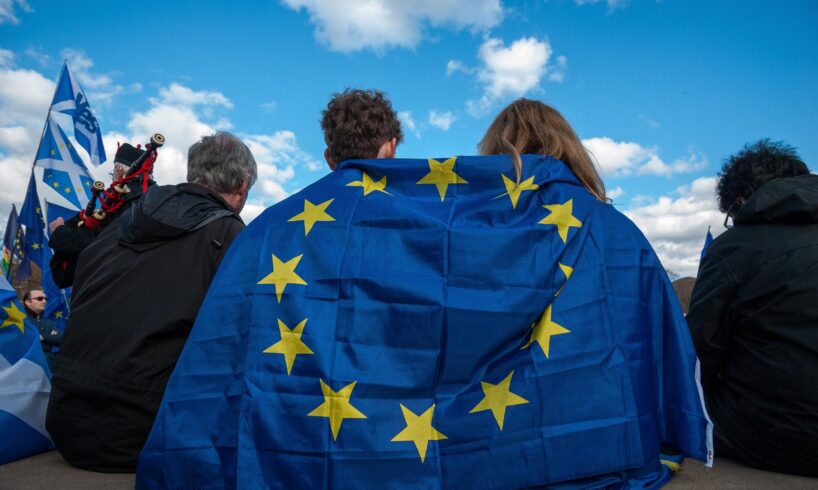
He spoke out after the chair of the European Movement in Scotland urged the Prime Minister Sir Keir Starmer to rejoin the bloc amid ongoing geopolitical pressures between the EU and the US which spilled out onto the floor of the World Economic Forum in Davos this week.
Mr Gethins said the UK had not been as isolated in Europe since the Suez crisis in 1956 which following months of political tensions between Egypt, Britain, and France.
Read More:
“The UK finds itself more isolated in Europe than at any point since Suez. The overwhelming majority of states in Europe consider Nato and the EU to be the twin pillars of European security. That is why states like Finland, Estonia, Ukraine and Moldova, and others threatened and attacked by Russia, want to join or have joined,” Mr Gethins told The Herald.
“Even Canada is joining the EU defence procurement programme which their Prime Minister has described as being good for investment and security in his country. Yet the UK sits outside, costing jobs and citizens less secure.
“Brexit was always a bad idea, costing £250 million a day in lost tax revenues, making life more difficult for business and removing opportunity from young people. However, if it was a costly decision a decade ago, it is downright dangerous today.
“We can’t blame Sir Keir Starmer for a disastrous Tory / Reform Brexit, but I cannot understand why he persists with the policy. There is recognition across Europe that it cannot rely on the United States and it must do more for its own security.
“Yet as Europe pulls together, the UK stands apart, caught on the outside, poorer and more vulnerable, at a time when we need to be closer to our allies in Europe. Rejoining the EU makes sense economically and would make us more secure in a more dangerous world.”
Mr Trump announced on Saturday he said he would charge a 10% tariffs on the UK and six EU countries if they continued to opposed his bid to “take over” Greenland, a semi-autonomous part of Denmark, which is an EU member.
Sir Keir Starmer does not support rejoining the EU but wants closer ties
In a lengthy statement, the US President said the UK and other Nato countries were “playing this very dangerous game” by sending military officers to Greenland, claiming the situation posed a threat to “the Safety, Security, and Survival of our Planet”.
Mr Trump said that tariffs of 10% would be imposed on all goods exported to the United States from the UK, Denmark, Norway, Sweden, France, Germany, the Netherlands and Finland from February 1 and that the levy would rise to 25% from June 1 unless a deal was reached for the “Complete and Total purchase of Greenland”.
The move escalated tensions between the US and the EU with the latter preparing a “bazooka” of tariffs on US goods totalling €93bn (£80bn; $108bn) into the EU.
On Wednesday night the US President backed down from his tariff threat announcing that he had reached a deal over Greenland. He made the announcement on his Truth Social media platform after talks at the World Economic Forum in Davos, Switzerland.
“Based upon a very productive meeting that I have had with the Secretary General of NATO, Mark Rutte, we have formed the framework of a future deal with respect to Greenland,” he said.
He did not give details, but said talks would continue to reach the deal.
Mr Rutte said he had not discussed the key issue of Danish sovereignty over Greenland in his meeting with Trump.
A poll for The Herald, carried out by Survation for True North Advisors, revealed last weekend that 73% of Scots said they would vote to undo Brexit if there was a new referendum on EU membership.
The UK government does not support rejoining the EU though the Prime Minister supports a closer relationship with the it.
On Thursday, the Prime Minister said Britain must “step up” and bolster its security, military and economic ties with Europe in the wake of President Trump’s threat to invade Greenland.
Sir Keir said that the world was in a “better place now than we were earlier this week” after the US president dropped his threat to unilaterally annex Greenland and impose tariffs on Britain and other European nations.
A UK Government spokesperson said: “We remain focused on making our new relationship work for the British people – we will not return to the EU, freedom of movement, the Customs Union or the Single Market.
“The UK-EU Reset is improving our diplomatic, economic and security cooperation and will be worth £9 billion to the UK economy by 2040.”