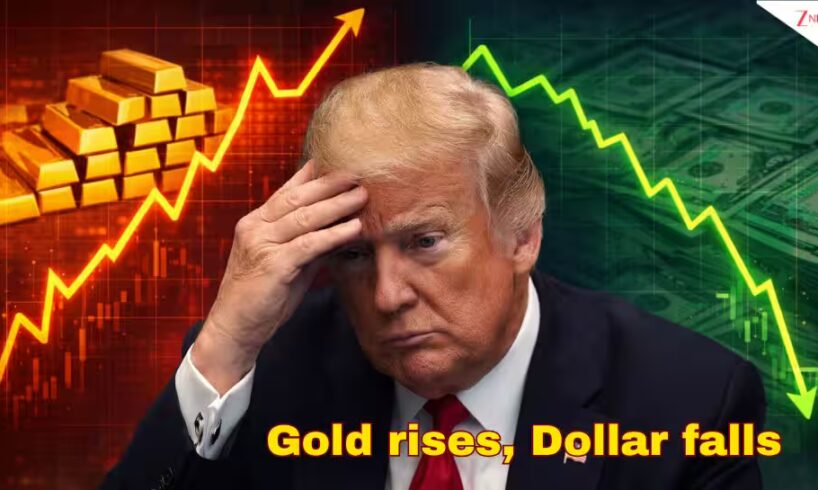
The world’s financial balance is shifting, and the tremors are being felt in both gold vaults and currency markets. On Monday, the US dollar plunged to a four-month low, while the price of gold surged past the $5,000-per-ounce mark for the first time. What was once considered a safe, steady asset for households is now the favourite of the biggest and most sophisticated investors – Central Banks.
Take the Reserve Bank of India (RBI) as a striking example. Its foreign exchange reserves jumped by over $14 billion in the week ending 16 January, the largest weekly gain in ten months. Yet nearly a third of that increase came from the RBI’s gold holdings, which total 880 tonnes and have risen sharply in value. By contrast, the central bank’s foreign currency assets grew just 5% over the past year, while total reserves increased 12%. Gold alone has driven the value of RBI holdings up by an astonishing 70%.
India is also pushing for innovation in global finance. The RBI has proposed that BRICS countries link their official digital currencies to make cross-border trade and tourism payments easier. This initiative, recommended for the agenda of the 2026 BRICS summit hosted by India, could reduce reliance on the US dollar amid rising geopolitical tensions. While the plan has not yet been formally accepted, it would mark the first time BRICS members consider connecting their central bank digital currencies. The move could irritate Washington, which has previously warned against attempts to bypass the dollar.
Add Zee News as a Preferred Source
Despite this, India has not been the year’s biggest buyer. Central banks in Poland (95 tonnes), Kazakhstan (49 tonnes), and Brazil (43 tonnes) led the surge, according to the World Gold Council. What matters more than volume, however, is gold’s share in reserves. For India, it now represents 17% of foreign exchange reserves, up from 12% a year ago, a shift strongly linked to US policy under President Donald Trump.
The Dollar Under Pressure
As per the reports, Morgan Stanley economists recently noted that Trump’s trade and sanction policies, combined with a global move towards multipolarity, are gradually pushing countries away from the dollar. “On net, we think these factors are neutral to slightly accelerating this transition away from the dollar, but their evolution over the near term will likely be critical in determining the extent of this shift,” they wrote.
Trump has made no secret of his aim to preserve the dollar’s supremacy. He has warned BRICS nations that pursuing a common currency could “degenerate” and “destroy” the US dollar. Yet, paradoxically, many of his actions, particularly tariffs, trade standoffs, and policy uncertainty, have weakened confidence in the greenback abroad. The result is that the dollar fell by 9% in 2025, its largest drop in nearly a decade, while safe-haven assets like gold climbed steadily.
Weaponising Capital Flows
The trend is evident beyond gold. JP Morgan analysts note that a growing proportion of energy contracts are now priced in non-dollar currencies. Sovereign debt markets are also shifting. The RBI reduced its holdings of US government bonds to $186.5 billion in November 2025, down from $234 billion a year earlier. China’s holdings of US debt have fallen to a 16-year low.
Elsewhere, Danish pension fund AkademikerPension announced plans to divest from US Treasuries by the end of January, citing Trump’s Greenland ambitions and America’s unsustainable finances. Three other Danish pension funds have already expressed scepticism about US bonds. Deutsche Bank has warned that Trump’s threats against Europe could prompt the continent to cut its US debt holdings. “Markets are increasingly discussing the de-dollarisation theme,” noted Nomura analysts on 21 January, as per the reports in Reuters.
Trump, in turn, has promised “big retaliation” if European nations offload US government bonds. The EU currently holds around $10.4 trillion in US portfolio assets, making up 29% of foreign ownership.
A Long-Term Shift
The push to diversify reserves away from the dollar gained momentum after the US froze Russian assets following the invasion of Ukraine in February 2022. Yet de-dollarisation has been a gradual trend for decades. IMF data show that the US dollar’s share of global foreign exchange reserves fell to 58.5% in 2024, a 30-year low, down from 71% in 1999.
“Meaningful de-dollarisation would have profound implications for global security, reducing the United States’ capacity to fund its military and impose coercive economic pressure,” said Ali Ahmadi, Director of Geoeconomics & Sanctions at ReshapeRisk and Executive-in-Residence at the Geneva Centre for Security Policy, as Reuters reported.
Despite the changes, the dollar remains dominant, accounting for 89% of turnover in over-the-counter foreign exchange markets. Morgan Stanley warns that Trump’s policies on debt, trade, sanctions, and security will be crucial in determining how far the dollar’s influence wanes. The US still has no immediate rival for a global reserve currency, though gold, now worth around $4 trillion in central bank reserves, has surpassed US Treasuries for the first time since 1996.
The dollar faces pressure from rising debt, political uncertainty, and international tensions, particularly the NATO strain over Greenland. Such dynamics create both push and pull forces – alliances may strengthen the dollar’s position, but insecurity can trigger a “flight to quality,” sending investors to safe-haven assets like gold.
The world may not yet be ready to abandon the dollar entirely, but as Trump’s policies continue to rattle markets, the rise of gold and the steady march of de-dollarisation suggest that the global financial landscape is shifting in ways few could have predicted.