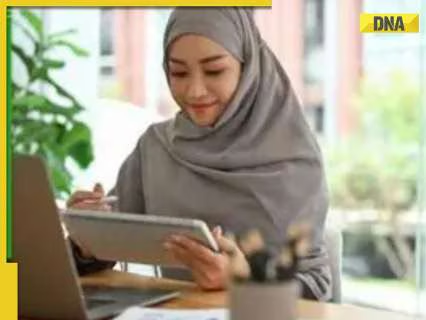
A new generation of Indian Muslim entrepreneurs and professionals are opening halal ventures that prepare these young Muslims, especially women to blend with modern life. A halal venture is an entrepreneurial or any professional initiative that functions abiding by the Islamic ethical principles.
Everyday examples are replete with a new trend that has covered many areas of the country. A new generation of Indian Muslim entrepreneurs and professionals are opening halal ventures that prepare these young Muslims, especially women to blend with modern life. These ventures range from career coaching and stock-market screening to digital religious education, fashion, and tech-enabled services. These modern business models are not considered political acts or forms of resistance by these people.
These are efforts towards building quite inclusive economic and professional spaces to become completely involved in contemporary markets and technologies with their religious values upheld. These Halal ventures signify a shift in the older trends where Muslims were visible only in the areas of food, repair work, drivers and such but now moving towards different market areas like finance, education, fashion, and technical services, enabling participation in mainstream society without compromising belief.
With these self-reliant initiatives, the young Muslim population is not only trying to blend into the mainstream but also navigate the basic but complex ways of life like: professional works, investment, daily fashion, marriage and practise faith in an urban, app-mediated life.
What is a halal venture?
A halal venture is an entrepreneurial or any professional initiative that functions abiding by the Islamic ethical principles. While “halal” is often linked with food, in this context it goes beyond the standard meaning. Halal ventures abstain from activities prohibited in Islam, like interest-based earnings (riba), gambling, alcohol, or unethical practices and focus on transparency, fairness and social responsibility. Contemporary halal ventures are spread across sectors like finance, education, fashion, technology, healthcare and services, adapting religious values to modern economic life.
How is it related to Muslim women in India?
As per the Periodic Labour Force Survey, the share of India’s female labour force was at about 31.7% in 2023–24. Among these, the share of Muslim women was around 21%, up from about 15% in 2021–22, according to ministry of minority affairs.
Halal ventures open professional and many public spaces for the aspirational Muslim women in India. These spaces exclusively designed for men and did not recognise social or religious realities of Muslim women. As these ventures openly welcomes the participation of Muslim women, they have been benefitted as they receive:
-Work environments that align with their faith and allow them to pursue careers alongside practicing their faith.
-They learn skill-building and get professional coaching, helping them enter formal employment.
-Entrepreneurial opportunities in rapidly growing areas like modest fashion, education technology and digital services.
-Autonomy which has increased their economic participation. This has benefitted specifically those women who are struggling with cultural expectations around mobility, dress and work.
Rather than being political or oppositional, halal ventures reflect a practical, everyday form of inclusion—enabling Muslim women to engage with the modern economy on their own terms, while remaining rooted in their values.