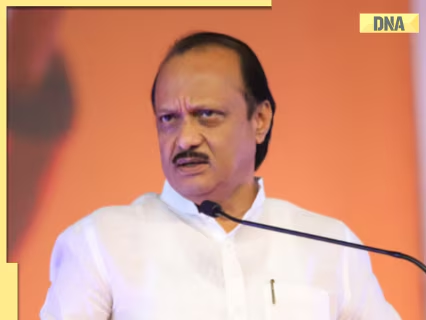
As the multi-term Finance and Water Resources Minister, Pawar’s policies focused on fiscal discipline, infrastructure, and rural development. Here are 10 major policy decisions that impacted Maharashtra:
Ajit Pawar held a central figure in transforming Maharashtra while serving multiple terms in the Maharashtra Legislative Assembly and earning respect across party lines for his analytical abilities and political acumen. Being the nephew of veteran leader Sharad Pawar, he split from the Nationalist Congress Party (NCP) in 2023 and led the faction that joined the BJP-Shiv Sena alliance (Mahayuti) and eventually secured the party name and symbol. Throughout his tenure of over decades in Maharashtra, he earned a reputation for his punctuality and decisive leadership, efficient state administration and key policies.
He served as the Minister of State for Agriculture and Power in CM Sudhakarrao Naik’s government from 1991 to 1992. He became Minister of State for Soil Conservation, Power and Planning in 1992. In 1999, he became a Cabinet Minister responsible for the Irrigation Department. He was additionally given the Rural Development Department in 2003. In the 2004 Assembly elections, he retained the Water Resources Ministry. Over the years, he handled several heavyweight portfolios, including irrigation, water resources and finance, and became a crucial figure in reshaping Maharashtra’s budget-making and bureaucratic decision-making. As the multi-term Finance and Water Resources Minister, Pawar’s policies focused on fiscal discipline, infrastructure, and rural development. Here are 10 major policy decisions that impacted Maharashtra:
1. Known as Maharashtra’s “finance manager-in-chief,” he prioritised capital expenditure and faster fund dispersal to districts while maintaining tight control over departmental spending. He presented multiple state budgets prioritising financial discipline, curbing tax evasion, and ensuring faster fund disbursal to districts. In Fiscal policy, he focused on increasing own tax revenue, which was projected to grow by 5%–6.4% annually, primarily through improved GST collections and stamp duty.
2. As Water Resources & Irrigation Minister, Pawar pushed for large-scale projects in the Krishna Valley, Marathwada, and Konkan to expand irrigation capacity and address drought in rural areas.
3. As Sports Minister, Pawar introduced a policy providing government jobs to medal-winning athletes. He also focused on decentralised infrastructure, building sports complexes in rural talukas so talent did not have to migrate to cities.
4. Under the Agriculture sector, he promoted technologies like AI in agriculture and bamboo cultivation. He advocated for increasing the Minimum Support Price (MSP) for essential crops like soybean and cotton. He strengthened policies that focused on milk unions and local banks to support the rural agrarian economy.
5. Pawar presented the flagship scheme, Mukhyamantri Majhi Ladki Bahin Yojana, in the 2024 budget, providing an initial monthly allowance of Rs 1,500 to eligible women from economically disadvantaged backgrounds.
6. Pawar introduced Panchsutri of Development, a five-pronged program, to push for state economic growth, targeting sectors like infrastructure and health. His 2025 budget stressed a new industrial policy aiming for Rs 40 lakh crore in investment and the creation of 50 lakh jobs.
7. Pawar was a force behind Mukhyamantri Yuva Karya Prashikshan Yojana, a scheme that provides six-month internships to 10 lakh youths annually with a monthly stipend of up to Rs 10,000.
8. He also announced the implementation of the PM Setu Scheme in ITIs across Nagpur, Chhatrapati Sambhaji Nagar, and Pune to further improve technical skills and job readiness.
9. Pawar made a crucial contribution in expanding the Pune Metro, the Mumbai-Pune Expressway “missing link,” and proposed a third airport for Mumbai near Vadhavan Port.
10. Reportedly, he aimed to reduce electricity procurement costs by Rs 1.13 lakh crore over five years by shifting to low-cost green energy, intended to lower industrial power rates.